Every time a reactor starts up, a fusion plasma burns, or a nuclear-powered spacecraft ventures into deep space, Los Alamos science is at work—the enduring influence of the Laboratory that has shaped the nuclear age from its first spark.
“Los Alamos has been and remains the nation’s leader in applied nuclear science,” says Mark Chadwick, Associate Laboratory Director for Simulation, Computing, and Theory and former Chief Scientist for Weapons Physics. “We’ve made iconic breakthroughs that range from definitive measurements in fission and fusion to nuclear databases and modeling methods that are used around the world.”
Best known for developing the world’s first nuclear weapons, Los Alamos also developed some of the first nuclear reactors, nuclear rockets, and remote-sensing satellites. For more than 80 years, Laboratory scientists and engineers have built an entire infrastructure of applied nuclear science with the aim of understanding nuclear power so completely that humanity can wield it wisely.
Nuclear weapons
The Laboratory was founded in 1943 as the U.S. Army’s central laboratory for the top-secret effort to develop atomic bombs. In those early days, the Lab’s applied nuclear technology encompassed plutonium purification, weapons-core fabrication, criticality experiments, and bomb design for deployment.
Two years in, by integrating theory, experiment, and engineering, and drawing together many of the era’s leading scientists and engineers, the Lab delivered two distinct atomic weapons: a gun-type device that drove one piece of uranium into another to create a critical mass, and an implosion-style device that used precisely timed explosives to compress a plutonium core to criticality. Although they used different materials and different designs, both weapons exploited the phenomenon of nuclear fission, whereby heavy atoms, like uranium and plutonium, are split into multiple smaller nuclei. First the atom absorbs a neutron which makes it unstable. Then it splits and releases more neutrons, which get absorbed by neighboring atoms, causing them to also split, thereby initiating a rapidly multiplying chain reaction.
Scientists knew that while the splitting of heavy atoms could release tremendous energy, the merging of light atoms—fusion—could release much more. But it would take the power of fission to force fusion to occur. So, having created fission-based weapons, the Lab’s attention was next fixed on fusion-based weapons.
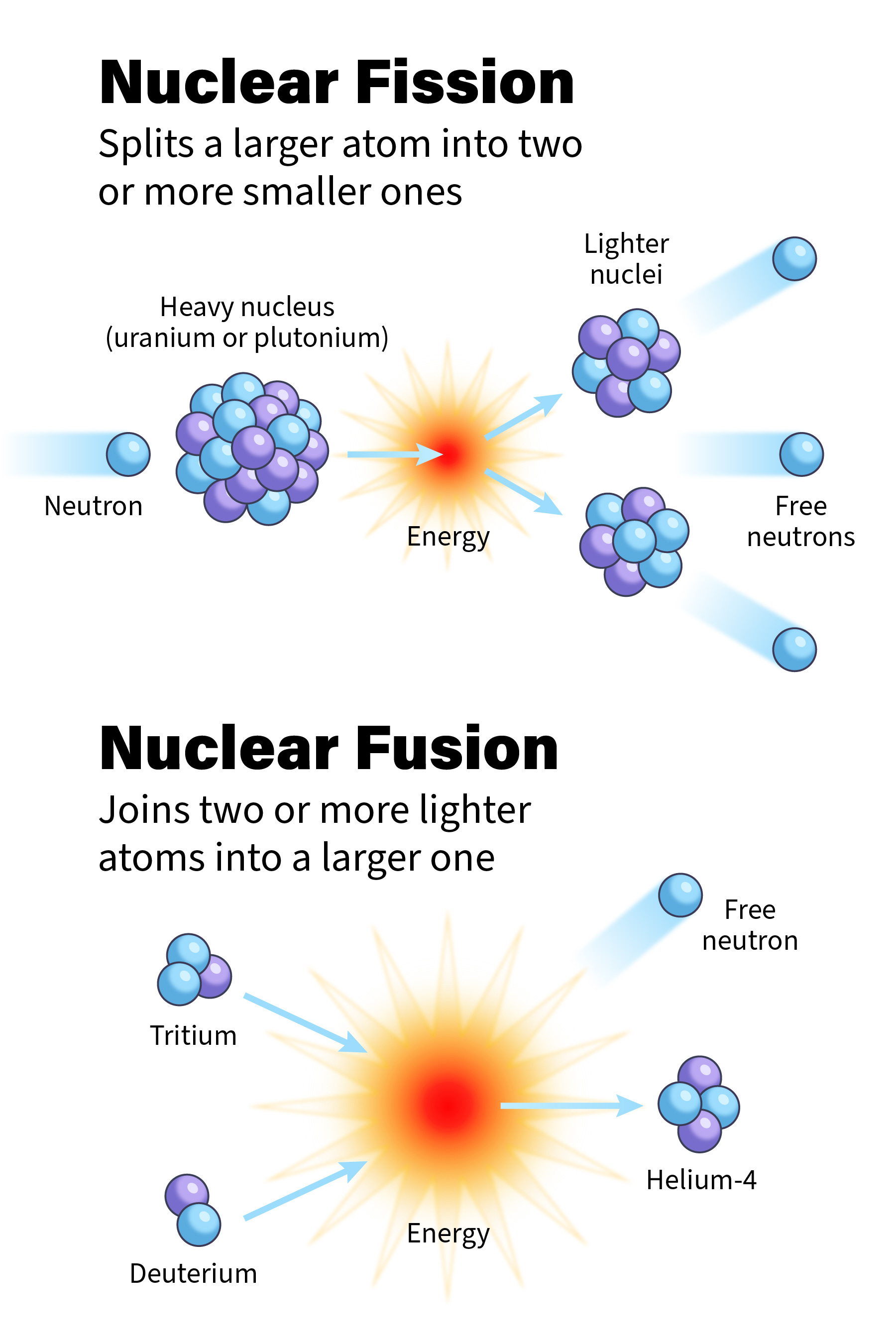
At Los Alamos in 1945, British physicist Egon Bretscher showed that the fusing of deuterium and tritium, both isotopes of hydrogen, had an unexpectedly large cross section, meaning those nuclei were more likely to fuse with one another than with any other nuclei. The cross section was so large as to dwarf all other fusion reaction cross sections at comparatively low energies. This phenomenon was attributed to the excited state of the compound nucleus formed, which quickly decays into a helium nucleus and a neutron. Bretscher correctly predicted this reaction—the fusion of deuterium and tritium—would make fusion technologies feasible.
Scientists knew that while fission—the breaking up of heavy atoms—could release tremendous energy, the merging of light atoms—fusion—could release much more.
Fusion-based weapons, or thermonuclear weapons, release many times the energy of fission-based weapons, in part because of fuel efficiency. Fusion fuel nuclei are small and light, while fission fuel nuclei are large and heavy, meaning a single gram of fusion fuel contains many more atoms than a gram of fission fuel, so many more energy-releasing reactions occur within the same mass of fuel.
Nuclear power
Fusion energy drives the sun and stars, and the excited state of the compound nucleus that Bretscher discovered, now known as the “Bretscher state,” underlies nearly every major branch of applied fusion science—well beyond nuclear weapons.
“It all comes down to an accident of nature,” explains physicist and Laboratory Fellow Bill Priedhorsky. “If you look at various things that fuse, you get these cross sections, and at the right temperature, deuterium and tritium are much more likely to fuse than anything else.”
Because fusion can produce roughly four times more energy per kilogram of fuel than fission and nearly four million times more energy than burning coal, it was of keen interest to the energy sector. Through the 1950s, ’60s, and ’70s, as different countries pursued fusion for energy, deuterium-tritium (DT) fusion was at the center of most designs. Magnetic confinement machines were built to hold a burning DT plasma using magnetic fields. Inertial confinement machines were built to heat and compress DT fuel pellets with lasers. The Lab even explored fusion-powered rockets for planetary defense. But it’s tough to create, confine, and control the power of the sun, and fusion for energy has faced engineering and technical challenges.
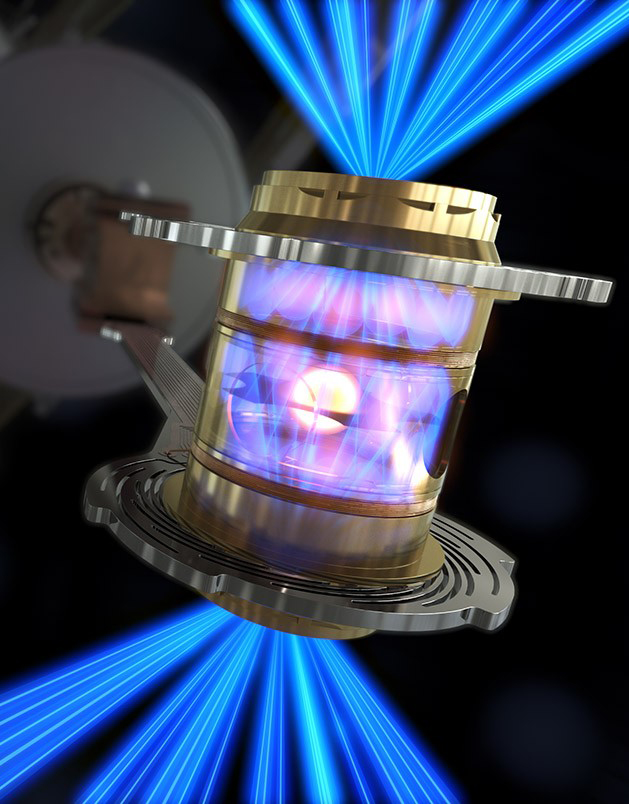
Although still in the research phase, interest in fusion energy is growing, momentum is building, and gains are being made. In 2022, a collaboration between Los Alamos and Lawrence Livermore National Laboratory achieved ignition, getting more energy out of a fusion experiment than went into it for the first time ever, tantalizing humanity with the dream of clean, safe, and endless energy.
Nuclear reactors that use fission, on the other hand, are well established and have powered cities, submarines, and spacecraft for decades. Nuclear energy is a key part of the Lab’s mission space. The official first fission reactor in the world, led by Enrico Fermi in 1942, proved the concept of a controlled fission chain reaction for the Manhattan Project. The first nuclear reactor in the world to generate usable electricity was the Experimental Breeder Reactor-I in Idaho in 1951. All the foundational knowledge—like neutron transport theory, cross-section measurement capability, and criticality safety procedures—needed for nuclear power plants came straight from Los Alamos’s wartime and postwar nuclear research. And as nuclear know-how grew, the scope of fission energy broadened to include nuclear reactors for machines on the move.
It didn’t take long to realize that nuclear power could be ideal for military submarines, providing virtually limitless power underwater without the need to surface. The U.S. Navy–led mission to create the first nuclear-powered submarine drew heavily on Los Alamos science. The product, the USS Nautilus, launched out of Connecticut in 1955 and traveled thousands of miles without surfacing, staying submerged for weeks on end. In 1958, after numerous successful voyages, she became the first vessel to reach the North Pole underwater.
Once compact nuclear power systems were proven to work reliably away from land, the next frontier was space. Project Rover was a joint effort between Los Alamos and the Atomic Energy Commission to build fission-powered rockets. In 1961, the project demonstrated that nuclear propulsion in space was not only feasible but could outperform chemical propulsion by a factor of two. A flight-ready, full-scale nuclear rocket engine was even demonstrated by project NERVA, the NASA-led follow-on to Rover, in 1972. But by then, Apollo 11 had put the first humans on the moon and no other immediate NASA mission required a nuclear rocket, so the work was shelved.
Most recently, Lab scientists have developed a compact, autonomous system called Kilopower, which could one day power human habitats on Mars and deep-space missions. For Earth-bound applications, the technology is being miniaturized to fit inside a shipping container to create standalone mobile power plants that can travel almost anywhere. Los Alamos scientists are even reimagining nuclear power all together, developing a whole new paradigm of molten-salt nuclear reactors, which recycle fuel, cut waste, and could be hundreds of times more fuel-efficient than current solid-fuel, water-cooled designs.
Stockpile modernization
As scientists have found new ways to use nuclear science to power discovery, weapons research has continued, and Los Alamos remains a pillar of the U.S. nuclear-weapons enterprise. The Lab’s approach to the design, certification, and assessment of the nation’s nuclear weapons includes top-notch computer simulation and experimentation.
To support simulation, the Lab invested heavily in computational capabilities, supercomputing, and physics modeling of weapons systems and nuclear materials. To support experimentation, the Lab used its world-class neutron facility, LANSCE, to deliver nuclear cross sections with unprecedented accuracy. Other types of experiments, particularly criticality experiments, were moved to Nevada and consolidated into the National Criticality Experiments Research Center (NCERC) under Los Alamos leadership. The NCERC is a direct descendent of the weapons work at Los Alamos and is the nation’s only facility capable of performing general-purpose critical experiments.
“These experiments provide accurate integral criticality data that allow us to validate and improve our simulation capabilities,” explains Chadwick. “Indeed, these simulations are calibrated to match the precise NCERC data.”
The modern Lab is both innovator and sentinel—advancing nuclear science while ensuring safeguards and deterrence.
Data from decades of supercomputing simulations and criticality experiments are kept in a database called the Evaluated Nuclear Data File (ENDF). This is the national repository of all the nuclear data that are needed to correctly integrate experimental results and theoretical simulations in support of the nation’s modern nuclear stockpile.
Internationally, Los Alamos promotes global security and nonproliferation by helping to establish nuclear safeguards for the International Atomic Energy Agency (IAEA), training all IAEA inspectors, and developing advanced detectors. Importantly, the MCNP code, the world’s most accurate and popular particle transport code, still used widely across national laboratories, universities, nuclear facilities, defense organizations, and private industry, is also a Los Alamos discovery.
Though the Lab’s nuclear-weapons legacy remains central, applied nuclear science at Los Alamos today reaches far beyond stockpile readiness, encompassing energy work, nuclear materials science, nuclear nonproliferation, and arms control. The modern Lab is both innovator and sentinel—advancing nuclear science while ensuring safeguards and deterrence. Los Alamos undeniably remains the Laboratory that knows the atom best.
People also ask:
- What’s more powerful, fission or fusion? Fusion is significantly more powerful than fission. Fusion can produce roughly four times more energy per kilogram of fuel than fission and nearly four million times more energy than burning coal. Although individual fission reactions release more energy than individual fusion reactions, because fusion uses light elements like hydrogen, while fission uses heavy elements like uranium, a single gram of fusion fuel contains many more atoms than a gram of fission fuel, meaning many more fusion reactions can occur using the same mass of fuel. Fusion is also more efficient, converting a larger percentage of fuel mass into energy, compared to fission.