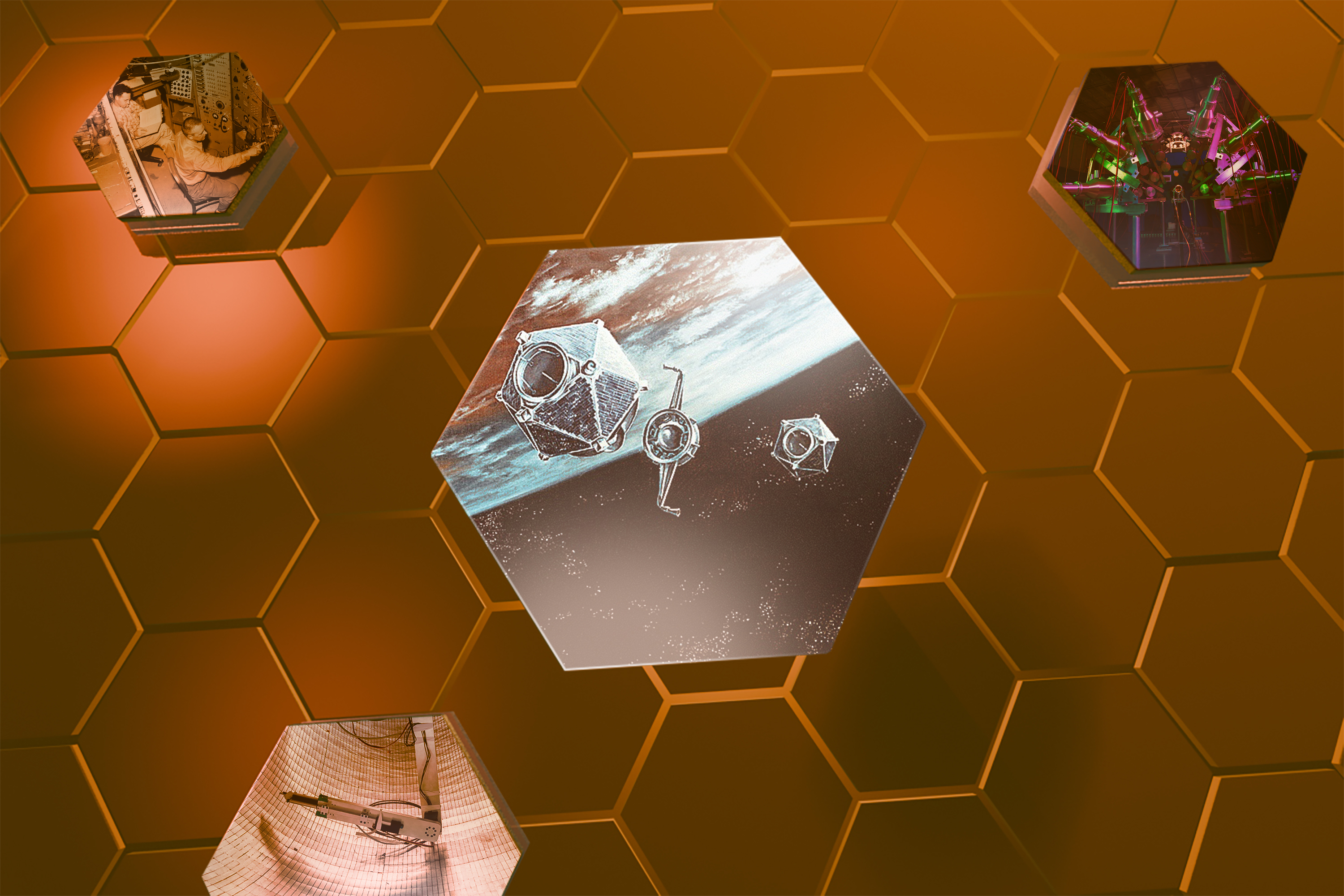
In 1963, some eighteen years after the world entered the atomic age, a pair of national security satellites launched from a low, sandy peninsula in Florida called Cape Canaveral. The Velas, as they were known, were the first in a series of far-seeing sentinels built by Los Alamos scientists that were capable of spotting high-energy terrestrial events from orbit. But while the scientists’ attention was fixed on Earth, the Velas were quietly collecting data that would redefine astrophysics and cement Los Alamos’s role in global space science.
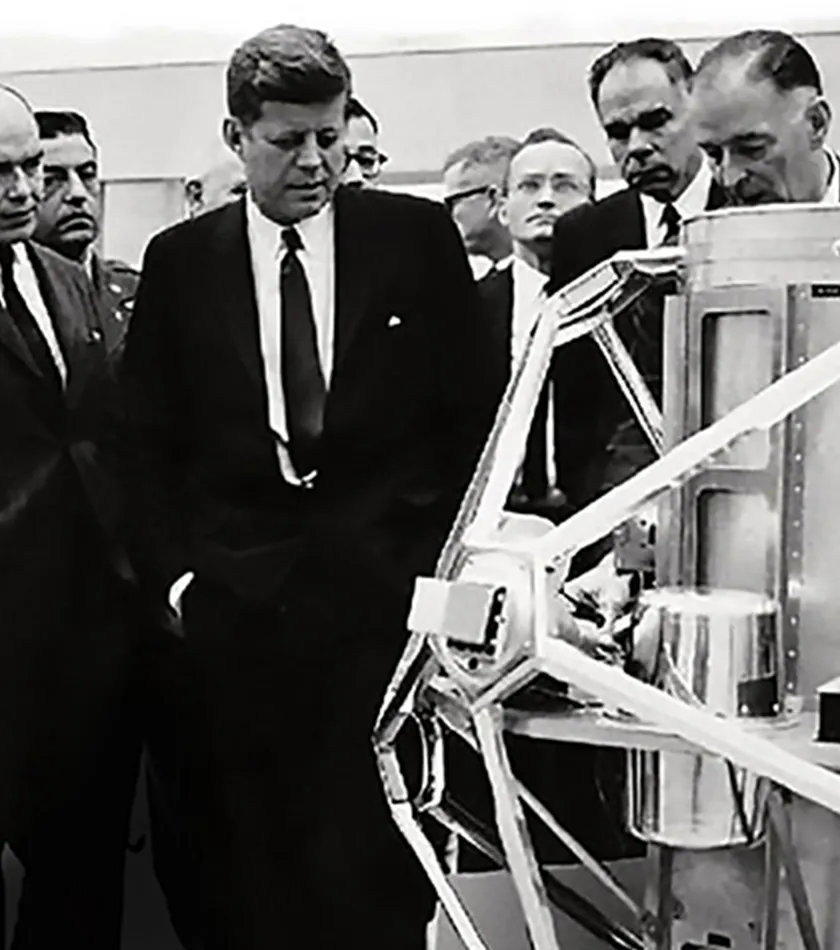
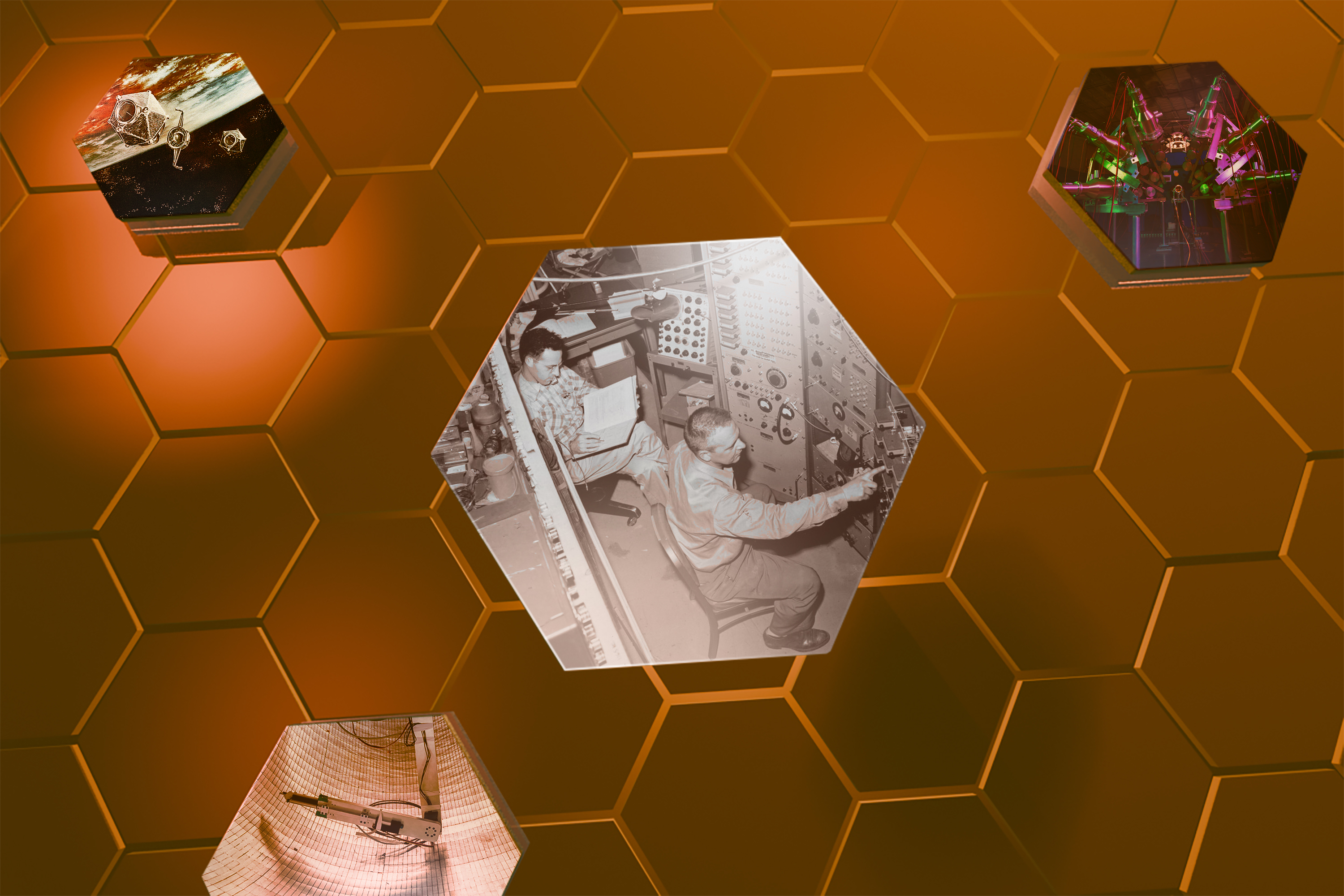
Each Vela carried detectors tuned to x-rays, gamma rays, and neutrons—the signatures of nuclear detonations. Scientists knew gamma rays—the most energetic form of light—appeared fleetingly during weapons detonations, as a byproduct of nuclear fission. The idea that such radiation could arise naturally in the cosmos, through any processes understood at the time, seemed inconceivable. “You have to be very, very hot to get gamma rays,” says Ed Fenimore, a Los Alamos astrophysicist and Laboratory Fellow. “We’re talking extreme conditions where gas clouds, or at least individual particles, have energies corresponding to billions of degrees.”
Then, in 1967, the Vela’s sensors lit up with brief, intense bursts of gamma radiation. The flashes were unlike anything the Vela team expected. On the gamma-ray curve, instead of a single, sharp, microsecond-scale pulse, they rose and fell irregularly over seconds or even minutes. “A nuclear weapon goes up sharp and comes down sharp,” Fenimore says. “These went spike, spike, spike … hiccup… and then off, never to repeat.” Somewhere in the universe, something was generating energy beyond anything known to humanity before.
After a few years spent ruling out any other explanation, in 1973, Ray Klebesadel, a Los Alamos physicist, published a paper announcing the discovery of gamma-ray bursts, or GRBs, that came from deep space. The paper, which reported on 16 Vela events, became one of astrophysics’ most influential publications and launched a global race to explain GRBs. “Where were gamma rays coming from?” Fenimore asks. “What natural process could make them?”
The mystery played a key role in the rise of high-energy astrophysics: the study of x-rays and gamma rays from cosmic sources. Throughout the 1970s and ’80s, Los Alamos led the new field, designing and building instruments for satellites worldwide and then analyzing the data. Each new generation of satellites and detectors strengthened Los Alamos’s role in high-energy astrophysics. Yet GRBs themselves remained elusive.
“Humans have been watching the sky for 50,000 years. We never knew that a star could turn on and off in ten minutes.”
As the search for GRBs became more sophisticated, it attracted new scientists, including Fenimore, who joined the Lab in 1974 and quickly became one of the central figures working on the GRB mystery. He developed a novel imaging technique that allowed bursts to be pinpointed more precisely. “The name of the game was location,” he says. “If you could figure out which star was doing it, maybe you could figure out how.”
By the early 1990s, the National Aeronautics and Space Administration (NASA) had intensified the pursuit of this goal by launching the Compton Gamma Ray Observatory—the gamma-ray-focused sister to the optical Hubble Space Telescope. It mapped hundreds of bursts. To everyone’s surprise, the data appeared isotropic, coming equally from all directions rather than along the plane of the Milky Way. Either GRBs lay in our immediate neighborhood, or they were not local at all but rather originated billions of light-years away.
The result was both thrilling and disorienting. If GRBs came from distant galaxies, whatever produced them had to be cataclysmic—some process that could release in seconds as much energy as the sun emits over its entire lifetime.
Around that same time, Los Alamos gamma-ray imaging technology was appearing on international missions, becoming standard equipment on high-energy astronomy satellites. Independently of that work, the next major breakthrough came in 1997, when the Italian–Dutch BeppoSAX mission localized a gamma-ray burst. Optical telescopes zoomed in and captured its fading afterglow, placing it between eight and nine billion light-years away, far beyond the Milky Way. Now, scientists just had to figure out what physical process could unleash enough power to be seen far across the universe.
That answer arrived a few years later. In 2004, to build on the success of Compton, NASA launched the Swift satellite—built with Los Alamos—to catch GRBs in real time. Using software written by Los Alamos physicist Dave Palmer, Swift could detect a burst, analyze it, and pivot its telescope within seconds to capture the fading light.
“We found something because of our national-security work. And from that, we developed entire scientific fields.”
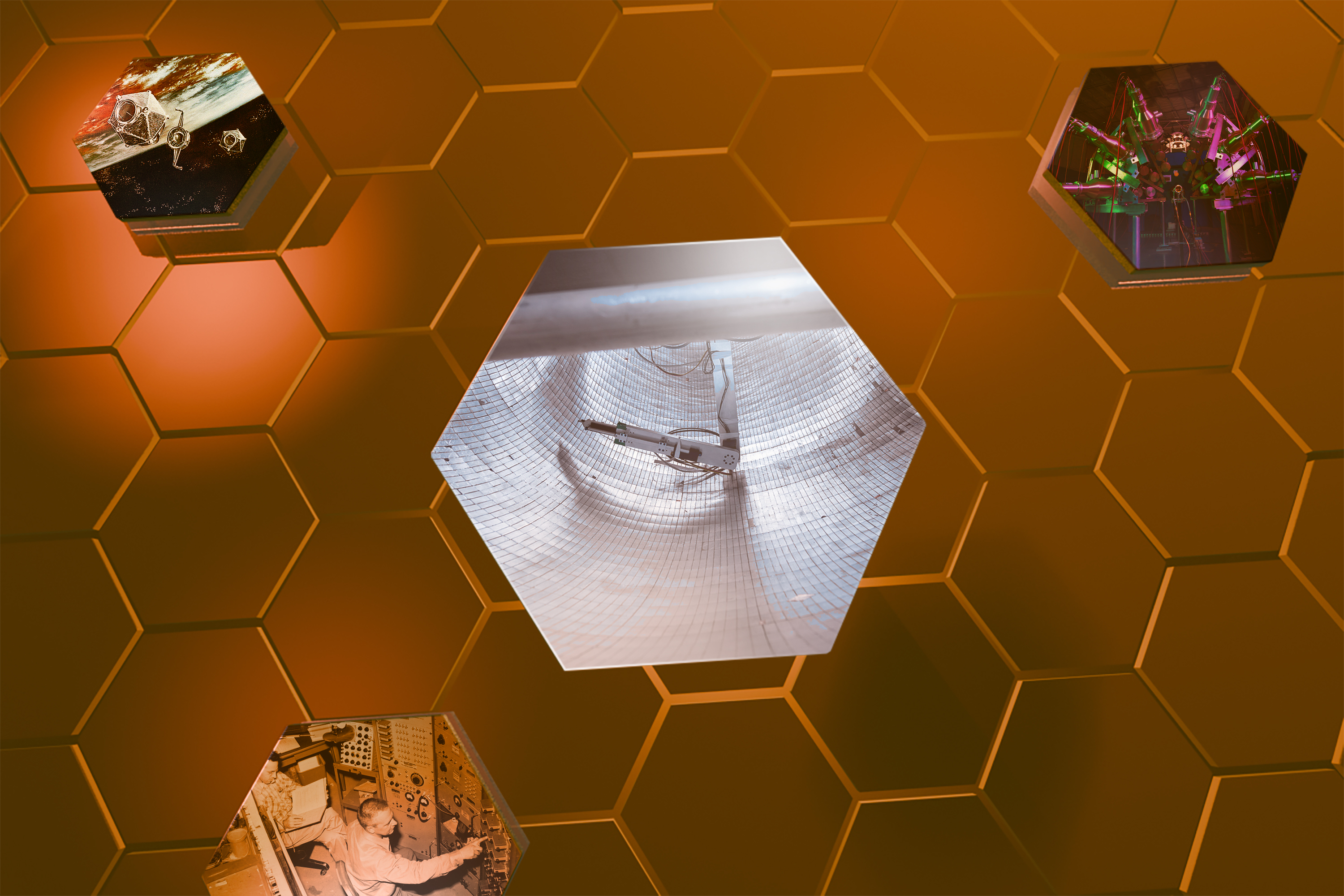
Meanwhile, the satellite also sent signals and coordinates to a Los Alamos-built robotic telescope at Fenton Hill in the Jemez Mountains. Once received, the telescope would autonomously swing toward alerts from space—a design replicated worldwide—to capture cosmologically transient events. In one 10-minute observation, the telescope at Fenton Hill recorded a star that seemed to appear and vanish, a visual echo of a burst nine billion light-years away.
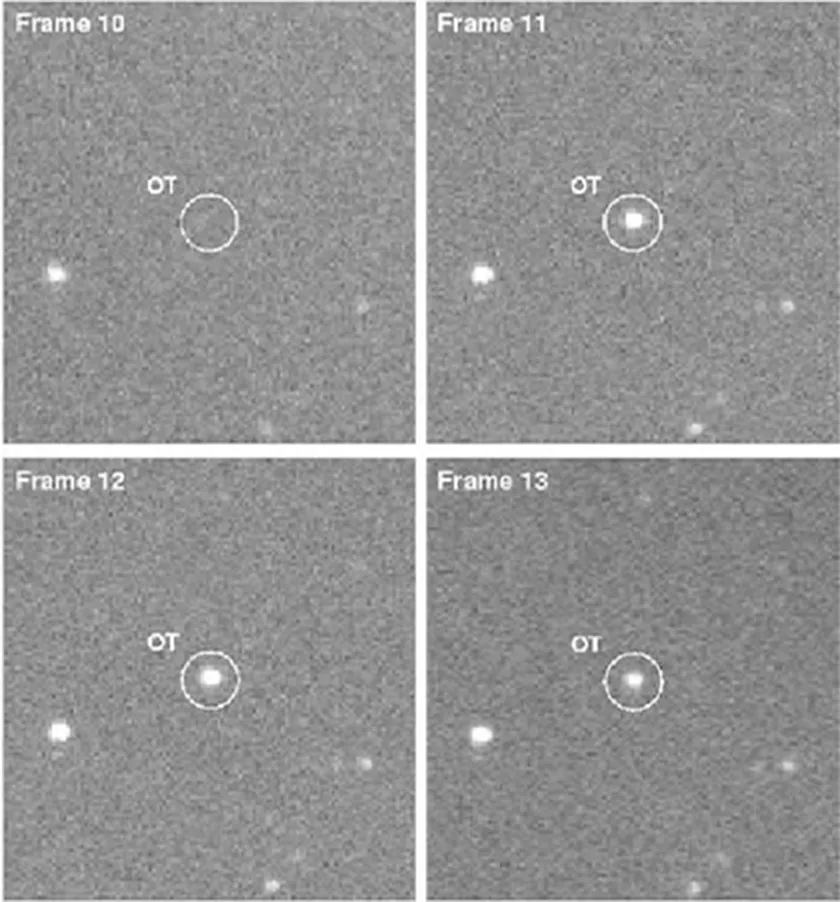
“Humans have been watching the sky for 50,000 years,” Fenimore says. “We never knew that a star could turn on and off in ten minutes.”
By the early 2000s, astronomers finally understood one cause of what the Velas had glimpsed decades earlier—the violent deaths of massive stars giving birth to black holes. Fenimore and others came to believe that GRBs mark the death of massive stars, between 20 and 100 times the sun’s mass collapsing into black holes. The process is fast, chaotic, and extraordinarily violent. As the core implodes, jets of plasma—“star guts,” Fenimore calls them—shoot out along the star’s rotational axis, and it’s the gamma-ray bursts released during this process that the Vela satellites detected. Astonishingly, Vela’s descendants detect roughly one such event a day. More astonishingly, these events can only be observed when a jet happens to point directly at Earth, implying that thousands more erupt unseen across the cosmos every day.
What began as a mission to monitor high-energy events from space led to a revolution in astrophysics. It also launched the modern space program at Los Alamos. The techniques developed to study GRBs—detector design, real-time data analysis, and satellite integration—became the foundation of a program that now spans everything from planetary exploration to space-weather forecasting.
“We found something because of our national-security work,” Fenimore says. “And from that, we developed entire scientific fields that in turn improved our national security. That’s what a national laboratory does.”
People also ask:
- What’s the most powerful thing in the universe? The most powerful known events in the universe are gamma-ray bursts—brief flashes of energy released when massive stars collapse into black holes. In just seconds, a single burst can emit as much energy as the sun will produce over its entire lifetime. These explosions were first detected by satellites built at Los Alamos. Decades later, the Lab’s scientists helped uncover their origin and modeled how collapsing stars drive the jets that make them shine so bright.
- How many black holes are there in the universe? Astronomers think there could be as many as 100 million black holes in the Milky Way alone, with trillions more scattered across the observable universe. Most are the remnants of massive stars that collapsed under their own gravity after exhausting their fuel. At Los Alamos, researchers simulate those collapses—from the first one-dimensional models in the 1960s to today’s three-dimensional supercomputer runs—to understand how dying stars give birth to black holes. The same physics drives the gamma-ray bursts that the Lab’s satellites first detected, connecting stellar death to the universe’s brightest mysteries.