By 1970, fourteen years after Los Alamos scientists first proved the existence of the neutrino, they knew something was amiss: an underground neutrino experiment built inside the Homestake Mine, an enormous active gold mine in South Dakota, was detecting way fewer neutrinos coming from the Sun than scientists had predicted, and they didn’t know why.
Neutrinos are famously elusive elementary particles. They are electromagnetically neutral and nearly massless, making them extremely hard to detect. These particles continuously and innocuously rain down on Earth from the Big Bang and sources in space. And they come in three varieties, called flavors—electron, muon, and tau.
“Either we didn’t understand the Sun, or we didn’t understand neutrinos,” recalls Thomas Bowles, retired Los Alamos physicist and Laboratory Fellow.
Neutrinos are doubly elusive: not only do they hardly interact with anything, including detectors, but they also shapeshift.
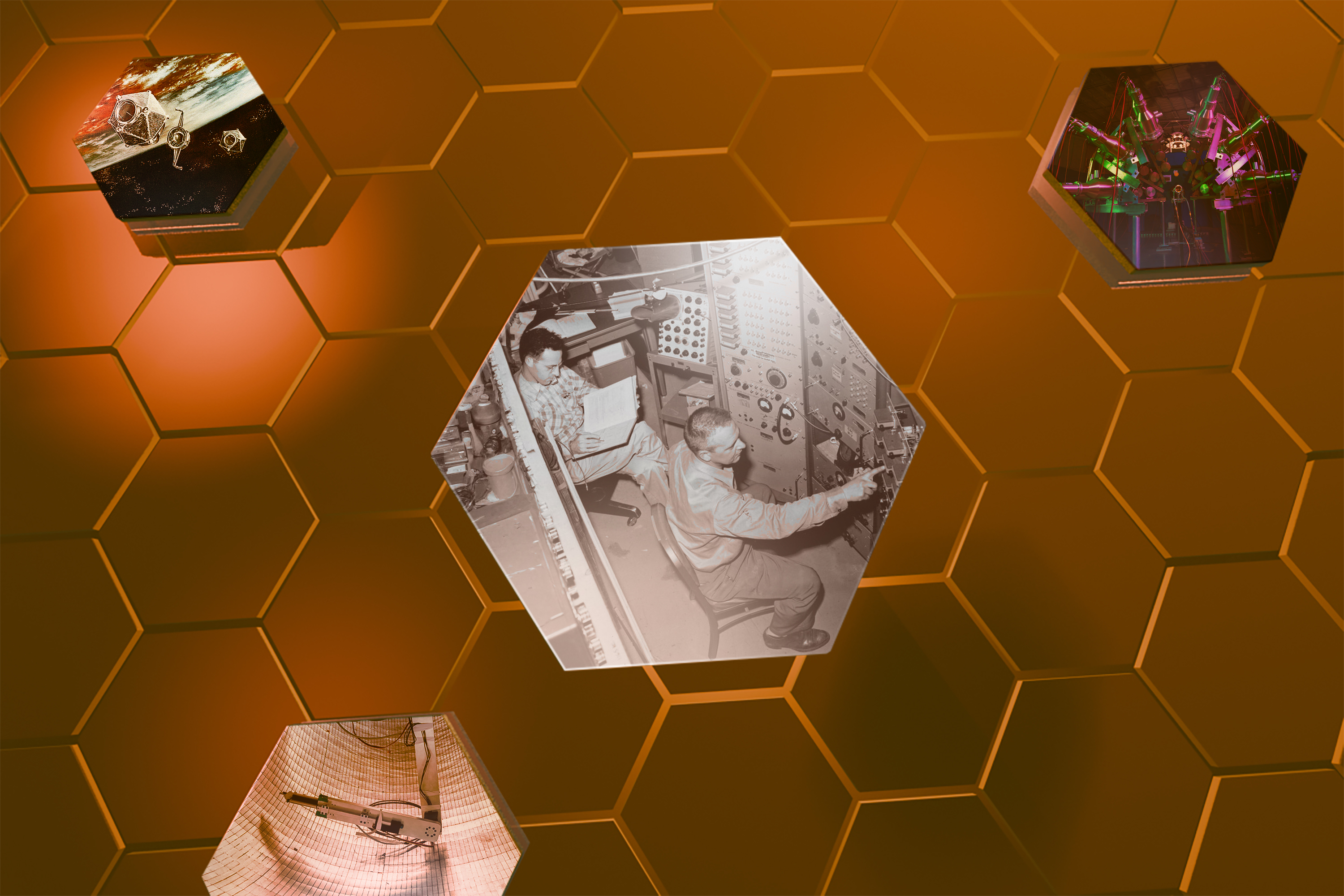
Bowles was lead on the Soviet-American Gallium Experiment (SAGE), a government-to-government collaboration launched in 1987 to figure out what was going on with the Homestake experiment’s data. As it turns out, the Sun was behaving as expected; the neutrinos were playing tricks. SAGE data showed that something was happening to solar neutrinos after production and before detection that caused the detected number to be lower than expected. Scientists proposed that the data could be explained by oscillation—neutrinos changing between flavors as they raced through space.
This would mean neutrinos are doubly elusive: not only do they hardly interact with anything, including detectors, but they also shapeshift. “It’s like a ghost in a white coat enters a room then suddenly the coat flips to black,” laughs Bowles.
Catching the ghost
Known physics was breaking down in the 1920s, and the neutrino fixed it. Physicists studying radioactive decay of atomic nuclei were seeing data that violated the principle of energy conservation. They theorized an undetected particle with specific properties—electrically neutral and nearly massless—that would make sense of the data. Inventing an invisible thing to precisely fill a specific gap was, they admitted, a desperate remedy. But once a new theory was drafted that included the neutrino, suddenly the math worked and the data made sense—the cosmic books were balanced.
Known physics was breaking down in the 1920s, and the neutrino fixed it.
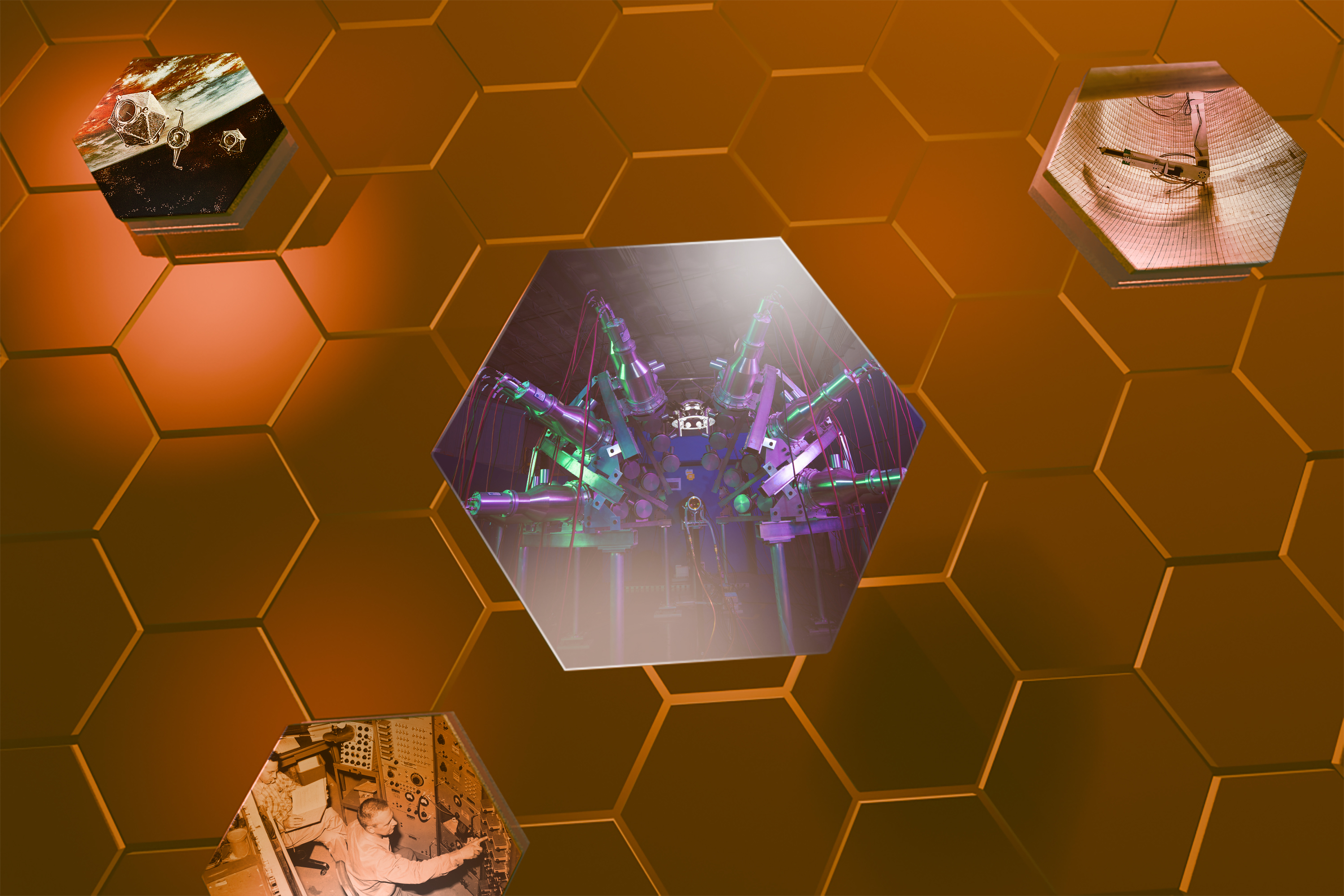
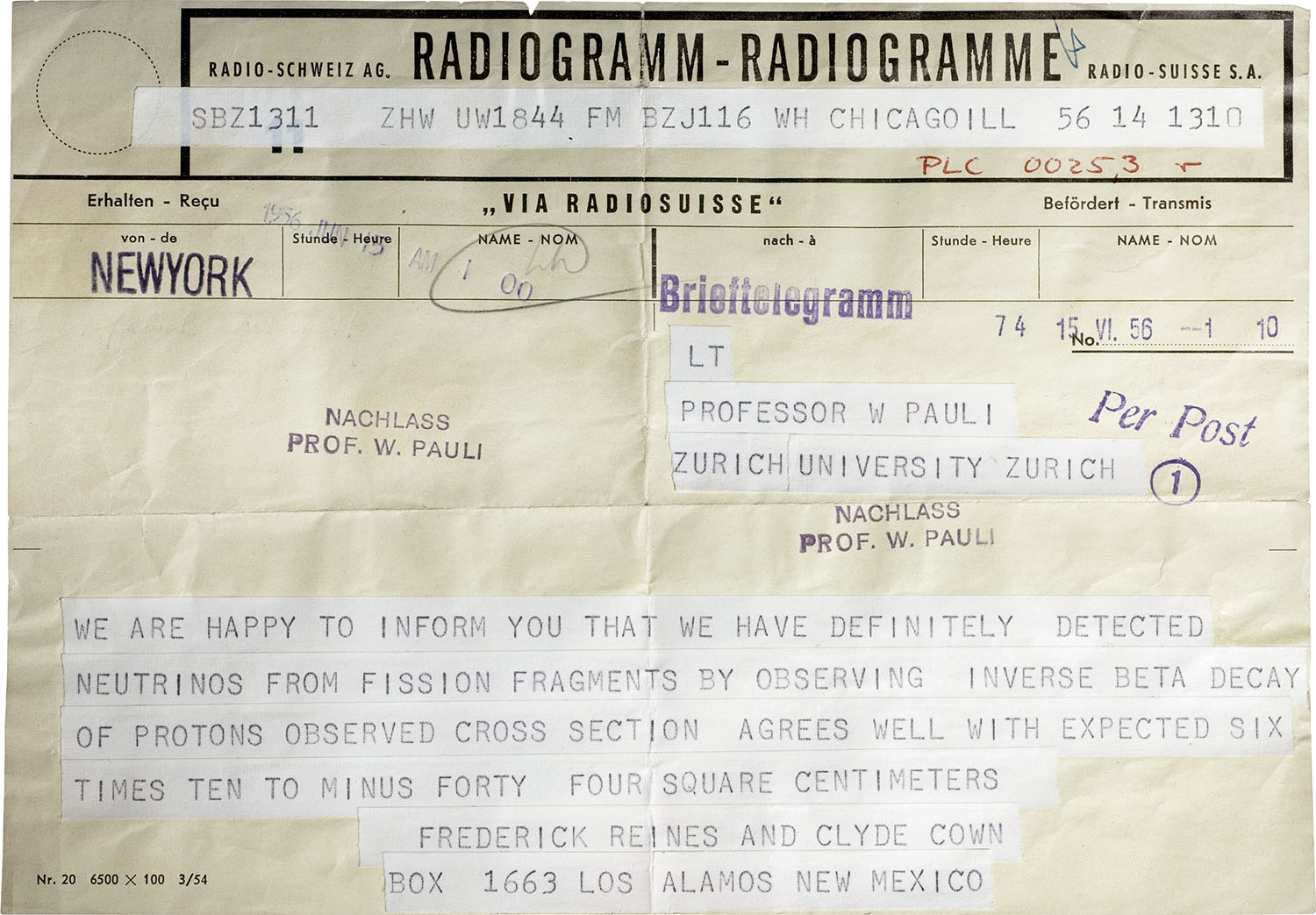
Just because neutrinos fit the data did not make them real. Neutrinos, if they existed, were predicted to interact so weakly that tens of quadrillions would need to pass through a detector before just one was detected. At Los Alamos in the 1950s, nuclear weapons and nuclear reactors were central areas of research, either of which, reasoned Lab physicists Fred Reines and Clyde Cowan, might produce enough neutrinos to catch one. Reines and Cowan explored both areas and in the end took a custom-built detector to the nuclear reactor at South Carolina’s Savannah River Plant in 1956, and made the catch. Specifically, they detected electron antineutrinos—the antiparticle of the electron neutrino, whose very existence proved the existence of the other. Cowan passed away in 1974, and Reines received the Nobel Prize in Physics in 1995 for their discovery.
Once neutrinos were real and scientists had ways to detect them, more specific questions could be pursued, like what is their miniscule but non-zero mass? Neutrino mass experiments do not weigh neutrinos directly; they set limits. Tiny distortions in the data indicate where observations deviate from what would be expected with massless neutrinos, pointing to upper limits of mass, rather than precise values.
However, in the 1980s, Soviet scientists reported a measured mass—not just an upper limit—of the electron neutrino to be around 26 electronvolts (eV). The claim shook the neutrino community and threatened to rewrite cosmology. If true, it would “close the universe,” meaning it would ascribe enough mass and energy to the universe to eventually halt its expansion and reverse it. Los Alamos scientists, including Bowles and his colleague Hamish Robertson, another physicist, made their own measurements using gaseous tritium. (The Soviets had used tritium too but as part of a complex molecule rather than a simple gas.) The Los Alamos team came back with a maximum mass of less than 9.3 eV—far below the claimed measurement and not enough to close the universe.
While the Soviet and Los Alamos scientists worked independently to measure mass, the SAGE collaboration to observe solar neutrinos was underway. SAGE was born, essentially, from a shared inventory list for a neutrino experiment. “We needed something like 60 million dollars’ worth of gallium metal to build neutrino detectors,” recalls Bowles. “Which we didn’t have. But the Soviets did. They also had an underground lab and a village to support it. What they didn’t have was the computers and high-end electronics they needed. Which we provided. It was a really good marriage, scientifically.” Indeed, as well as predicting neutrino oscillation, the SAGE data set a new mass limit for the electron neutrino at under 1 eV, leaving the universe decidedly unclosed.
One in a billion
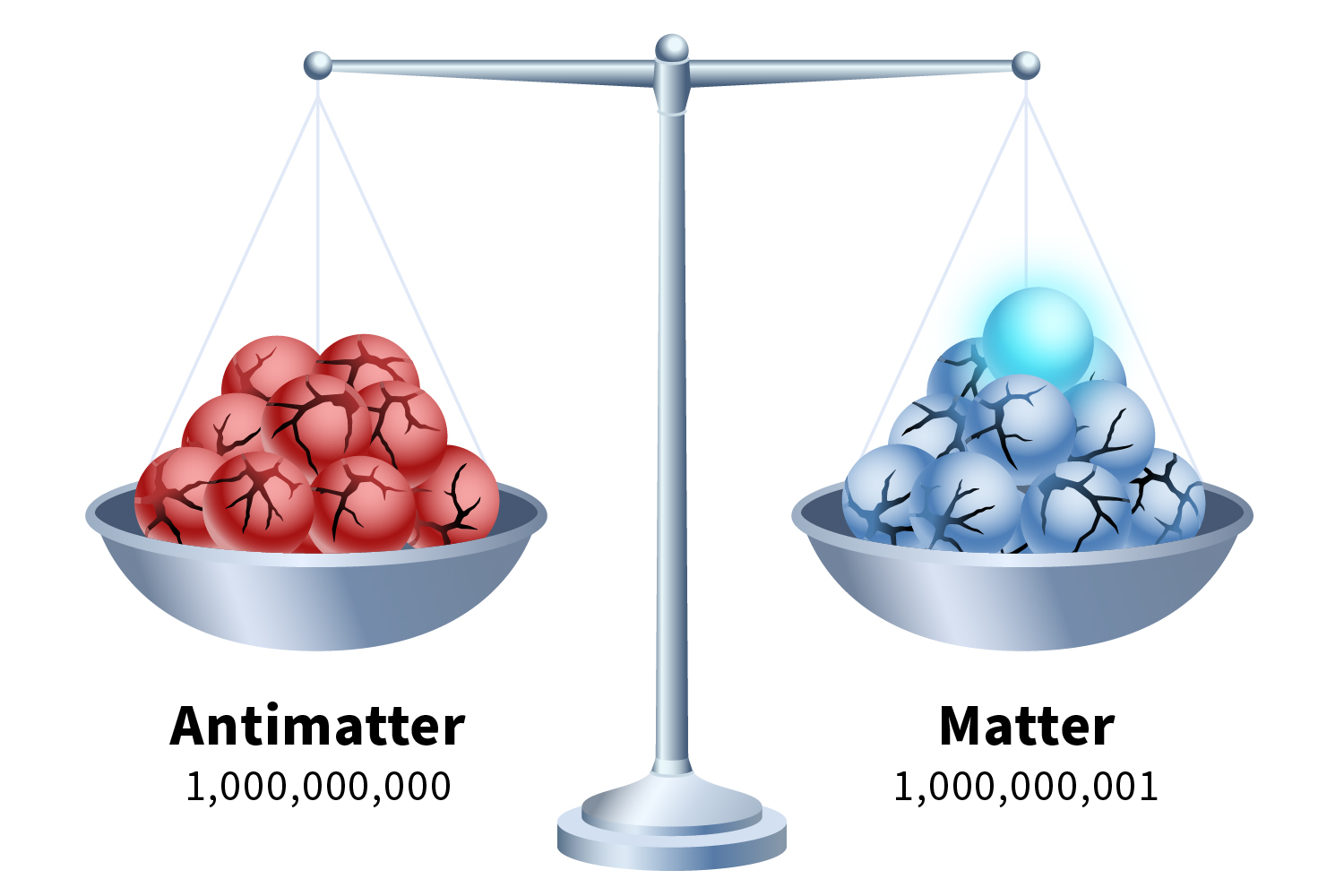
As alluring as they are enigmatic, neutrinos spur speculation around big questions—like why we are here at all. Some physicists think neutrinos may hold the key to the matter-antimatter asymmetry problem: why the universe is made of matter. The Big Bang should have created equal amounts of matter and antimatter, which would have annihilated each other completely. But the slight imbalance of about one extra matter particle for every billion matter-antimatter pairs allowed matter to survive and form everything we know, from protons to planets to people.
The question is no longer whether new physics exists in the neutrino realm, but how much more is hiding there.
The fact that anything remains after matter-antimatter annihilation is one of cosmology’s deepest puzzles. The Standard Model, science’s best theory for describing fundamental particles and their behavior, cannot adequately explain the cause of the asymmetry. The model is spectacularly successful at predicting particle physics to extraordinary precision, but it is incomplete—while its core structure is stable, its parameters are under constant refinement. For example, the model originally assumed neutrinos were massless, which oscillation experiments disproved. Because neutrino mass requires physics beyond the minimal Standard Model, physicists suspect neutrinos may hold additional clues—possibly even the cause of matter-antimatter asymmetry. The question is no longer whether new physics exists in the neutrino realm, but how much more is hiding there.
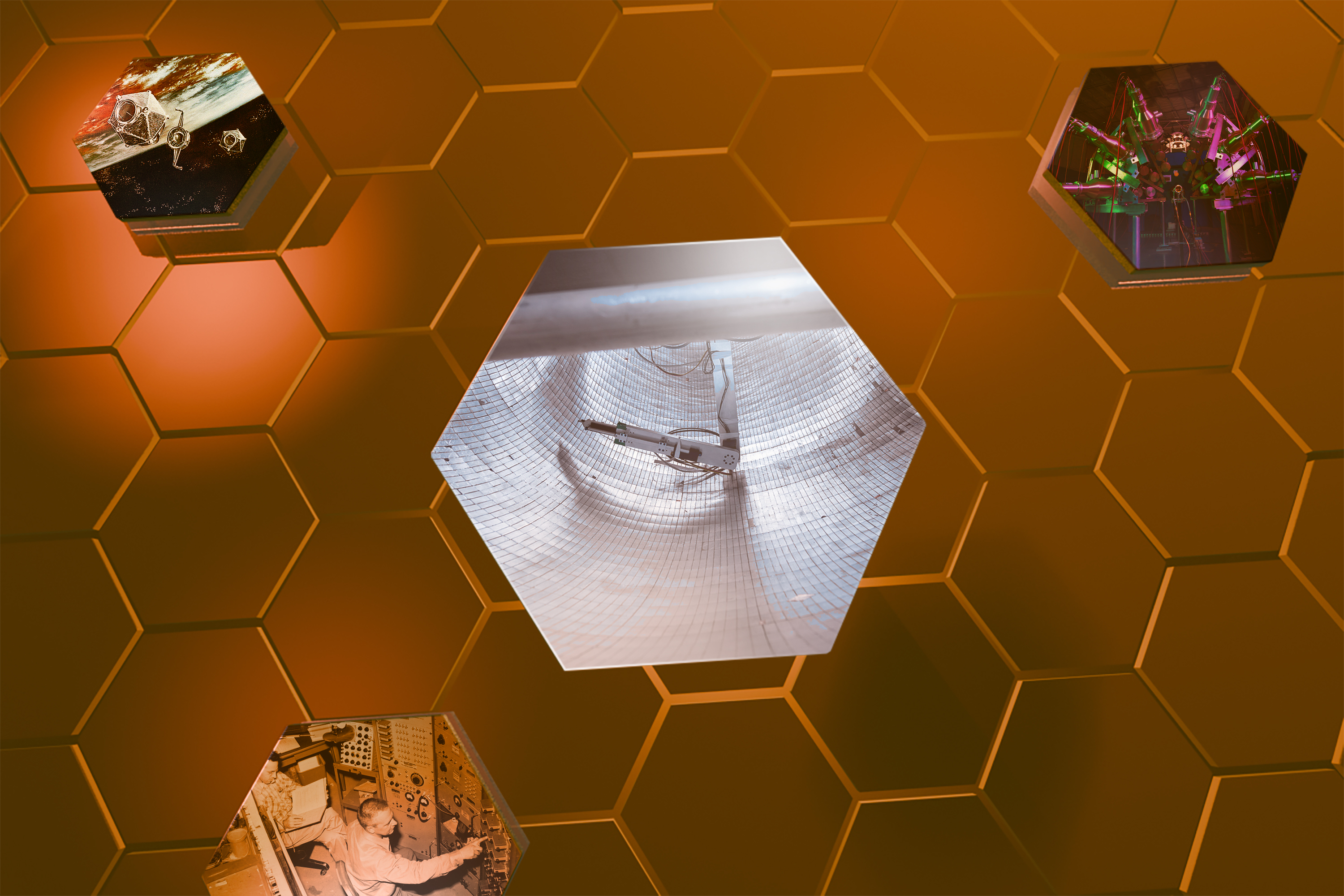
When something in nature seems hidden or doesn’t add up, scientists build experiments to reveal what’s missing. The flagship Los Alamos neutrino experiment, the Liquid Scintillator Neutrino Detector (LSND), ran in the 1990s to test whether muon neutrinos could oscillate into electron neutrinos over a short distance—a pattern the Standard Model could not easily accommodate. LSND data was consistent with such oscillations, pointing to physics beyond the three known neutrino types and providing the first hint at what would come to be called sterile neutrinos. Whereas active neutrinos are nearly inert, interacting with matter only through a fundamental force called the weak force, sterile neutrinos would be truly inert, subject only to gravity. An active neutrino oscillating into a sterile neutrino would to a detector look like the neutrino disappeared. And neutrino experiments had previously seen neutrinos seeming to disappear from experimental data streams, so the sterile neutrino theory made sense.
Since the LSND experiment, more clues have come in from experiments around the world that point to the existence of sterile neutrinos. Similarly, clues have come in that refute it. In 2007, the MiniBooNE experiment at Fermilab first disagreed, then agreed with LSND. A follow-on experiment, called MicroBooNE, was built specifically to look for sterile neutrinos, and in late 2025, it reported no evidence of the expected signatures. But absence of evidence is not evidence of absence. Every neutrino experiment looks for a specific phenomenon in a specific way, so just because they have not found it, doesn’t mean they won’t. One by one, contradictory results are narrowing the range of possibilities. What has not been refuted is that the data suggest lingering mysteries, potentially involving dark matter or other exotic particles. Once again, new physics is needed to make it all add up.
The dark sector
Particles that do not interact and the black-box nature of the physics afoot has led physicists to posit a “dark sector,” a hidden extension of particle physics that includes weakly coupled particles and forces. Dark matter is the most famous resident of the dark sector.
Still hypothetical in the sense that it is not well understood, dark matter is accepted as real because many independent observations require it. Whereas about 5 percent of the universe is ordinary matter—atoms, galaxies, sandwiches—27 percent is dark matter. (The remaining 68 percent is thought to be dark energy, a mysterious something that does not behave like matter and is accelerating the expansion of the universe). Scientists believe that dark matter is real, massive, electrically neutral, gravitationally active, and weakly interacting. But what it’s made of is a mystery. Maybe it’s sterile neutrinos.
In 1990, Los Alamos joined the Sudbury Neutrino Observatory (SNO), an underground neutrino experiment in Canada designed to pick apart the solar neutrino question. The Homestake experiment and SAGE had measured the solar neutrino deficit and SNO wanted to explain it. SNO showed that electron neutrinos oscillate into muon and tau neutrinos, and Los Alamos played a key role by providing an independent method of measuring all three types of neutrinos. When all flavors were measured together, the solar output was as expected—the deficit only appears when neutrinos are measured by flavor.
Whereas previous mass estimations had placed increasingly stringent upper limits on neutrino mass, SNO was the first to actually make a mass determination, showing that neutrinos must have a mass around 1 millielectronvolt (meV), which is about a billion times less than a single electron. But even with this miniscule mass, because of sheer numbers, neutrinos still account for 5 percent of the mass of the universe. SNO director Art McDonald was awarded the 2015 Nobel Prize in Physics, and he invited Robertson, who developed the independent measurement capability, to attend the ceremony.
SNO’s findings indirectly nudged dark matter theory toward sterile neutrinos. If active neutrinos account for 5 percent of the total mass budget, they alone cannot account for dark matter, which makes up 27 percent. Sterile neutrinos could be the missing mass.
Lighting a path
Los Alamos continues to participate in large, international neutrino collaborations. Right now, the Lab is collaborating on the LEGEND project, deep below a mountain in Italy, where the neutrino detectors are shielded from cosmic ray backgrounds. Working underground, the Lab’s expertise in high-sensitivity detectors and low background environments has been foundational for LEGEND.
LEGENDS’s scientists are looking at the matter-antimatter asymmetry problem in a new way, specifically asking if neutrinos could be Majorana particles—particles that are their own antiparticle. If they are, these particles would violate the accounting rules of particle physics and offer a mechanism for matter to have persisted. Neutrinos have already forced physicists to rewrite the rules; this could be another rule that neutrinos are breaking. To check for Majorana behavior, the LEGEND project is looking at a nuclear decay process called double beta decay, during which an atomic nucleus changes to a different element by converting two neutrons into two protons. As byproducts, the nucleus emits two electrons and two antineutrinos. If neutrinos are their own antiparticle, then the two antineutrinos will instantaneously annihilate, leaving only the emitted electrons.
Whether LEGEND detects neutrinoless double beta decay or not, it will constrain the possibilities in a useful way. If detected, the Standard Model cracks open and scientists can open the door to extending the model to include Majorana particles. If not detected, scientists can close the door on most Majorana models, shrinking the range of possibilities. Either way, it’s progress.
The neutrino story at Los Alamos is a story of stubborn questions, diverse detectors, and collaboration. “It’s really about breadth of knowledge,” says Bowles. “Basic science answers a lot of fundamental questions that the weapons program and national security programs need answered. Our world-leading science brings the brightest minds here, and once they’re here, they engage with all sorts of important questions.”
Neutrinos have never behaved the way physicists expected them to. They were invented to fix a bookkeeping problem and continually refuse to fit cleanly into the Standard Model. For seventy years, they have pulled Los Alamos scientists into collaborations that span continents and generations. And they still refuse to add up, pushing new questions. Either way, the story hasn’t ended.
People Also Ask:
- What is neutrino oscillation? Neutrino oscillation is the phenomenon in which a neutrino changes from one flavor—electron, muon, or tau—into another as it travels through space, proving that neutrinos have mass.
- Are neutrinos dark matter? Neutrinos are not the main form of dark matter, but some types of neutrinos could contribute some dark matter. The three known neutrinos—electron, muon, and tau neutrinos—do have mass, but it is far too small for them to account for the amount of dark matter in the universe. However, physicists have proposed the existence of sterile neutrinos, hypothetical neutrinos that do not interact through the weak force and would interact only by gravity. If they exist and have the right mass, sterile neutrinos could make up some or even all of the dark matter. So far, evidence for sterile neutrinos is mixed and inconclusive.