Despite its neutral charge, a neutron’s role is hardly benign. Neutrons contribute to the fundamental forces that hold atomic nuclei together. And sometimes they let go, causing the radioactive decay of certain elements and subsequent formation of others.
Shortly after British physicist Sir James Chadwick discovered neutrons in 1932, scientists took advantage of neutrons to induce fission, making them key to the development of nuclear weapons and nuclear energy. Building on this foundation, Los Alamos National Laboratory scientists have spent decades studying the fundamental properties of neutrons to improve their understanding of how elements are formed and how our universe is made.
Particles and forces
The Standard Model of particle physics is a theory describing the particles and forces that make up the universe. To date, it’s a fairly comprehensive map of the building blocks of matter and the forces that act on them. The building blocks range from the well-known—electrons, protons, and neutrons—to more recently discovered particles such as quarks and the Higgs Boson. The forces comprise electromagnetism, which acts on charged particles, and the strong and weak forces that hold together atomic nuclei.
The Standard Model is well grounded in experimental evidence and mathematical theory and universally accepted as a pretty good explanation of the building blocks of the universe, however, there are gaps. The Standard Model does not account for dark matter, dark energy, or gravity, and there are lingering questions that continue to tug at scientists’ minds. For instance, when studying the Big Bang, models predict that it should have created equal amounts of matter and antimatter, which would have then annihilated each other. However, the asymmetry that resulted (about one extra matter particle for every billion matter-antimatter pairs) is responsible for our universe and all the things we know existing of matter. Evidence beyond the Standard Model—often referred to as extensions to the Standard Model—is all around us, and physicists continue the search for a deeper understanding of the physical world.
Cold and precise
Protons and electrons are understood to be stable, with their lifetimes each exceeding the 14-billion-year-age of the universe. Neutrons, on the other hand, can go through a process called beta decay, during which they devolve into an electron, an antineutrino, and a proton. When neutrons decay within the nucleus of an element, the number of protons in the atom changes, resulting in it becoming a different element.
And when a neutron is free, unattached to any nucleus, it decays, on average, in roughly the time it takes to boil a gallon of water. The exact amount of time was elusive for decades.
“Los Alamos scientists measured the neutron lifetime with unprecedented accuracy”
“A reliable neutron lifetime measurement can be used as an input in models of Big Bang nucleosynthesis to help us understand the formation of elements in the early universe,” says Lab physicist Steven Clayton. Beyond understanding the Big Bang, neutron lifetime data can be combined with additional measurements to further test the bounds of the Standard Model.
After the neutron was discovered, scientists began trying to measure its lifetime. Over the decades researchers derived several different strategies to measure the lifetime of a free neutron with the highest precision and struggled when their measurements did not match up. For one approach, the number of protons produced in a well-measured beam of neutrons was counted. Another approach used a container to confine ultracold neutrons and measured the fraction of neutrons that survived after given elapsed times. Groups of scientists using these two approaches determined the neutron lifetime to be approximately 887 or 879 seconds, respectively. However, because the two types of measurements were expected to give the same lifetime, but were instead conflicting, scientists at Los Alamos decided to seek a less disputable answer.
After the Manhattan Project, Lab scientists continued studying many aspects of nuclear science. In the 1980s and 1990s, several collaborations investigated the fundamental symmetries of the universe, such as the disparity of matter and antimatter, and sought to devise experiments to better understand phenomena such as beta decay. These endeavors led Los Alamos to develop an ultracold neutron capability (UCN) in 1995 in which neutrons are cooled to low temperatures so they move slowly, making them easier to study. Led by Laboratory Fellow Chris Morris (winner of the American Physical Society’s 2026 Bonner Prize) the Lab further developed the capability to facilitate a range of precise low-energy particle physics experiments and in 2005 the UCN began operating as an international facility. The Laboratory’s UCN Source is now considered one of the highest intensity UCN sources in the world. This capability made it possible for Los Alamos to take the lead on measuring neutron lifetimes.
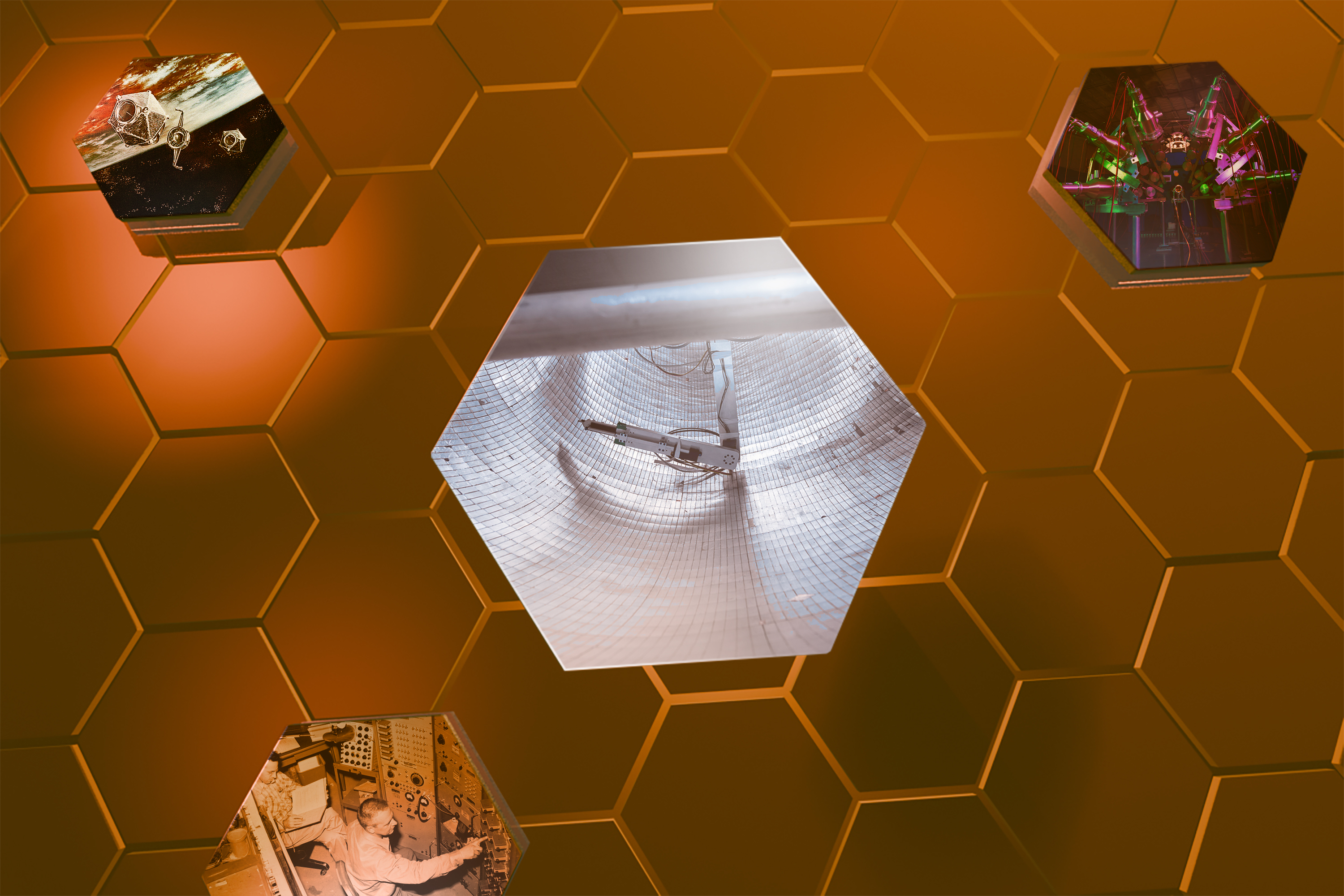
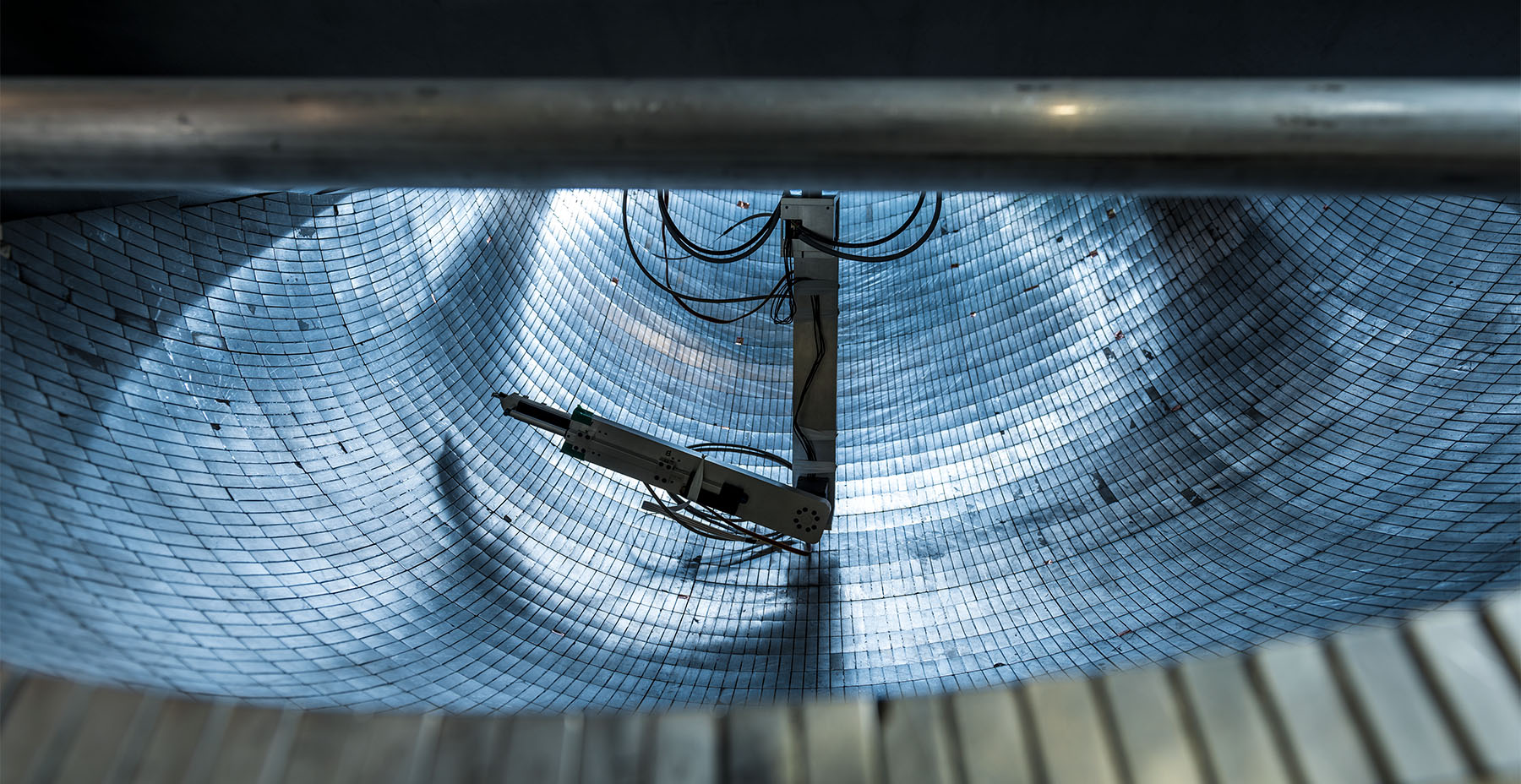
The UCN Source uses a solid deuterium crystal to cool neutrons energies to about 1 millikelvin (one-thousandth of a degree above absolute zero), so that they move at speeds of only a few meters per second. Cooling neutrons to “walking speed” enables them to be completely confined by magnetic fields and gravity. Taking advantage of this unique capability, Los Alamos scientists developed a new kind of neutron-lifetime experiment by building a magnetogravitational trap, a container resembling a bathtub whose concave surface is covered in magnets and the top is open. Using this trap, the team set a record in 2021 when they measured the neutron lifetime to 877.75 seconds, cutting the uncertainty of the previous best measurements in half.
Then, in 2025, the team analyzed an additional three years of data and updated the measurement of a neutron’s lifetime to 877.83 seconds, with uncertainty reduced to under 0.3 seconds.
Beyond what is known
The LANSCE UCN Source attracts collaborators from more than 20 universities across the United States and Europe, helping them play leading roles in fundamental neutron physics efforts at other institutions. And, in addition to experimental research, several Los Alamos theoretical physicists are evaluating the results of neutron and other particle experiments to both speculate about what is possible and to analyze what has been observed.
One UCN project is to measure the correlation between the spin of a beta-decaying neutron and the resulting electron. When this measurement is combined with the precise neutron lifetime, the self-consistency of the Standard Model can be tested, allowing scientists to identify limits on extensions to the Standard Model that could explain other phenomena such as new properties of known or hypothetical particles.
“Further improvements to these measurements could someday lead to a new Standard Model of particle physics,” says Clayton.
Another project that is currently underway is the Los Alamos Neutron Electric Dipole Moment (nEDM) experiment, which not only challenges the Standard Model, but could also lead to a better understanding of the origin of the matter-antimatter balance of the universe.
“We want to understand if the laws of physics are the same if time runs backwards,” explains Los Alamos physicist and Lab Fellow Tom Bowles. In other words, consider a film of two billiard balls colliding. If you watch the film played forward or backward, you can’t tell the difference. However, if the balls were neutrons, and one had a nonzero EDM, it would look different being played forward versus backward.
A neutron would spin counterclockwise or clockwise, depending on the direction of time.
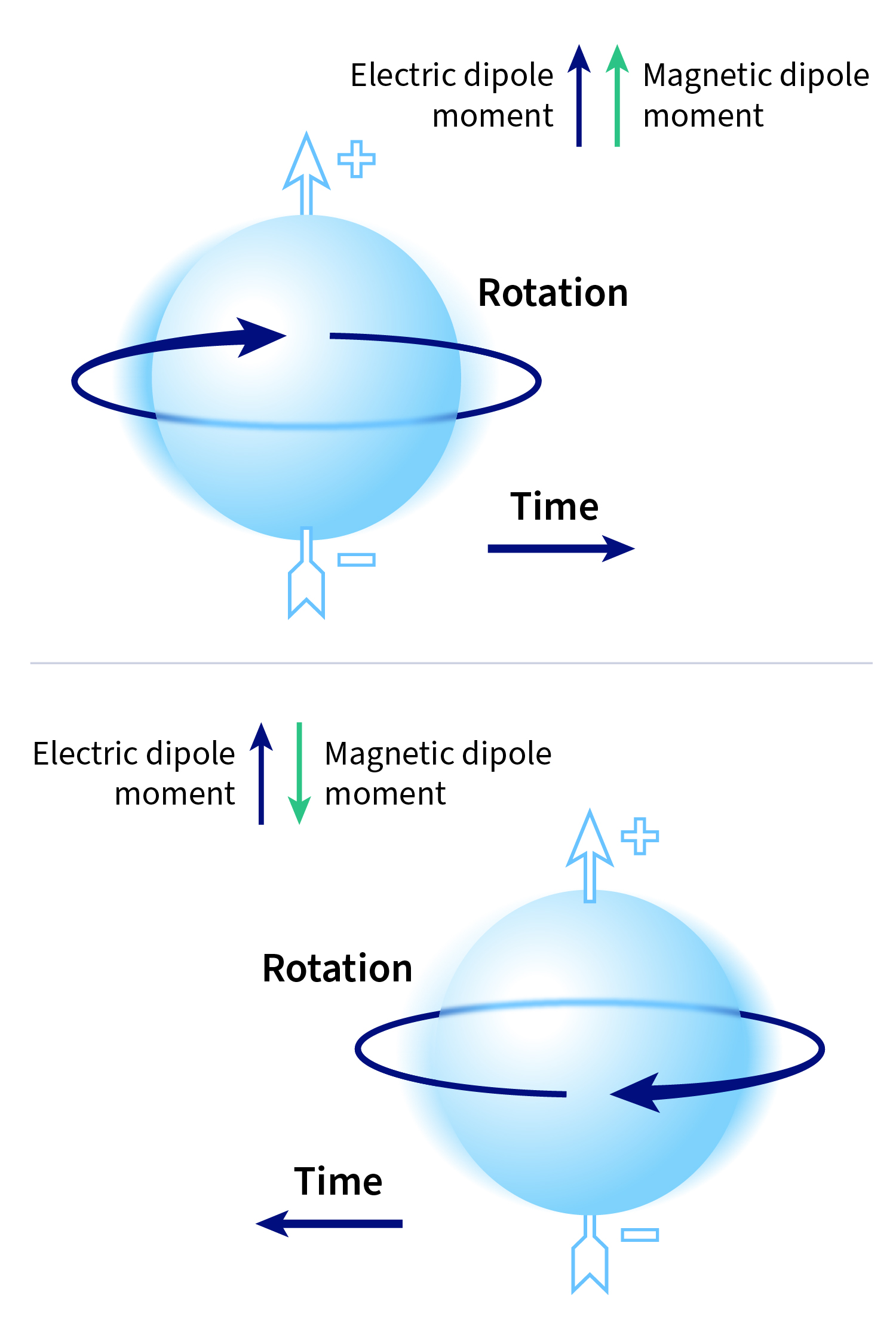
The electric dipole refers to the separation of positive and negative charge within a neutron. The nEDM is vanishingly small in the Standard Model: If the neutron were the size of Earth, the charge separation would be about the thickness of a human hair. In spite of how difficult it is to detect, some theoretical extensions to the Standard Model suggest a nonzero EDM could be measurable.
“The nEDM experiment at the LANSCE could well answer questions about the origin of the universe”
At the LANSCE UCN Source, Los Alamos scientists are working to improve on past nEDM experiments by using high-precision nuclear magnetic resonance (NMR) measurements of stored UCNs with a strong electric field applied along or opposite the applied magnetic field. If the NMR signal frequency changes when the field is reversed, that would indicate a nonzero EDM.
In our four-dimensional universe (x, y, z, and time) our best theory tells us that differences between left and right, matter and antimatter, and time reversal need to all balance out. But high-energy physics data don’t support that theory. Measuring a nonzero nEDM could help answer these questions about asymmetry.
“Because time reversal is related to the matter-antimatter balance in the universe, a nonzero nEDM measurement could explain the asymmetry in matter and antimatter. The nEDM experiment at the LANSCE could well answer the question of why we are here,” says Bowles.
People Also Ask:
- Why does the neutron lifetime matter for the Standard Model? Deviation between the measured neutron lifetime and that which is predicted by the Standard‑Model of particle physics could reveal missing or new physics phenomena.
- What is the asymmetry of the universe? The universe is made almost entirely of matter and contains only a tiny trace of antimatter. If the Big Bang had produced equal amounts of matter and antimatter, they would have annihilated each other, leaving a universe filled only with radiation and no galaxies, planets, or people.