Asterix is a multipurpose instrument for studying the structure of interfaces and for cold neutron imaging
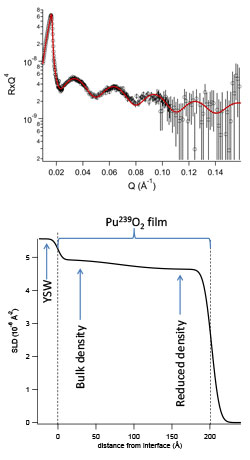
Asterix operates on the Lujan Center’s cold neutron moderator and views an intense polychromatic neutron beam with a 4 to 13 Å wavelength range through a 36-cm2 neutron guide.
The location of the instrument in the quiescent environment of Experiment Room 2 and the robust neutron shielding greatly minimize instrumental background.
Surfaces and Interfaces
Asterix is a versatile nano- and meso-scale neutron scattering spectrometer primarily used to investigate interfaces and thin organic and inorganic layers ranging from 5 to 5,000 Å. This time-of-flight instrument is capable of utilizing reflectometer, diffractometer, and grazing-incidence-SANS scattering geometries and is designed to perform studies of the in- and out-of-plane structures of condensed and soft matter thin films.
The 2.5m long detector arm is readily configurable for a variety of experimental needs including reflection in either horizontal or vertical planes.
A special strength of Asterix is the ease with which a great variety of experimental requirements and sample environments can be accommodated. Special sample environment capabilities exist including solid-liquid interface cells, high P/T cells (up to 200MPa and 200°C), and a RF induction furnace to reach 1,200°C.
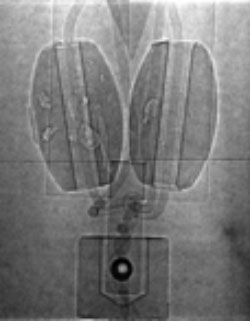
Radiography and phase contrast imaging
Imaging techniques using cold neutrons (0.5 to 5.0 meV) can be performed on Asterix. The beam defining aperture is controllable from <1mm2 to 9cm2 and the aperture to detector distance ranges from to 1.0 to 5.5m.
Phase contrast imaging, which relies on contrast generated from refraction of neutron waves, is ideally suited for imaging of low neutron absorbing materials and for enhancing the appearance of internal and external surfaces and interfaces.
Cold neutron radiography, which relies on absorption contrast in the sample, is ideal for materials science studies of hydrogen distribution in materials that are often difficult to study with other techniques. Cold neutron radiography complements the thermal neutron imaging (Flight Path 5) and high energy neutron imaging (WNR 60R) capabilities at LANSCE.
Specifications
- Moderator: Lower-tier coupled liquid-hydrogen moderator
- Beam cross-section: Unpolarized, 60 mm by 60 mm
- Primary flight path: Target to sample position: 18 m
- Secondary flight path: Sample to detector position: 0.5–2.5 m
- Wavelength frame: 4 to 13 Å
- Resolution:
- Time-of-flight wavelength resolution: 0.2 to 0.6%
- Geometrical resolution: > 0.04cotθ (%)
- Neutron detector — reflectometry: One-dimensional position-sensitive detector (PSD) on a detector arm with range of motion from 6° to 40°. The PSD can be rotated 90° about the normal to the detector face.
- Neutron detector — grazing-incidence SANS: Two-dimensional PSD on a detector arm with range of motion from 6° to 40°. The PSD is equipped with two ³He pencil detectors that can be translated in the horizontal and vertical directions.
- Neutron detector — imaging:
- 10 × 10 cm two-dimensional Li-doped ZnS scintillator with 125 μm pixel size
- 3 × 3 cm two-dimensional time-resolved CCD detector with 55 μm pixel size
- Neutron detector — diffraction: Two-dimensional array of PSD tubes that can be placed anywhere inside the Asterix cave. Maximum scattering angle is 100°.
- Sample environment options tailored for Asterix experiments:
- Controlled gas content and temperature cells, up to 1200°C
- Solid-liquid interface cells with shear flow
- In situ electrochemistry cells
- Solid-liquid high-pressure/high-temperature cells, up to 200 MPa and 200°C