The LANSCE proton beam pulses and produces neutrons with different energies, which researchers determine using time of flight (TOF) techniques.
Neutron Time of Flight
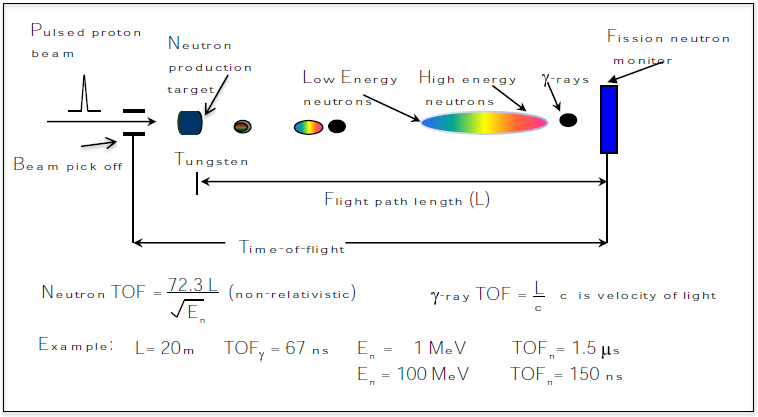
The proton beam pulse strikes the tungsten neutron production target producing neutrons, gamma rays, and charged particles. Permanent magnets remove the charged particles from the beam.
The neutrons and gamma rays travel the distance of the flight path to arrive at a sample or detector. Because gamma rays travel at the speed of light, the gamma rays arrive first.
As neutrons travel along the flight path, the pulse spreads out with higher energy neutrons arriving before lower energy neutrons. A measurement of the time between the proton beam pulse and the detection of a signal from the detector gives the velocity, or the energy, of the neutron.
Time of flight technique.
Depending on the micropulse spacing, gamma rays and high-energy neutrons produced by the following proton pulse will arrive at the same time as low-energy neutrons. This is called "wrap around" and sets a lower limit for the neutron energy that can be used in an experiment.
One contribution to the incident neutron energy resolution in a TOF experiment is the time resolution of the detector system. The energy resolution is given by ΔE/E= 2 ΔT/T, where ΔE is the neutron energy resolution, ΔT is the time resolution of the detector, and T is the TOF of the neutron.
The table below gives values for neutron and gamma ray TOF, wrap-around energy for 1.8 μs and 3.6 μs spacing and energy resolution for various flight path lengths assuming 1 ns detector time resolution.
Flight Path Length (m)
Neutron Energy (MeV)
TOF-γ (ns)
TOF n (ns)
Wrap Around 1.8 μs (keV)
Wrap Around 3.6 μs (keV)
ΔE (keV)
10
1
33
722
161.34
40.33
3
2
511
8
10
230
87
20
164
244
100
78
2569
500
44
22739
20
1
67
1445
645.34
161.34
1
2
1023
4
10
460
43
20
328
122
100
156
1285
500
88
11369
90
1
300
6502
13068.23
3267.06
0
2
4601
1
10
2071
10
20
1476
27
100
701
285
500
396
2527
Time Structure of the LANSCE Beam
One of the greatest strengths of the LANSCE facility is that it can produce proton beams with a wide range of time structures.
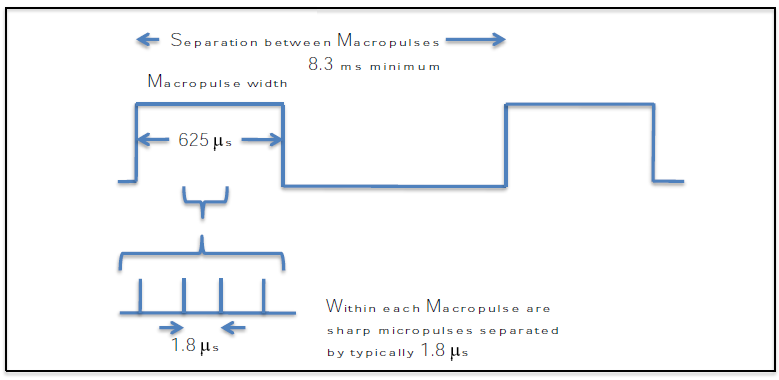
The time structure of the LANSCE proton beam can be optimized for particular experiments within the constraints of the accelerator operating parameters. The LINAC accelerates beam during the time that the radiofrequency (RF) drive is applied to the accelerating elements. The time that the radiofrequency drive is on defines a macropulse of beam. Because of limitations in the RF power that can be produced and the cooling that can be provided to the elements, the LINAC is limited to a maximum of 120 macropulses/second.
The duration of the macropulse is set by the Master Timer and is typically 625 μs long, although longer and shorter macropulses are possible.
Within each macropulse are micropulses. The width of the micropulses is dominated by the frequency and tuning of the radiofrequency driver and is typically less than 100 ps at the exit of the LINAC. The minimum separation of the micropulses is determined by the operating frequency of the 201 MHz drift tube LINAC. Because the frequency is 201 MHz, the minimum micropulse separation is 5 ns. The separation between micropulses determines the number of pulses per unit time and thus the average current that is accelerated in the LINAC.
The time structure is programmed in the Master Timer, which controls choppers in the low-energy beam transport between the ion source and the beginning of the drift-tube LINAC.
Below we will look at the time structure of the beam for three cases: Target 1 (low-energy neutron production), Target 4 (high-energy production), and Target 2 (proton beam experiments) to aid the interested user in understanding the beam parameters and available beam delivery options.
Target 1 Operation
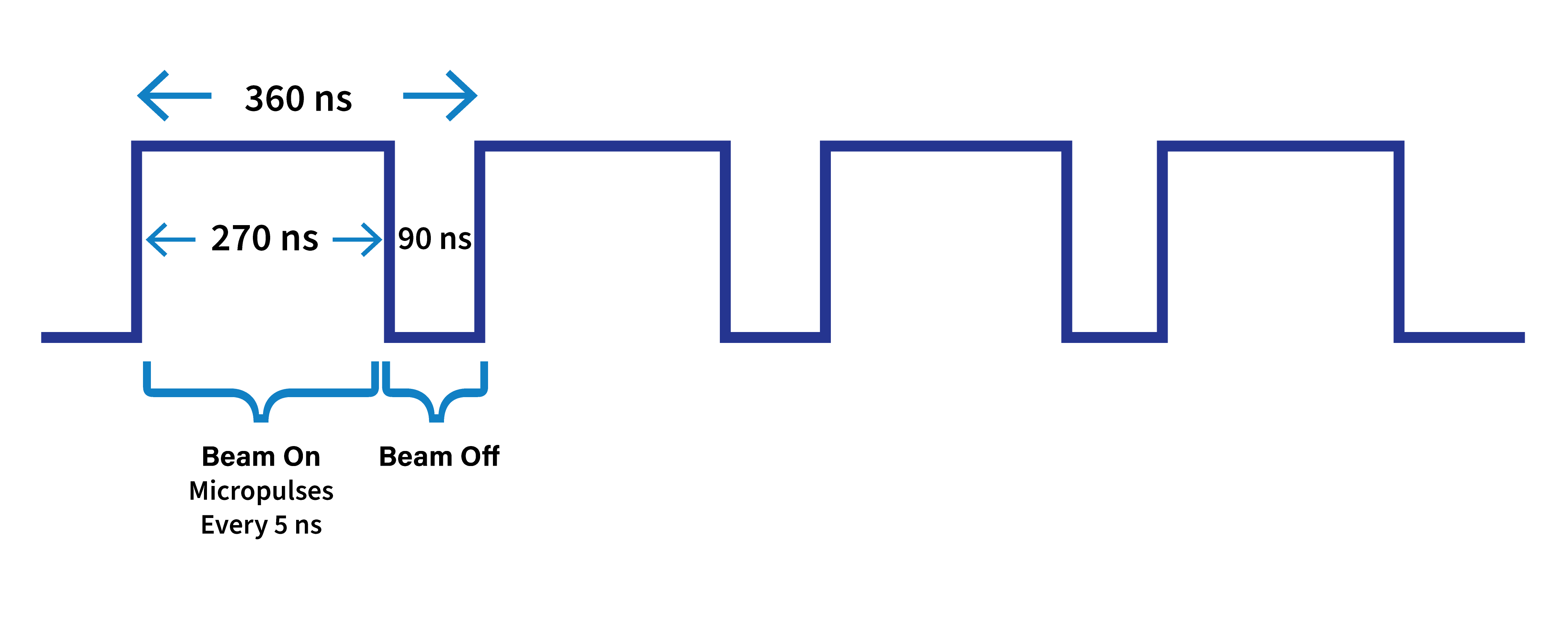
The proton beam is delivered to Target-1 after passing through the proton storage ring (PSR). The time it takes an 800-MeV proton to travel one circuit of the PSR is 360 ns.
The beam entering the PSR is filled with micropulses separated by 5 nsec (the minimum separation) for a duration of 270 ns. There is then a gap of no beam for 90 ns for each 360 ns cycle. This pattern is repeated for the entire macropulse or 625 μsec / 360 ns = 1736 times. The 90 ns gap is required for the magnets to switch, then the beam is extracted from the ring.
The time structure of LINAC beam that is injected into the PSR is shown below. The beam that exits from the PSR consists of a triangular pulse approximately 270 ns wide at the base.
Diagram of the LINAC beam that is injected into the PSR.
Target 2 Operation
Beam can be transported to Target 2 (aka the Blue Room) directly from the LINAC or after being compressed in the PSR. At this time, the beam current is limited by the radiation shielding surrounding Target 2 to approximately 80 nA for an unshielded sample. Because the Lead Slowing-Down Spectrometer shields the target with 0.6 m of lead in all directions, the beam current can be raised to the 1 μA level.
The limitations to the time structure that can be delivered to Target 2 can be estimated assuming there are 7x10⁸ protons in a micropulse. For example, if we operate with a 625 μs wide macropulse at a repetition rate of 10 macropulses/s with a micropulse separation of 10 μs, the beam current will be [10] * [625/10] * [7e8] * 1.6E-19 = 70 nA which is within the operating limits for an unshielded target.
Single proton pulses on demand can also be delivered.
Target 4 Operation
For time-of-flight measurements, the beam pulses must be separated by enough time so that the slowest neutrons of interest reach the detector before the highest energy neutrons from the next pulse arrive. If this condition is not achieved, then backgrounds may occur in the measurement that may be difficult to remove.
For typical operation of Target 4, we separate micropulses by 1.8 μs. This allows observing neutrons down to approximately 160 keV for a 10m flight path.
Should experiments require measuring lower energy neutrons, the pulse-to-pulse spacing may be increased with fewer pulses and lower beam current.
Time structure of the proton beam for typical Target 4 operation.
If we operate with 40 macropulses per sec which are 625 μs long with 1.8 μs between micropulses, the number of micropulses per sec is [625]/ [1.8] *[40] = 13889 pulses per sec. If we assume there are 7 x 10⁸ protons in a micropulse, there will be 7 x 108*13889 ~ 1013 protons per sec or ~1.5 μA of beam.