DOE/LANL Jurisdiction Fire Danger Rating:
  1. LANL Home
  2. Science & Engineering
  3. Science Facilities
  4. LANSCE

LANSCE Accelerator and Experimental Facilities

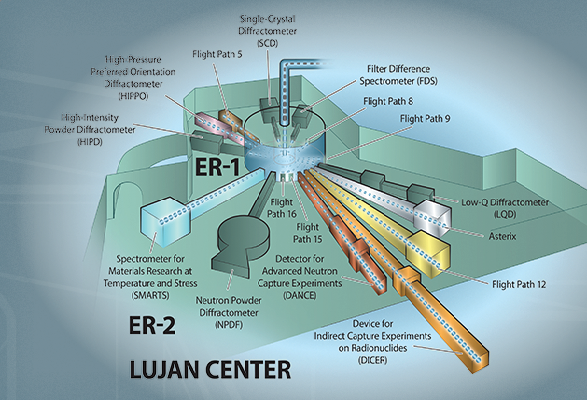
LANSCE neutron research facilities include the Lujan Center, Proton Radiography, Isotope Production Facility, Ultracold Neutrons, and the Weapons Neutrons Research Facility.

Beam Schedules

  • Isotope Production Facility (IPF)

    The Isotope Production Facility (IPF) uses a 100-MeV proton beam extracted from the main LANSCE accelerator to produce isotopes for application in the fields of medicine, fundamental nuclear physics, national security, environmental science, and industrial applications.

    • Learn More
  • Lujan Neutron Scattering Center

    The Lujan Center delivers science by exploiting the unique characteristics of intense beams of moderated pulsed neutrons for academia, national security, and industry. Supports DP and Department of Energy (DOE) Office of Science missions.

    • Learn More
  • Proton Radiography

    Proton radiography employs a high-energy proton beam to image the properties and behavior of materials driven by high explosives.

    • Learn More
  • Ultracold Neutrons (UCN)

    The UCN source produces high energy spallation neutrons and uses solid deuterium to cool the neutrons by one million billion-fold.

    • Learn More
  • Weapons Neutron Research (WNR)

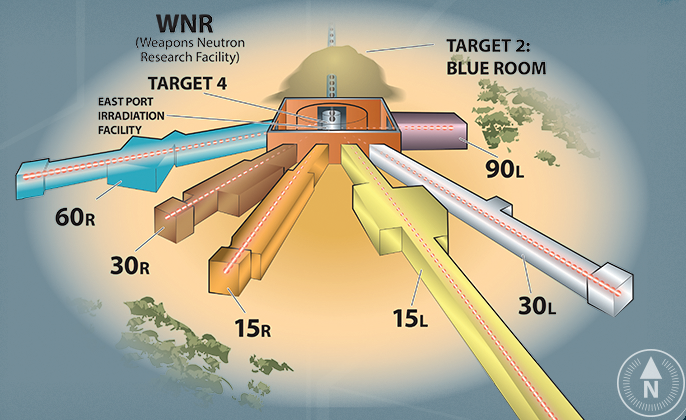
    The Weapons Neutron Research Facility (WNR) provides neutron and proton beams, and detector arrays for basic, applied, industrial, and defense-related research.

    • Learn More
  • LINAC

    At the core of LANSCE facility is one of the nation's most powerful proton linear accelerators, LINAC. The 800-mega-electron-volt (800 MeV) LINAC provides beam current, simultaneously, to five major facilities with unique capabilities.

    • Learn More

Sole Use Operation at LANSCE

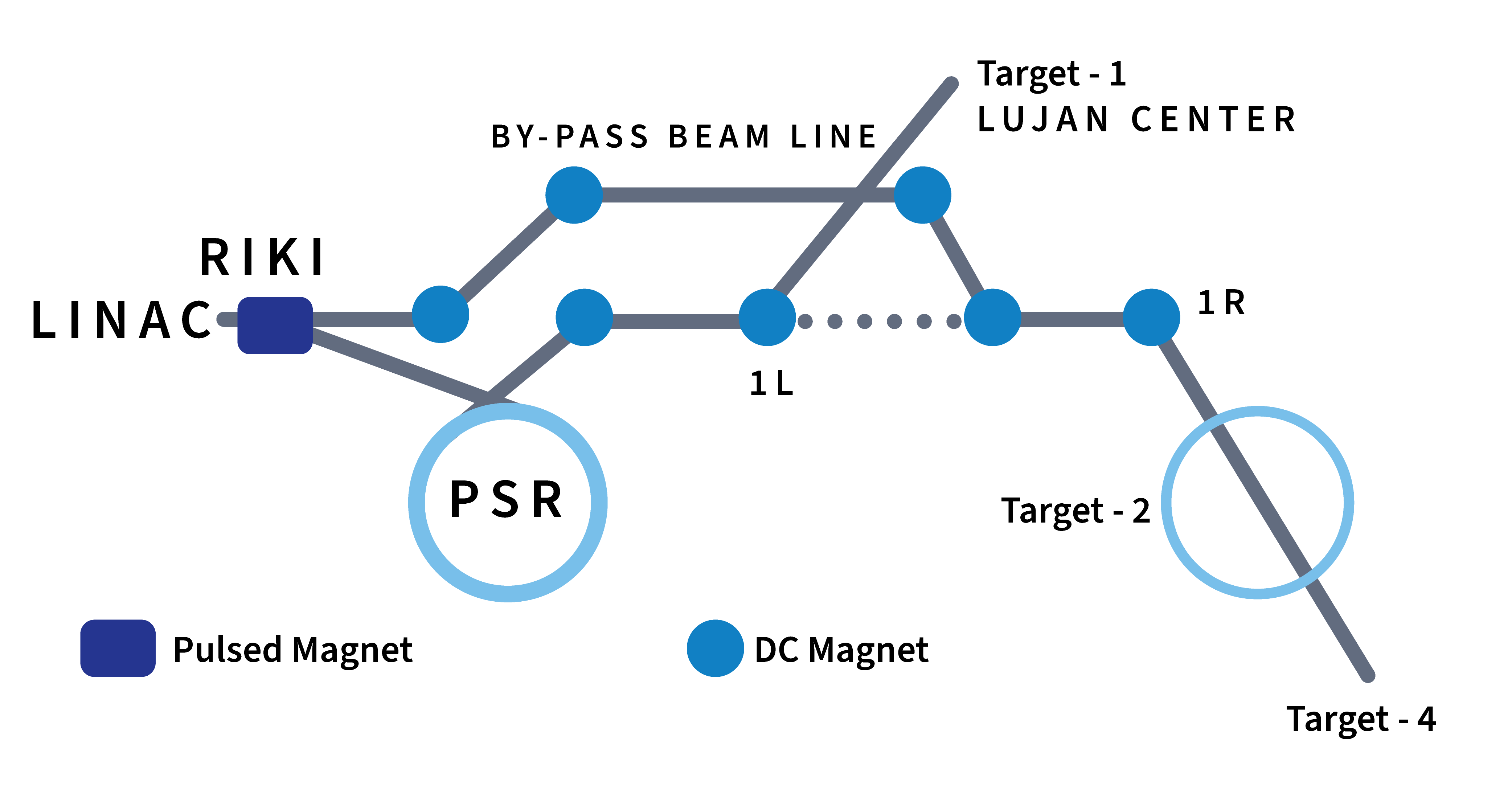
Sole use operation is when beam conditions are such that the Lujan Center (Target 1) cannot receive beam. For example, when PSR beam is transported to Target 2, the 1-L magnet is turned off and beam goes through the dashed line to Target 2. Since the 1-L magnet is not pulsed no beam can go to Target 1.

Another example of sole use operation is when proton beam energies other than 800 MeV are used for Target 2 experiments. In this case, the magnets upstream from the Ring Injection Kicker (RIKI) magnet in the beam line are set for non-800-MeV operation, and since they are the same magnets that are used for transporting beam to Target 1, Target 1 and the Lujan Center cannot be used.
Beam Transport
Simplified drawing of the beam transport beam lines.

Beam Transport

One of the greatest strengths of the LANSCE facility is that it can produce proton beams with a wide range of time structures.

In usual operation, beam is transported from the LINAC through the pulsed RIKI magnet. When RIKI is switched on, the beam is injected into the storage ring with the time structure. The beam is accumulated in the proton storage ring (PSR) and then transported to Target-1.

When RIKI is switched off, the beam is transported through the "bypass beam line" to Target 2 or Target 4. RIKI switches between macropulses. Typically, 20 macropulses per sec are sent to the Lujan Center and the remainder are delivered to Target 2 or Target 4. Presently, the LINAC is accelerating 60 macropulses per sec so 40 macropulses per sec go to Target 2/4.

Flight Path Contacts

Contact Us

LANSCE User Office

  • 505-667-6797
  • lansce-user-office@lanl.gov

Los Alamos National Laboratory

P.O. Box 1663

Los Alamos, NM 87545

(505) 667-5061

At The Lab

  • Business Opportunities
  • Jobs
  • Organizations
  • Research Library
  • User Facilities

Information

  • Emergency
  • Ombuds
  • Reading Room
  • Resources
  • Science Museum

For Employees

  • AskIT
  • LANLInside
  • MyMail
  • Training
DOE White Seal
  • Terms of Use/Privacy

Managed by Triad National Security, LLC for the U.S. Dept. of Energy’s NNSA

Copyright 2026 Triad National Security, LLC. All Rights Reserved.

Learn about the Department of Energy’s Vulnerability Disclosure Program