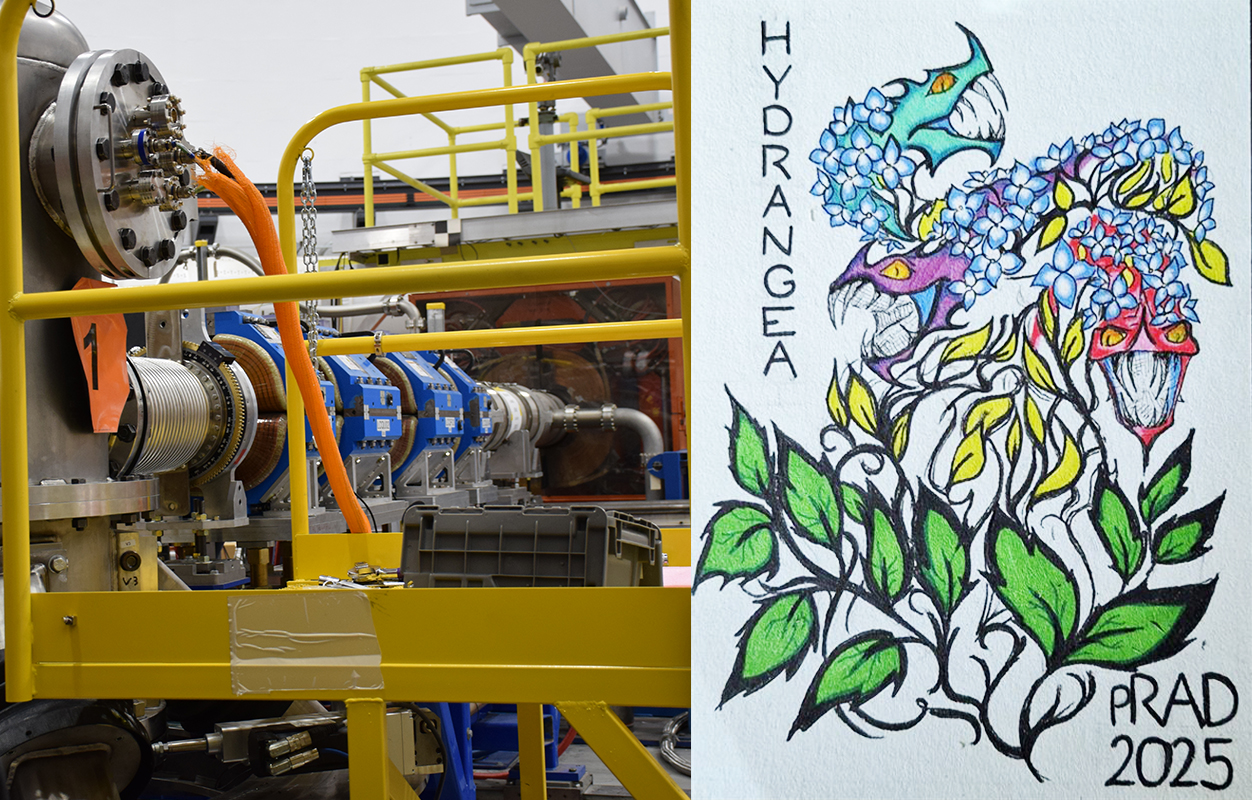
In September 2025, the Proton Radiography (pRad) facility, part of the Los Alamos Neutron Science Center (LANSCE) at Los Alamos National Laboratory, executed the first experiment in the Hydrangea series. This experiment marked the return of dynamic imaging—capturing a series of images over time to visualize movement—of plutonium for the first time at pRad since 2007. The experiment provided essential data to study the physical properties of plutonium relevant to stockpile stewardship.
During the experiment, a sample of plutonium housed in a specially designed containment vessel was placed in the path of LANSCE’s high-energy proton beam. Multiple images—compiled into a time-lapse movie—were taken of the plutonium’s response.
“Directly capturing in situ radiography data during the dynamic response of plutonium unlocks a new level of fidelity in validating the equation of state, strength, damage, and mix models—the fundamental constructs of our national certification science,” says scientist and principal investigator Saryu Fensin.
Scientist and principal investigator Anna Llobet has been working on Hydrangea since 2016 and says that executing the experiment is a dream come true. “This achievement stands as a testament to the collaboration and dedication of many stakeholders,” she says. “The experimental design, build, and operations that support such experiments are also highly complex, requiring the integration of cross-disciplinary expertise and extensive coordination.”
Llobet notes that as additional experimental series unfold, the ability to dynamically image plutonium at pRad “provides an agile and flexible capability to explore the dynamic behavior of plutonium under explosive drive and to validate the models we routinely use to address critical national security questions.” ★