On May 28, 2014, “Los Alamos National Laboratory” was one of the question categories on the television game show Jeopardy! Prompted by short videos filmed at the Laboratory, contestants answered questions about some of Los Alamos’ signature science facilities. How would you have performed if you’d been a contestant on the show? Turn to the next page to find answers to the questions below—and remember that your answer must be phrased as a question!
1. For $400: At the heart of the Neutron Science Center is a powerful linear accelerator that accelerates protons to 84 percent of this, the c in E = mc².
2. For $800: When Trident is active, its three beams produce in 500 quadrillionths of a second the equivalent of 200 times the electrical output capacity of the U.S.; it’s a type of this beam device first suggested by Einstein.
3. For $1,200: A Los Alamos operation center monitors instruments that help this craft that landed on Mars in 2012 analyze rocks and soil.
4. For $1,600: The National High Magnetic Field Lab owns a world record. Its magnet reached the goal of 100 of these magnetic units named for a European American scientist.
5. For $2,000: The lab’s 3D visualization theater uses 33 digital projectors to study complex physical systems—for example, the asteroid impact that created the Chicxulub Crater on this peninsula, leading to the extinction of the dinosaurs.
Answers:
1. Answer: What is the speed of light?
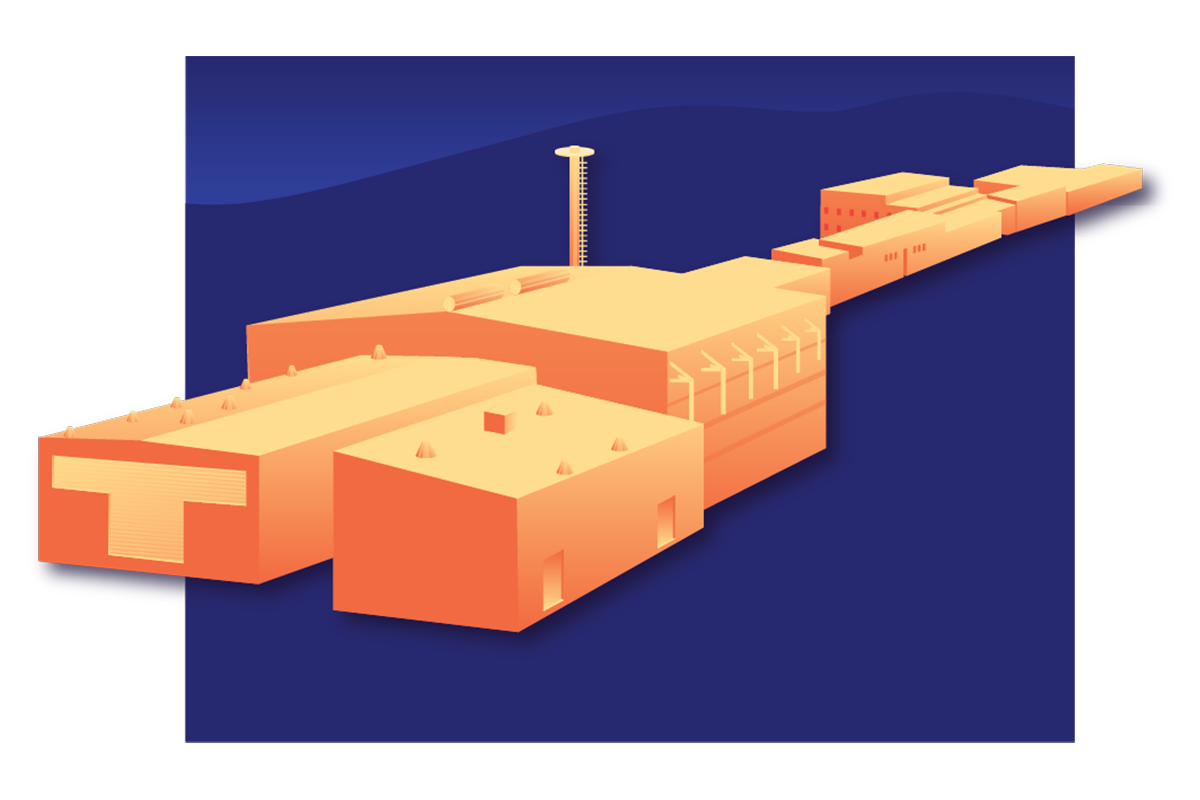
At the kilometer-long Los Alamos Neutron Science Center (LANSCE), protons are accelerated to 800 million electronvolts, where they’re used for everything from probing the structure of atoms to science that directly supports national security–related research and development. LANSCE celebrated its 50th birthday in 2022, and in the next few years, the LANSCE Accelerator Modernization Project is slated to replace the entire frontend of the accelerator, ensuring that the facility will support vital research for decades to come.
2. Answer: What is a laser?
At the Trident Laser Facility, researchers used Trident, which was built in the 1980s, to conduct important inertial confinement fusion research (which involves heating and compressing small capsules of nuclear fuel to initiate nuclear fusion). The final Trident experiments were conducted in 2017, and the laser has since been decommissioned.
3. Answer: What is Curiosity?

For some 13 years, Curiosity has roamed Mars’ surface, traveling more than 22 miles. Los Alamos developed Curiosity’s ChemCam instrument—a laser that “zaps” rocks and enables researchers to analyze their elemental composition. Among other findings, ChemCam has helped establish that Mars’ surface once featured shallow, salty ponds.
4. Answer: What are teslas?
The National High Magnetic Field Laboratory, or MagLab, is the largest and highest-powered magnet laboratory in the world. MagLab comprises three sites (at Los Alamos, Florida State University, and the University of Florida). These facilities help researchers understand how materials behave under extreme magnetic fields, probe the behavior of biomolecules, analyze the atomic structure of rocks and minerals, and more.
5. Answer: What is the Yucatán Peninsula?

Los Alamos is home to some of the most powerful supercomputers in the world—machines that are used to produce simulations of everything from protein folding to nuclear explosions. At the Laboratory’s Cave Automatic Virtual Environment, researchers and visitors don 3D glasses and experience some of these simulations as immersive experiences produced by high-definition projectors. ★