In a home office overlooking a well-watered garden in Los Alamos, planetary scientist Nina Lanza watches the surface of the moon ripple across her monitor. Neutron data glow in bands of blue and red. It’s a map that shows hydrogen signals puddled on the floor of the moon’s permanently shadowed craters—evidence of water in a place that not so long ago was thought impossibly parched. “The moon is going to be a major player in national security,” says Lanza. “We need to know what’s there.”
For Lanza and her colleagues, the search for water on other worlds is more than an academic question. It’s the end of a scientific thread that stretches from Cold War origins to the Artemis III mission that in the coming years aims to land astronauts on the moon’s southern polar region.
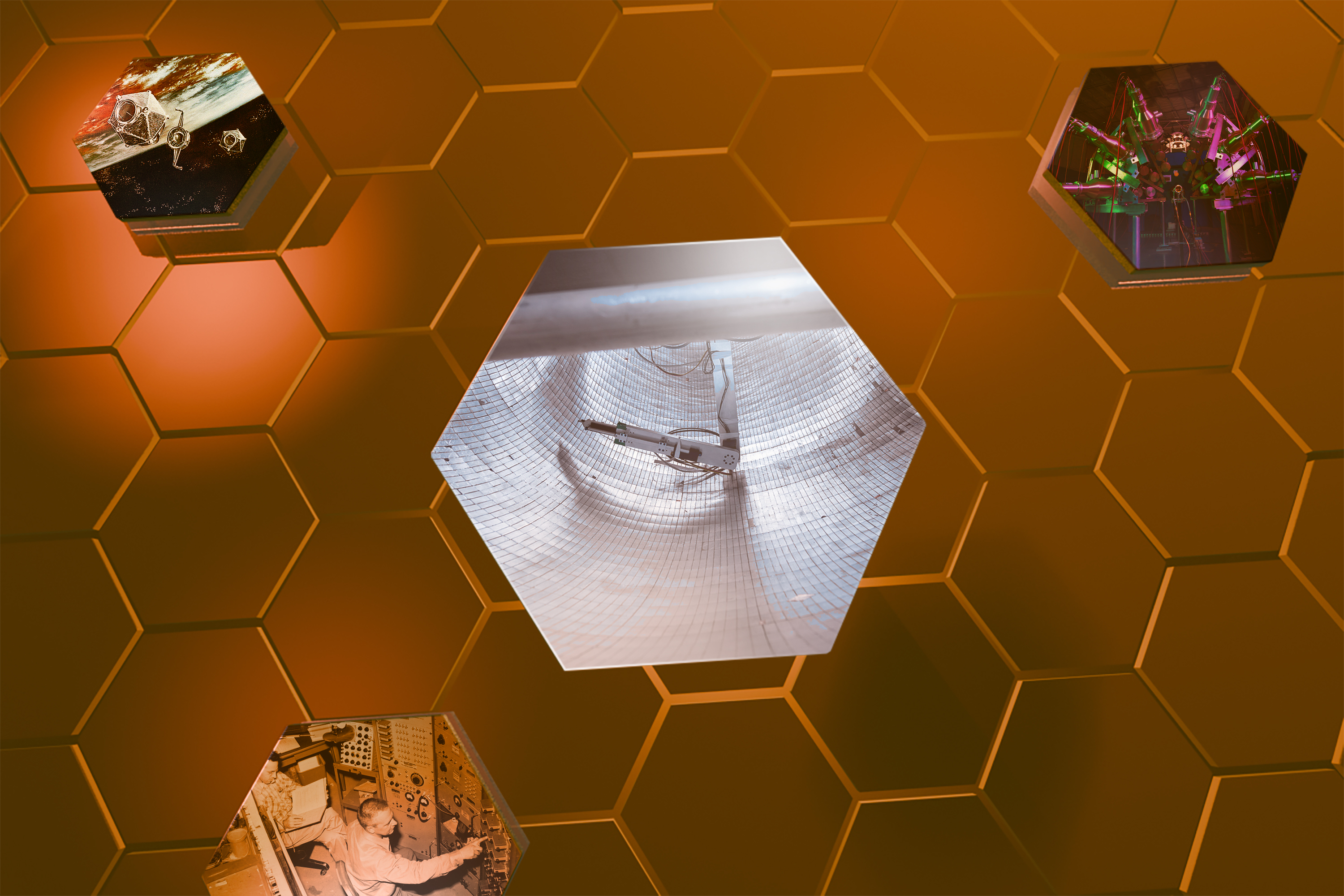
Los Alamos National Laboratory’s journey into space began in the 1950s when scientists turned their nuclear expertise skyward with Project Rover, an audacious attempt to use a nuclear reactor as a rocket engine. The project, a collaboration with the Atomic Energy Commission, demonstrated that fission could propel spacecraft, but it also cemented the Lab’s reputation for building machines that thrive in extreme environments. A few years later, as the Cold War intensified, Los Alamos engineers pivoted their space research away from propulsion to detection. One primary tool for detecting nuclear detonations was the radiation-sensor equipped Vela satellites. Launched in 1963, these Los Alamos–built instruments watched from orbit for the telltale flash of an atomic blast.
“Human curiosity leads to discovery. If you let scientists pull on the threads they’re most interested in, they find things you didn’t even know existed.”
When nuclear weapons detonate, they release an unmistakable flood of neutrons. To detect that signal, Los Alamos scientists equipped the Vela satellites with instruments tuned to the energy and flux of neutrons. Those sensors ended up revealing something beyond their mission: a steady background of neutrons—a signal scientists later understood to be produced when cosmic rays strike matter throughout space, including the surfaces of airless worlds.
In the 1990s, Los Alamos physicist Bill Feldman realized that this phenomenon could reveal water in space. While many elements can slow neutrons, hydrogen does it most efficiently. Its nucleus is nearly the same mass as a neutron, allowing the two to trade energy on impact. That distinctive interaction makes hydrogen stand out in neutron data. On airless bodies like the moon, where hydrogen is almost always bound to oxygen, detecting it becomes a reliable proxy for water. “So if you see hydrogen, it’s stuck to oxygen,” says Lanza. “That’s a pretty good sign you’re looking at water.”
In 1998, the National Aeronautics and Space Administration (NASA) launched the Lunar Prospector mission to map the moon’s composition and its magnetic and gravitational fields. Onboard, at Feldman’s bidding, was a Los Alamos–built neutron spectrometer. Within months of reaching lunar orbit, Feldman’s instrument had detected elevated hydrogen levels at both lunar poles—a clear indication that the moon’s permanently shadowed craters harbored water ice.
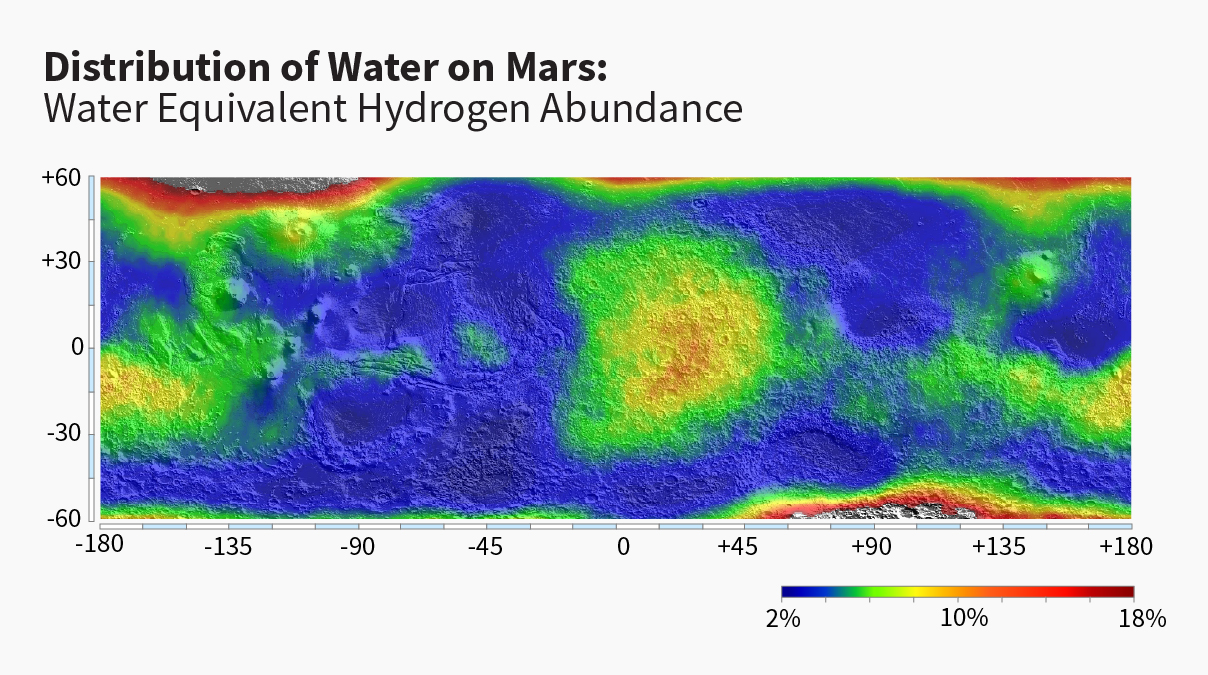
Three years later, Mars Odyssey carried an updated version of the instrument to the Red Planet, where it found vast stores of hydrogen in the top meter of soil. The discovery sent a shockwave through planetary science. “Bill built the field,” says Lanza. “He changed how we view every rocky planet.”
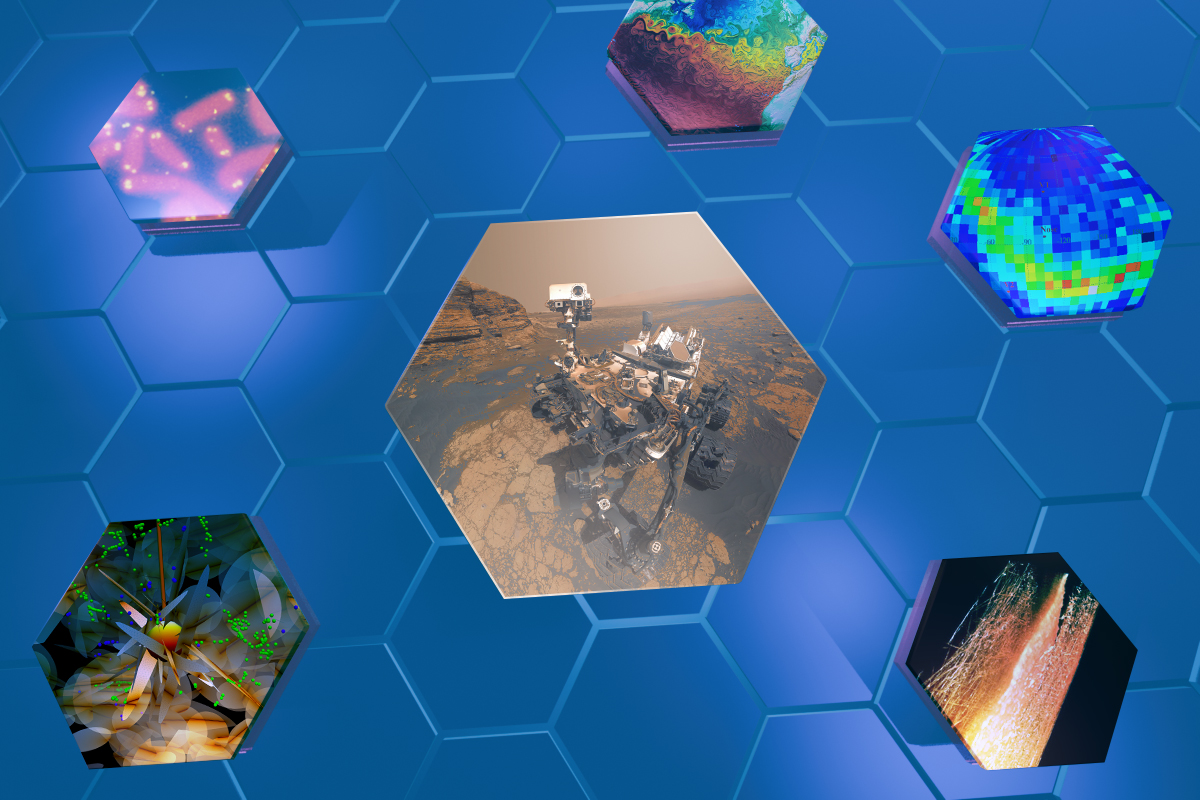
These findings also laid the foundation for Los Alamos’s ongoing planetary science work. By the time Lanza joined the team in 2006, Los Alamos was trying to put instruments on planets—not just around them. She joined the ChemCam team and helped put the first laser spectrometer ever sent to another world onto NASA’s Curiosity rover. Mounted on the rover’s mast, ChemCam fired thousands of laser shots at Martian rocks, vaporizing pinhead-sized patches and reading the spectrum of light from the resulting plasma. “The laser’s first shot on Mars showed hydration in the dust,” Lanza says. “It confirmed what we’d been seeing from orbit.” Water is on Mars.
ChemCam’s successor, SuperCam, now rides aboard NASA’s Perseverance rover, where it adds color imaging, Raman and infrared spectroscopy for identifying minerals and organic compounds, and even a microphone. The instrument captured the first sounds ever recorded on another planet—the crackle of its laser impacts and the whistle of the Martian wind. SuperCam’s data have already confirmed manganese oxides in Martian rocks, evidence that ancient Mars once had abundant water and perhaps even oxygen.
With work on Mars ongoing, the Lab’s and country’s scientific focus has turned closer to home: back to the moon. Potentially rich in critical minerals, home to radio-quiet zones prized for astronomy, and a possible outpost for missions to Mars, the moon has also become a new frontier of geopolitics. “It’s the highest possible ground we have and valuable to everybody because of it,” Lanza says. “Los Alamos has new scientific questions to answer there.”
“The moon is going to be a major player in national security. We need to know what’s there.”
One possible source of inquiry seems absurdly mundane: the moon’s dust. But on its low-gravity surface, the angular, abrasive dust can behave like an accidental weapon. Particles kicked up by a lander’s thrusters can travel kilometers at hundreds of meters per second, scouring any equipment it touches. “We’re thinking about questions that go beyond science,” Lanza says, referring to the accelerating international push to develop infrastructure on the moon. “If China builds something on the moon and we land nearby, what happens to the dust our landers kick up? These are national-security questions now.”
Even as exploration grows more complex, the Lab’s purpose has remained remarkably constant: to reveal what we can’t see, to measure what we can’t touch. “Human curiosity leads to discovery,” Lanza says. “If you let scientists pull on the threads they’re most interested in, they find things you didn’t even know existed. That curiosity and careful investigation can change science, technology, and exploration in ways nobody ever imagined.” Those changes often benefit national security.
People Also Ask:
- Is there really water on the moon and Mars? Yes—both worlds hold water, though not in liquid form. On the moon, NASA’s Lunar Prospector mission first detected hydrogen near the poles in 1998, evidence of water ice buried in permanently shadowed craters. Just a few years later, the Mars Odyssey mission found vast deposits of frozen hydrogen beneath Mars’s surface, showing that the Red Planet still stores water in its soil. Both discoveries were made with Los Alamos–built neutron spectrometers that traced hydrogen—the atomic fingerprint of water—across the solar system.
- Why are countries racing back to the moon? The moon is suddenly valuable again. It’s potentially rich in critical minerals; its radio-quiet far side offers prime ground for astronomy; and its southern pole may become a staging point for missions to Mars. But as multiple nations prepare to land there, competition is growing over where and how to build. At Los Alamos, scientists like Nina Lanza are studying how lunar dust, propelled by lander exhaust, could damage nearby equipment—research that’s shaping how America approaches exploration and security on the moon’s new frontier.