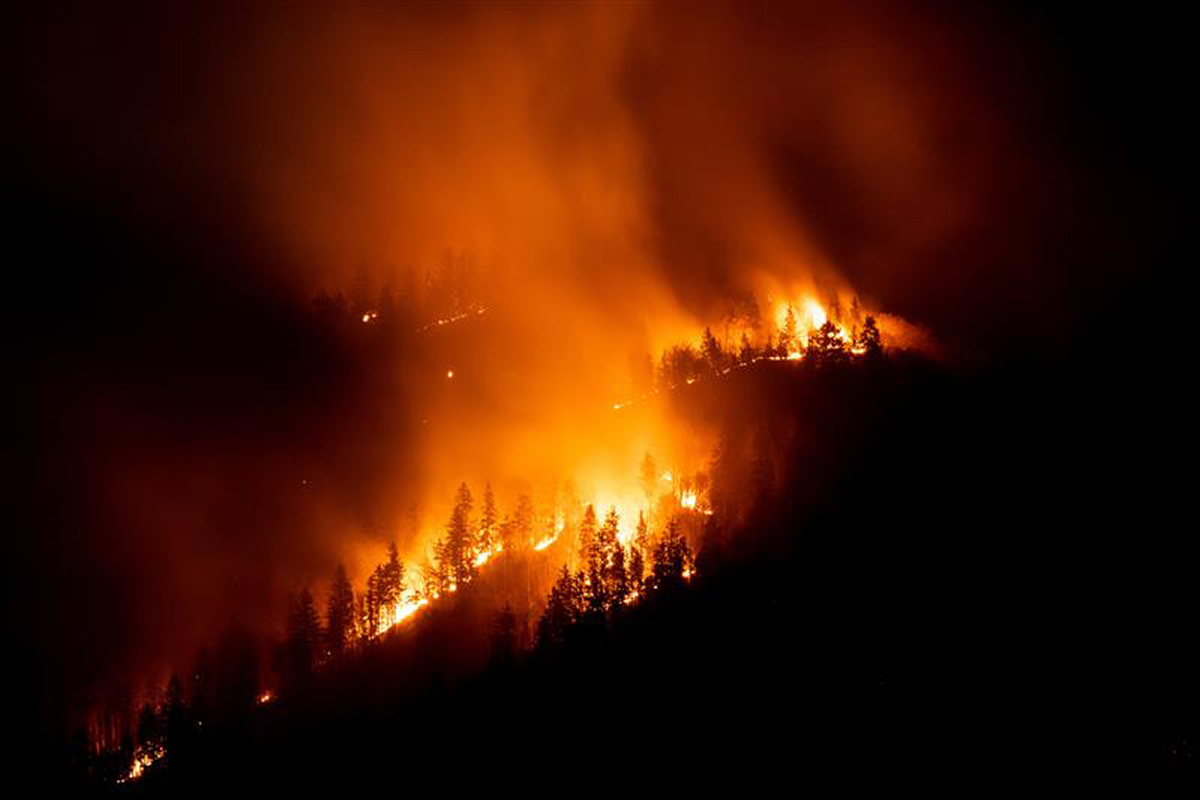
A wildland fire modeling capability from Los Alamos National Laboratory spans rapid-response simulation tools and physics-based models. Building on the Lab’s expertise in computational fluid dynamics, atmospheric modeling, combustion and high-performance computing, this capability enables realistic simulation of wildfire behavior across a wide range of scales and use cases.
How it works: Fast-running tools enable simulation of fire spread and fire-induced winds, while computationally intensive models provide detailed physics-based representations of combustion, turbulence and atmospheric response. Read about the five platforms.
Why this matters: Users can evaluate wildfire behavior, smoke impacts and fuel-driven fire dynamics in complex, real-world environments where simplified fire spread models may be insufficient. These realistic representations can benefit teams that need to plan prescribed burns, predict wildfire risks, make decisions about a full-blown fire or conduct research.
Applications:
- Wildfire behavior prediction and risk assessment
- Prescribed burn planning and evaluation
- Smoke transport and air quality impact analysis
- Ember (firebrand) transport and spotting studies
- Fire–atmosphere interaction research
- Landscape-scale fire behavior analysis in complex terrain
About licensing opportunities: Through the Richard P. Feynman Center for Innovation, the Laboratory licenses its inventions, technologies, software and research tools to companies that can turn them into products and services that benefit society.
LA-UR-26-24242