An improved model from Los Alamos scientists predicts how metals can develop microscopic holes quickly and eventually fail when hit with fast, intense forces — such as impact, explosions or shockwaves. The work, published in the International Journal of Solids and Structures, has potential for real-world military applications.
Why this matters: Predicting damage in metals accurately is crucial for the safety and design of weapons and other defense systems.
How it works: The Los Alamos team reformulated the original TEnsile PLAsticity (Tepla) damage model, which identifies the point where tiny holes first form and how they grow and connect, leading to increasing damage until the stretched metal breaks completely. The Lab’s standard tool for simulating the failure of metals under dynamic loading suffered undesirable mesh sensitivity and lacked the capability to simultaneously predict macroscopic and microscopic measurements.
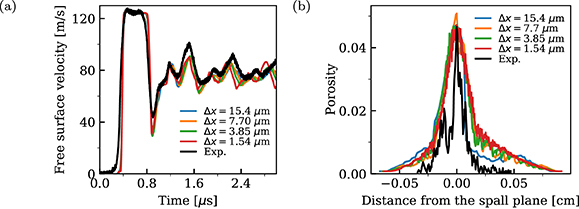
What they did:
- The team separated two kinds of viscosity in the original Tepla model: one that affects the material’s overall (big‑scale) flow behavior and another that controls how tiny voids grow inside the material. Treating these separately makes the model more accurate and improves its ability to predict what really happens.
- Los Alamos scientists tested and confirmed the revised model using data from impact and explosion experiments.
Funding: The U.S. Department of Energy National Nuclear Security Administration’s Advanced Simulation and Computing program
LA-UR-26-25205