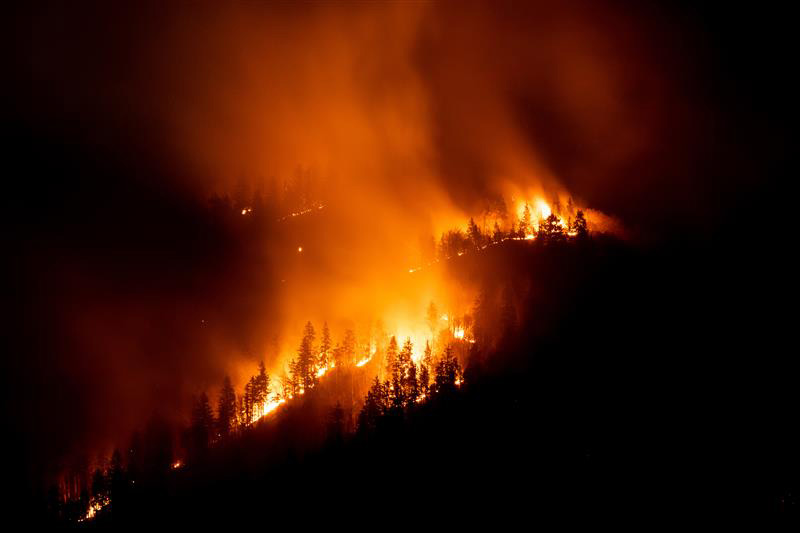
Wildland fire behavior is governed by tightly coupled interactions among fuels, terrain, atmospheric flow, and combustion processes. Many operational fire models rely on empirical or simplified approaches that can limit their ability to represent fire–atmosphere feedbacks, fuel heterogeneity, and complex wind behavior in realistic landscapes.
Los Alamos National Laboratory has developed an integrated wildland fire modeling capability that spans rapid-response simulation tools and high-fidelity physics-based models. Building on LANL’s long-standing expertise in computational fluid dynamics, atmospheric modeling, combustion, and high-performance computing, this capability enables realistic simulation of wildfire behavior across a wide range of scales and use cases.
Value Proposition
This capability enables predictive, physics-informed modeling of wildland fire behavior across complex terrain, vegetation, and atmospheric conditions. By combining fast-running operational models with high-fidelity, fully coupled fire–atmosphere simulations, the capability supports wildfire risk assessment, prescribed burn planning, smoke and ember transport analysis, and advanced fire behavior research.
Key benefits include realistic representation of fire spread, fire-induced winds, fuel heterogeneity, smoke dispersion, and fire–atmosphere feedbacks across spatial and temporal scales relevant to both operational decision-making and research applications.
Advantages
- Captures two-way coupling between fire behavior and atmospheric winds
- Represents complex terrain, vegetation structure, and fuel heterogeneity
- Supports both fast-running operational models and high-fidelity research simulations
- Models fire spread, smoke transport, and ember (firebrand) generation
- Applies across landscape scales relevant to wildfire planning and analysis
- Extends beyond empirical fire models to physics-based fire–atmosphere interaction
Technology Description
The Wildland Fire Science Capability integrates multiple modeling approaches to represent fire behavior and its interaction with the surrounding environment. Fast-running tools enable efficient simulation of fire spread and fire-induced winds, while computationally intensive models provide detailed physics-based representations of combustion, turbulence, and atmospheric response.
Together, these tools allow users to evaluate wildfire behavior, smoke impacts, and fuel-driven fire dynamics in complex, real-world environments where simplified fire spread models may be insufficient.
Market Applications
- Wildfire behavior prediction and risk assessment
- Prescribed burn planning and evaluation
- Smoke transport and air quality impact analysis
- Ember (firebrand) transport and spotting studies
- Fire–atmosphere interaction research
- Landscape-scale fire behavior analysis in complex terrain
Software Available for License Agreements
QUIC-Fire, Version 1.x (C16094)
QUIC-Fire is a fast-running wildfire modeling framework that captures two-way coupling between fire behavior and local wind fields. It integrates the QUIC-URB 3D diagnostic wind solver with reduced-order fire spread and heat-release models to simulate fire propagation as a function of fuel properties, moisture content, wind conditions, and turbulence.
By accounting for fire-induced wind feedbacks, QUIC-Fire provides a computationally efficient yet physically grounded tool for modeling fire behavior in complex terrain and vegetated environments.
QUIC-SMOKE (C22095)
QUIC-SMOKE is a Lagrangian atmospheric transport and dispersion model designed to simulate the downwind transport of combustion products from wildland fires. Intended to act as a companion to QUIC-Fire, it supports analysis of smoke plume behavior and exposure impacts.
FIRETEC, Version 2.x (C11069)
FIRETEC is a physics-based, three-dimensional wildfire simulation code designed to model the coupled interactions among fire, fuels, atmosphere, and topography at landscape scales. It combines combustion physics, heat transfer, aerodynamic drag, and turbulence modeling with computational fluid dynamics to represent fire–atmosphere feedbacks in detail.
FIRETEC leverages HIGRAD to simulate coupled fire and atmospheric dynamics and is used primarily for high-fidelity fire behavior research.
HIGRAD/FIRETEC 2009 (C09041)
HIGRAD/FIRETEC is the first fully physics-based 3D wildfire simulation framework developed to capture the dynamic feedbacks between fire and its environment. In addition to fire spread and atmospheric coupling, it includes a Lagrangian transport capability for modeling lofted burning material (firebrands) that can initiate secondary fires.
DUET – Distribution of Understory Cover using Elliptical Transport (C22039)
DUET is a mechanistic fuel modeling tool that represents surface fuel heterogeneity resulting from tree litter dispersal, grass growth, and moisture dynamics. It uses voxelated canopy data and environmental inputs to generate spatially realistic fuel distributions, supporting improved modeling of low-intensity fire behavior and ecosystem dynamics.
DUET has been tested in conjunction with tree datasets developed for use with HIGRAD/FIRETEC at Los Alamos National Laboratory.
IP Information
The following U.S. patent supports the Wildland Fire Science Capability:
- Patent pending – Apparatus and Methods for Determining Ground Biomass Distributions Using Elliptical Transport (S-167641.001)