Long-duration gamma-ray bursts are some of the most energetic events in the universe, releasing more energy in just a few seconds than the sun emits in 10 billion years. Los Alamos National Laboratory scientists, having discovered gamma-ray bursts more than 50 years ago, continue to add to the understanding of these mysterious events.
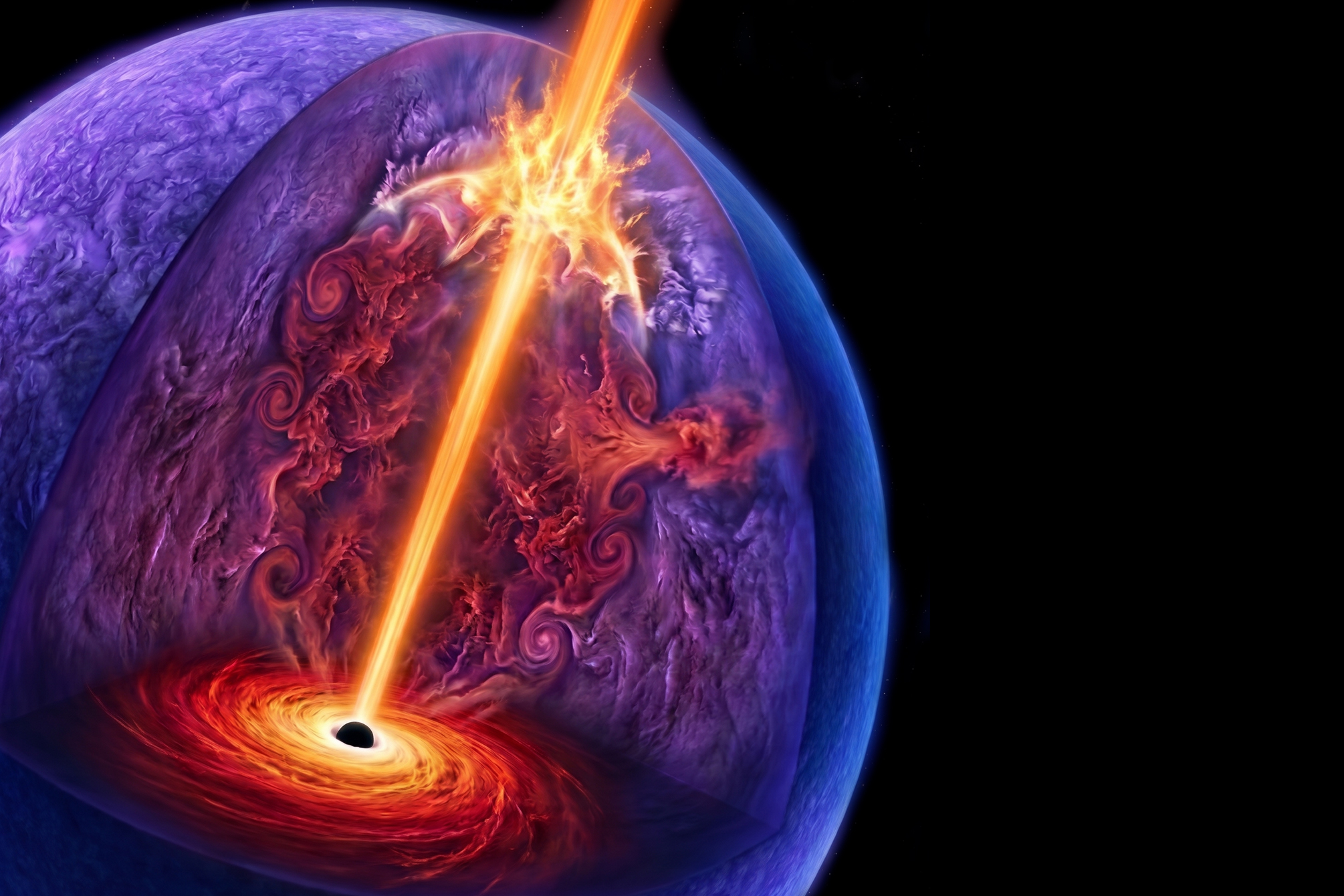
Writing in The Astrophysical Journal Letters, a research team interpreted two recent long-duration gamma-ray bursts, thought to be from the merger of two neutron stars, as consistent with nucleosynthesis originating from a collapsar — a massive, fast spinning star that is collapsing in on itself to form a black hole, releasing prodigious bursts of gamma ray energy in the process.
“Gamma-ray bursts are products of some of the most intense, exotic situations in the universe, with really high densities and temperatures, relativistic effects and different time scales coming together,” said Marko Ristić, Los Alamos postdoctoral fellow. “With our modeling and simulation of a new perspective on these two peculiar long-duration gamma-ray bursts, we’re gaining a new view on these complicated and fascinating extreme events.”
The team’s findings point back to the original, collapsar-indicative interpretation of the events, despite recent suggestions — prompted by unusual signatures in the data — that a neutron-star merger might be the cause of the gamma-ray bursts. The results prompt a reevaluation of the assumptions that go into modeling these exotic astrophysical events.
Gamma-ray bursts and the role of heavy elements
The research team undertook analysis and modeling of the long-duration gamma-ray bursts GRB 211211A, detected by NASA’s Fermi Gamma-ray Burst Monitor in 2021, and GRB 230307A, an extremely bright burst detected by the same monitor in 2023. The bursts have been interpreted as originating from the merger of two neutron stars. Using NASA datasets from the detection of the gamma-ray bursts, the team modeled the events to better understand the creation of kilonovae — light associated with the formation of heavy elements — and the resulting nucleosynthetic yields (what elements are or are not created during these events).
One interpretation of gamma-ray burst detections is that they cleave in two ways: Short-duration bursts, under two seconds, are thought to result from neutron star mergers, and long-duration bursts, over two seconds, seem to originate from collapsars. The particular heavy element signature and the emission of “red” infrared light in 230307A suggested, unusually, a neutron-star merger as the originating event.
Heavy elements — elements heavier than iron (gold, lead, uranium, etc.) — are created in the intense cauldrons of cosmic events via rapid neutron capture. Last year, the team predicted a new mechanism for element creation associated with collapsars, establishing a new framework useful for understanding the two gamma-ray bursts events. They found that an element composition without the very heavy elements, such as gold and lead, are a near identical match to observations — just what was predicted from their collapsar mechanism.
“What we’ve learned is that, contrary to contemporary interpretations, the type of kilonova represented with these long-duration gamma-ray bursts does not inherently imply the synthesis of gold, despite the signal showing a red component typically associated with lanthanide production,” said Los Alamos theoretical physicist Matthew Mumpower. “A simple explanation arises from this work, requiring only a single component model, which suggests kilonovae are even more varied and difficult to interpret than we thought in the past.”
The team ran their simulations on the Laboratory’s Chicoma supercomputer. Future multi-messenger observations that include gravitational wave detections will allow astrophysicists to better assess the cosmic origins of kilonovae and their associated gamma-ray bursts.
Paper: “Kilonovae and Long-duration Gamma-Ray Bursts.” The Astrophysical Journal Letters. DOI: 10.3847/2041-8213/ae5e53
Funding: The work was supported by the Laboratory Directed Research and Development program at Los Alamos.
LA-UR-26-24890