Scientists at Los Alamos National Laboratory have demonstrated a new quantum-dot mechanism that could significantly expand the reach of light-driven chemistry. By introducing magnetic manganese dopants into semiconductor quantum dots, the team created an ultrafast spin-exchange pathway that captures hot-electron energy before it is lost as heat and uses it to drive chemical reduction.
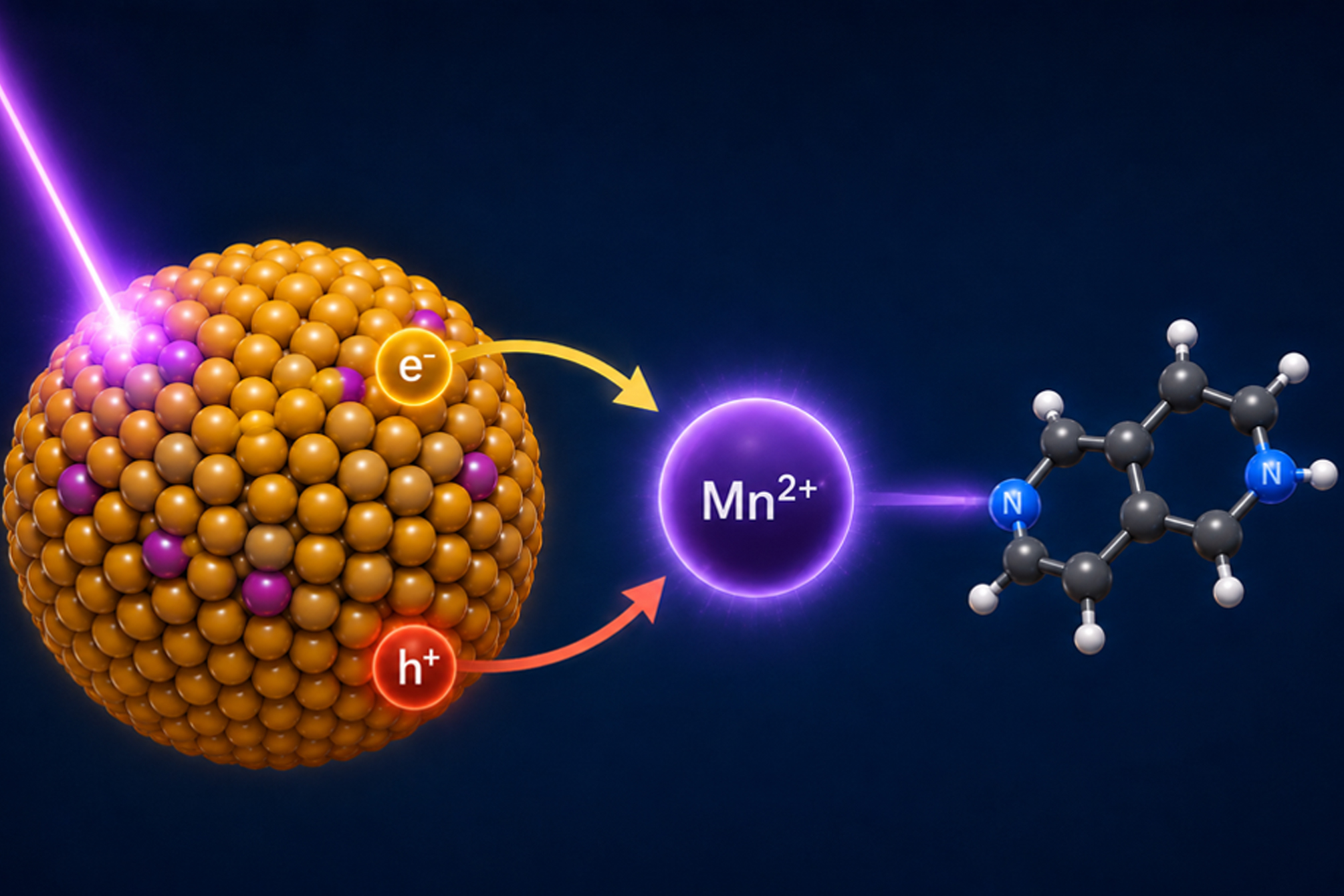
The work, published in Nature Communications, provides a direct demonstration that magnetic dopants can enable efficient hot-electron reduction in quantum dots. Using methyl viologen as a model molecular acceptor, the researchers showed that manganese-doped quantum dots can transfer electrons significantly faster than undoped particles and can drive reduction even when conventional band-edge energetics are unfavorable.
“Our study shows that magnetic dopants can do much more than modify the optical properties of quantum dots,” says Victor Klimov, Laboratory Fellow at Los Alamos and principal investigator on the project. “They can capture hot-exciton energy on ultrafast time scales and redirect it into useful chemistry, which opens a fundamentally new route to high-energy photoreduction.”
Overcoming rapid thermalization losses
Quantum dots are nanoscale semiconductor crystals that absorb light and generate electrons. In principle, energetic hot electrons could enable unusually strong reduction chemistry, but in practice they usually lose their excess energy within a few picoseconds — a few trillionths of a second — through phonon-assisted cooling. The new work overcomes that long-standing obstacle to practical hot-electron photochemistry by exploiting spin exchange among photoexcited quantum dots, magnetic manganese ions acting as mediators, and molecular acceptors.
In the Los Alamos experiments, femtosecond transient absorption spectroscopy revealed a two-step process. (A femtosecond is a quadrillionth of a second.) First, a hot exciton transfers its energy to a manganese ion through ultrafast spin exchange. Then the excited manganese ion undergoes spin-flip relaxation, which drives charge separation and reduction of the attached molecular acceptor. The result is a hot-exciton reaction channel that is absent in undoped quantum dots.
“What is especially important is that we can directly watch this process unfold on the femtosecond time scale,” says Valerio Pinchetti, a postdoctoral researcher at Los Alamos and the lead spectroscopist on the project. “The measurements show that manganese doping not only speeds up interfacial electron transfer but also activates a hot-exciton pathway that makes reduction possible in cases where conventional transfer would be too slow or energetically blocked.”
The discovery has broad implications for photocatalysis and other light-driven technologies that require highly reducing electrons. By showing that magnetic dopants can be used to generate, preserve and exploit hot carriers, the work points to a new class of spin-engineered nanomaterials for demanding photochemical transformations.
Paper: “Ultrafast photoreduction driven by interfacial spin exchange in manganese-doped quantum dots.” Nature Communications. DOI: 10.1038/s41467-026-74659-9
Funding: This work was supported by the U.S. Department of Energy Office of Science, Office of Basic Energy Sciences, the Photochemistry and Radiation Chemistry Program, and by the Laboratory Directed Research and Development program at Los Alamos National Laboratory.
LA-UR-26-25457