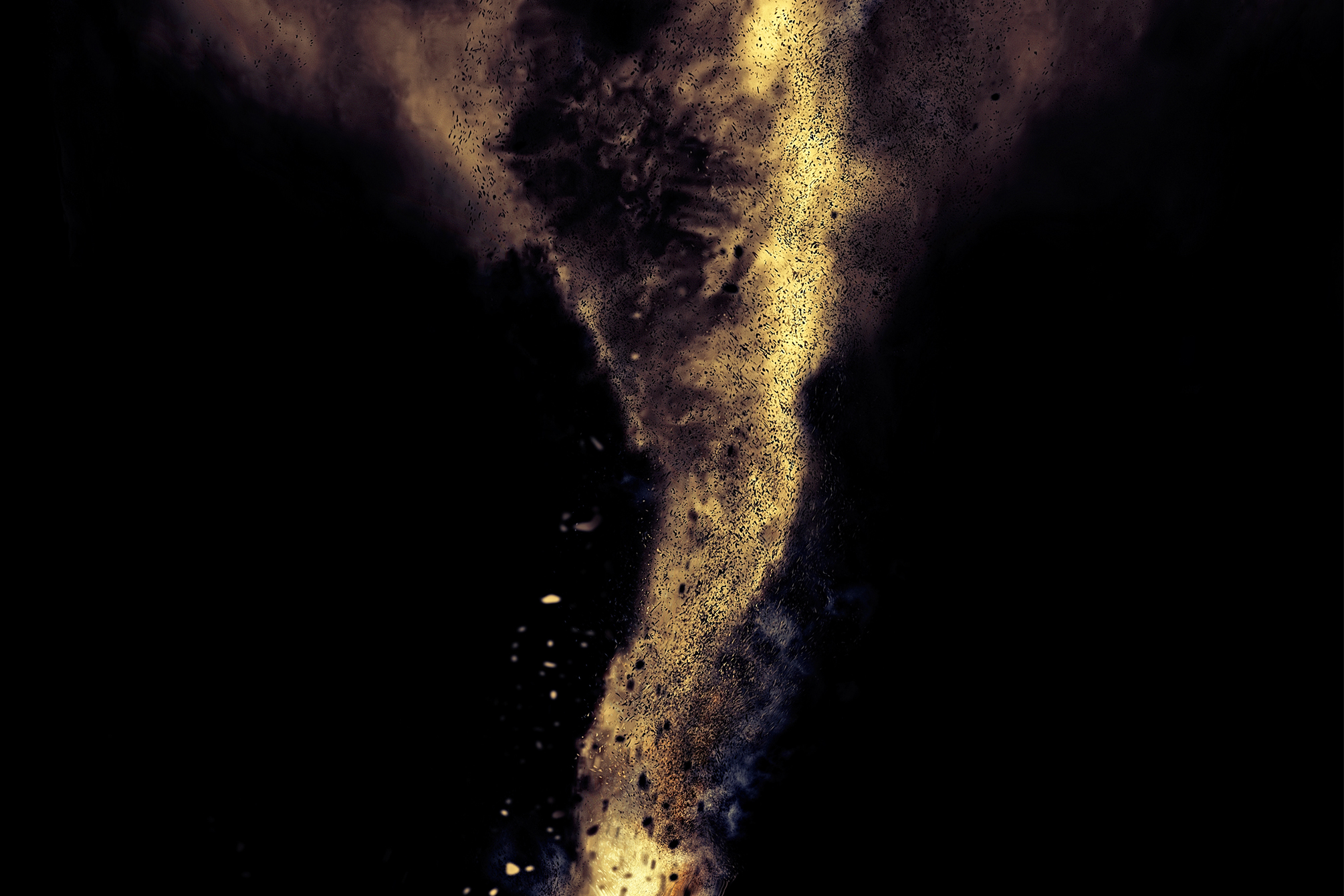
Whether the dust borne on the violent winds of a tornado or the sugar grains in a swirled cup of coffee, the behavior of particles carried along in turbulence is subject to some similarities — all of them difficult to predict at scale. As described in a recent publication in the Proceedings of the National Academies of Science, a research team led by Los Alamos National Laboratory scientists has developed a first-of-its-kind machine learning framework that models chaotic particle motions in a turbulent flow.
“Modeling turbulence is a big, open problem, and it’s probably the hardest problem in classical physics,” said Daniel Livescu, Los Alamos scientist and one of the leaders of the work. “A subset of that challenge is modeling particle motions within turbulence. To meet that challenge, our artificial intelligence approach offers an innovative theoretical construct tested with a real-world application.”
The team has developed and applied the first data-driven, auto-regressive machine learning framework to capture the dynamics of turbulence at scale. The research demonstrates that machine learning can overcome longstanding barriers in modeling chaotic particle motions.
Models for practical calculations in physical systems
Turbulent flows occur in many complex physical systems — weather, astrophysics, inertial confinement fusion and other problems. Turbulence is a multiscale phenomenon, characterized by swirling motions that cover a large range of scales, from large vortexes to smaller and smaller vortexes. At the smaller scales, the chaos — the inability to predict behavior such as trajectory and velocity among particles — becomes even more of a challenge.
Surrogate models reproduce characteristics such as particle trajectories to demonstrate them without incurring the high computational cost of simulations with similar expansive scales. The model developed by the team learns a surrogate dynamical system of turbulent Langrangian trajectories — accounting for all the dynamics of the system — that can make pinpoint short-term predictions and accurate statistical longer-span predictions.
The team used neural networks layered on top of their machine learning framework. Critically, the model employs the Mori-Zwangzig formalism, which mathematically breaks up the dynamical system into sets of resolved dynamics based on current state observations and on past history — on memory. The team trained the model on the short time predictions, resulting in an accurate realization of the longtime statistical behavior of Langrangian turbulence.
“We really hope that this research with memory effects is going to open a new field of study and help in other problems,” said Xander de Wit, Los Alamos researcher and lead author on the paper. “Future problems might be applied to things like crowd movements, where many of the same Lagrangian aspects are also at work. Providing models of those types of situations will be a logical and useful extension of this work.”
The research group included members of the Physics Aware AI/ML at the Laboratory, as well as an external collaborator from Europe. De Wit joins the Laboratory full time next fall as a Richard Feynman Distinguished Postdoctoral Fellow.
Paper: “Data-driven Mori–Zwanzig modeling of Lagrangian particle dynamics in turbulent flows.” Proceedings of the National Academies of Science. DOI: 10.1073/pnas.2525390123
Funding: The work was supported by the Laboratory Directed Research and Development program at Los Alamos National Laboratory.
LA-UR-26-24175
Contact
Media Relations | media_relations@lanl.gov