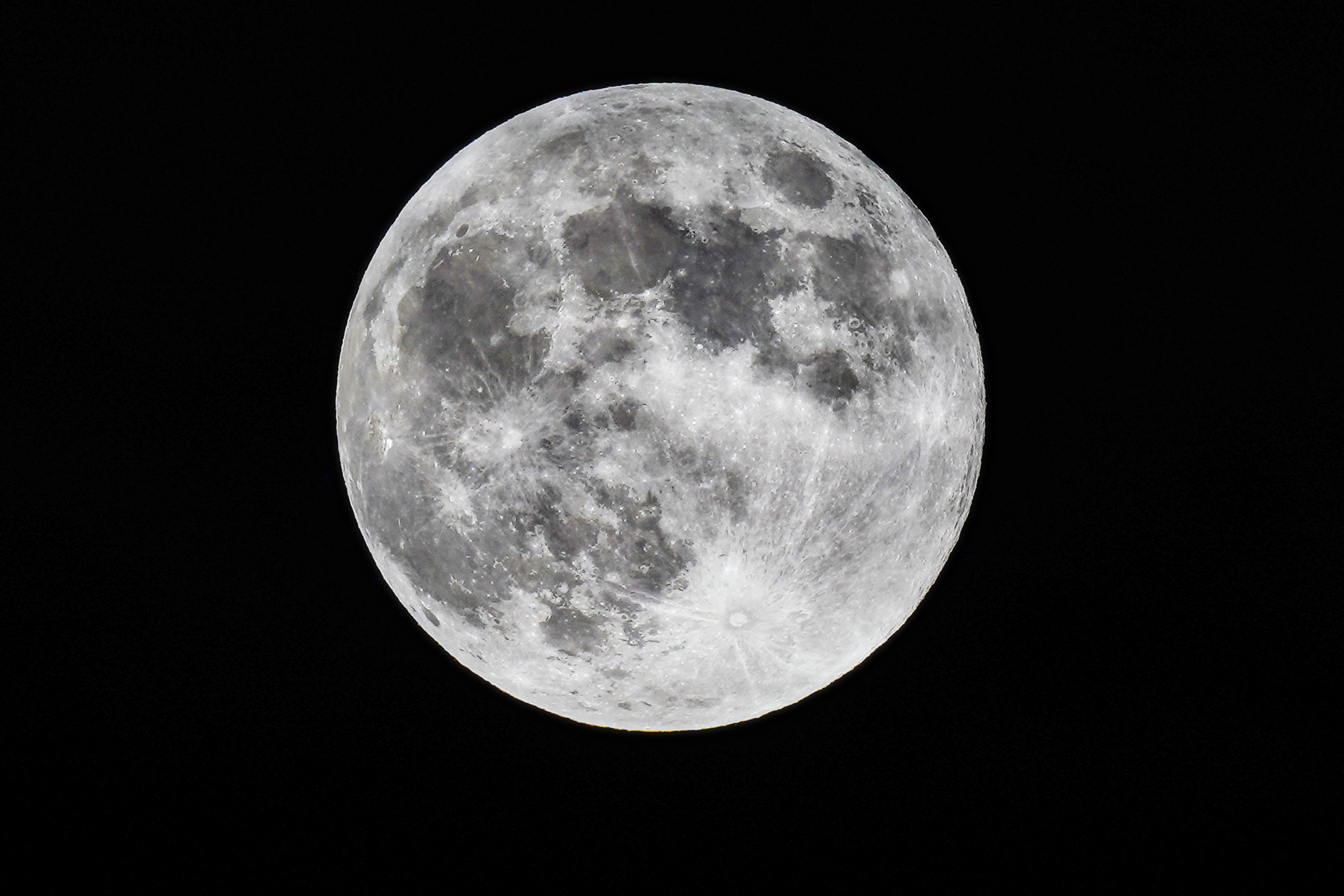
Typically, Los Alamos National Laboratory Postdoctoral Fellow Ben Fernando’s work deals with space debris re-entering Earth’s atmosphere, but in the early morning hours of Wednesday, August 5, his attention was instead directed toward the Moon. That’s because at around 2:35 a.m. ET the upper stage of a SpaceX Falcon 9 rocket impacted the Moon.
“This event provided an opportunity to attempt to record an artificial impact in real-time,” Fernando says. “It could give us valuable information on localized seismic impacts, dust and plume dynamics and hazards associated with artificial space debris impacts.”
Observations made by Carl Schmidt from Boston University, using the Very Large Telescope, have confirmed the impact occurred, and a plume was detected via its chemical fingerprint. Fernando and Carly Donahue, a research scientist working in Los Alamos’ National Security Earth Science group, used the VLT’s ERIS instrument to record the impact visually and are now working to analyze that data.
Re-entries and wayward debris
Fernando, also a researcher in the National Security Earth Science group, is part of a team that monitored the nearly 40-foot-long object as it hurtled into the lunar surface. Falcon 9 rockets use a two-stage design, and typically, the upper stage is discarded such that it eventually returns to Earth, often burning up in the atmosphere upon re-entry. A significant portion of Fernando’s current work involves studying the re-entry of debris like these upper stages.
“We have this issue where more and more objects of human origin are entering Earth's atmosphere and we struggle to track and characterize those objects once they're burning up within the Earth's atmosphere,” Fernando says. “My work involves using seismic and acoustic techniques to characterize and understand more about how often these objects enter the atmosphere and what impacts they're having on the atmosphere and occasionally the ground.”
This particular Falcon 9 upper stage, however, was discarded in a location where it was unable to re-enter the atmosphere. The upper stage is believed to be part of a rocket launch from January 2025, when a Falcon 9 delivered two lunar landers to the surface of the moon. While the main stage itself returned to Earth, the upper stage ended up on a collision course with the Moon.
A chance for valuable data
Because of the Moon’s non-existent atmosphere, the object didn’t burn up on re-entry like it would if it re-entered Earth’s atmosphere. This meant there was a significant impact leaving behind a crater and kicking up debris and dust around the impact site. The upper stage isn’t the first man-made object to impact the Moon, and in the past objects have even been intentionally launched at the Moon.
“Meteoroid impacts are fairly commonplace on the Moon, but artificial impacts are much rarer, having occurred only a handful of times,” Fernando says. “Nonetheless, they are particularly valuable for impact dynamics studies as they involve sources with pre-determined mass, volume and speed and are generally known ahead of time. This means we can eliminate some uncertainties and develop an optimized plan for data collection, which generally isn’t the case with natural impacts.”
Artificial impacts can provide a wide range of data with past experiments capturing information on soil and rock composition and seismic data, which in turn can reveal information about the Moon’s interior, based on how long the wave takes to propagate through the Moon. Fernando’s team largely focused on the resulting impact flash and will further study plume information while also evaluating existing lunar monitoring capabilities.
Fernando says the last point is particularly important as further lunar exploration and study become increasingly likely. He notes that the lower Earth orbit is flooded with satellites, and there are already issues associated with that, such as difficulty tracking re-entries and environmental impacts of toxic materials burning up upon re-entry. To avoid similar complications with the space around the Moon, organizations need to develop a robust monitoring and tracking system.
“Given the renewed interest in the lunar exploration, the space around the Moon will inevitably become more crowded and as a result, artificial impacts on the Moon are going to become more frequent,” Fernando says. “To avoid a situation where the growth of space debris outpaces our ability to track it, we need to continue advancing monitoring of cislunar space from ground- and space-based facilities will be key.”
To learn more about Fernando’s work and the plan the team developed for the Falcon 9 impact, you can read the paper that he co-authored for the journal arXiv.
LA-UR-26-26981