In the field of human biology, there are many still-unanswered questions about the role of RNA, the less well-understood companion to DNA also found in all living cells, as scientists begin to unravel the complicated and important responsibilities of nucleic acid. In research described in Communications Biology, a Nature publication, an international research team applied innovative techniques to understand the structure and function of a particular ribozyme RNA.
“One challenging aspect of learning about RNA structure and function is that there is not much data. We were surprised that RNA is structurally much more variable and often floppier than proteins built by DNA,” said Los Alamos scientist Karissa Sanbonmatsu. “That means we have to be able to predict many different structures to be able to map RNA to functions. Because RNA plays a role in cellular response to stress, heat, infection and other conditions, structural information is fundamentally important to unlocking RNA’s therapeutic potential.”
The research team specifically tackled the SINE B2 retrotransposon, or jumping gene, a genetic element that can move around in the DNA sequence, often by making an RNA copy of itself. That function is part of the regulation of gene expression: what a gene in DNA directs or enables a cell to do and when. The research provides an essential foundation for future studies on RNA structural dynamics and their impact on biological functions.
A unique self-cleaving RNA system
Where it appears on the DNA-based genome, the SINE B2 retrotransposon is a repeated sequence that gets converted into RNA. From there, the RNA can regulate processes in a cell. The research team sought to understand the structure of the RNA in those situations and how that structure impacted process regulation.
The SINE B2 retrotransposon offers a useful system to study because it is one of the few RNA systems known to work as a molecular switch. Environmental conditions in the body can impact the shape it takes, and in some conditions the gene actually cuts or cleaves itself. That self-cleaving RNA (a “ribozyme”) has been known in bacteria and other organisms for a long time, but this is one of the only instances of that activity known to occur in mammals.
The research team studied that cleavage site and activity as well as other aspects of the ribozyme. Using an RNA engineering approach, the team examined the effects of point mutations, deletions of the main cleavage site, and deletions of the cleavage domain on the structural ensemble of the RNA. Combining this approach with methods that disrupt the RNA and observe reactions, the team was able to highlight the relationships between the structure and biologically relevant functional outcomes.
Next steps: AI models for 3D structures
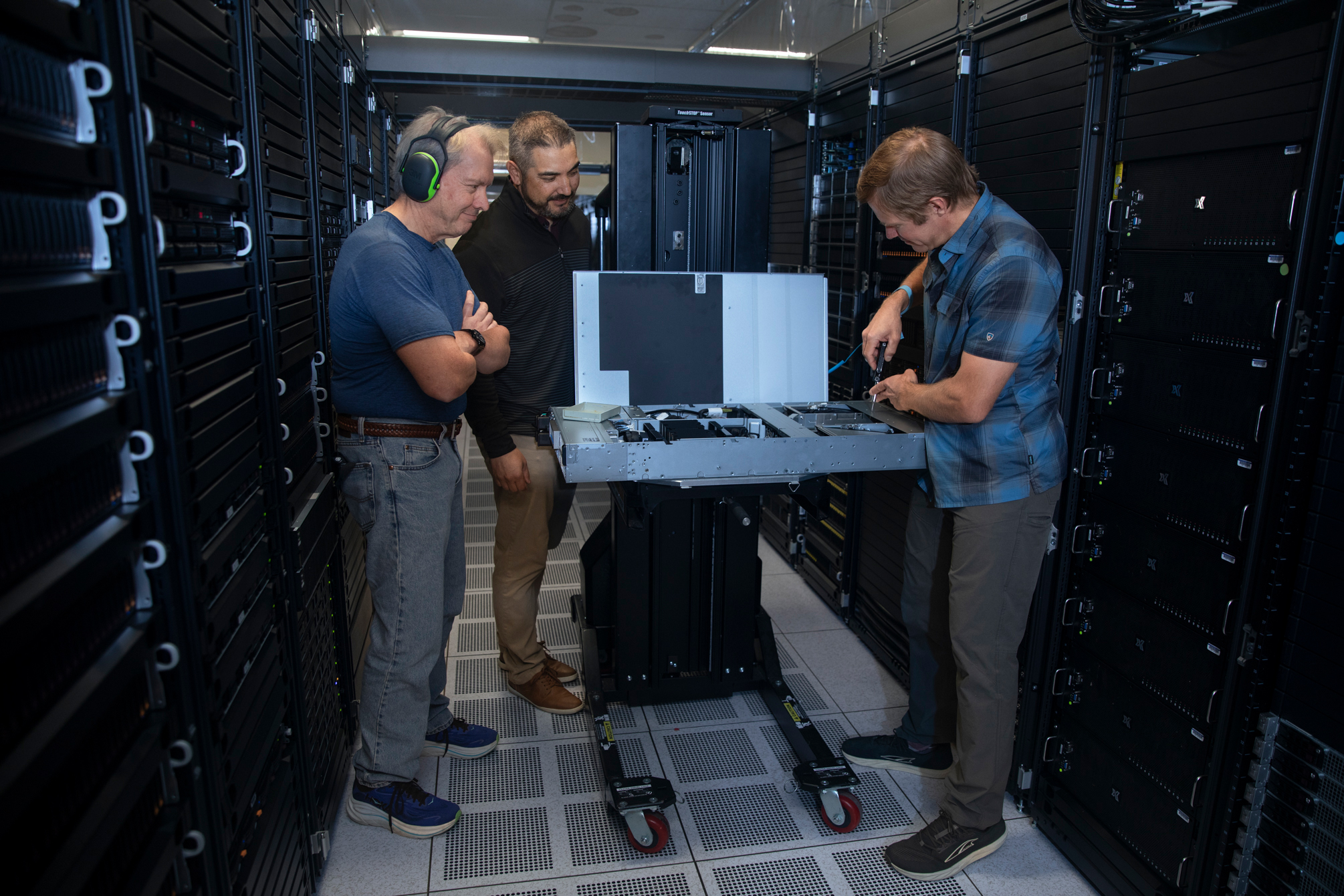
The team’s approach exemplified the new field of integrative structural biology, in which multimodal data — molecular biology, biochemistry, biophysics and structural biology experiments — is gathered and brought together with computer simulations to obtain a 3D model of molecules in action. The international team each contributed different components of the research: cell biology, X-ray scattering and RNA biochemistry experiments, tying it all together with the RNA modeling using Los Alamos’ Chicoma supercomputer.
The analysis will be contributed to a new artificial intelligence project the team is developing called “Beyond Alpha Fold.” Many of the computational techniques employed in the research will be brought into the Beyond Alpha Fold AI project. The team will seek to leverage AI for its long-term vision of building an ensemble of 3D structures of the RNA for a given sequence.
“Understanding RNA’s structure and function in the body is one of the challenges of the century in biology,” Sanbonmatsu said. “Non-coding RNA is like the dark matter of the genome; we know it’s there, and we know it plays a role, but we have a lot of work to do to pin those things down. We still don’t understand how cells with the same DNA look very different and do different things. One of the keys to unlocking this understanding is likely the role RNA plays in regulating gene expression.”
Paper: “Cleavage region organizes the structural architecture of the SINE-derived B2 repressive ribozyme.” Communications Biology: 10.1038/s42003-026-09819-0
Funding: The work was supported by the Laboratory Directed Research and Development program at Los Alamos and by the National Institutes of Health.
LA-UR-26-23522