The UCN source produces high energy spallation neutrons and uses solid deuterium to cool the neutrons by one million billion-fold.
The resulting UCNs have some unique properties that allow them to be studied precisely: they move at speeds of only a few meters per second, and are completely confined by magnetic fields and material bottles for many hundreds of seconds at a time. These properties lead to very precise low energy particle physics experiments that search for small differences between measurement and prediction, and these precision measurements are a powerful tool for investigating new physical processes which can complement and rival experiments at high energy colliders such as CERN.
There are several new and on-going experiments at the UCN source that measure decay correlations and other properties of the neutron. This program of measurements probes the particle physics underlying neutron decay, and has important implications for high energy physics and cosmology.
In addition, because of the interaction between UCNs and material surfaces, the facility is used to study materials relevant to high precision experiments, and will provide a detailed understanding of neutron induced fission on actinides.
Ultracold neutrons (UCNs) have extremely low energy, less than 300 neV. At these energies, they are sensitive to magnetic, gravitational, and material potentials that can be realized in a laboratory.
UCNs have a temperature of less than 4 mK, move less than 8 m/s, and have a wavelength of more than 500 angstroms. They can be polarized by strong magnetic fields of about 6 Tesla, and are reflected by materials such as Nickel and Copper.
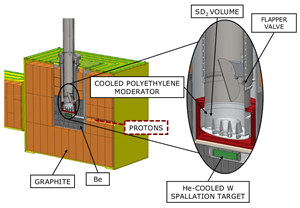
The LANSCE UCN source uses spallation to create UCN. 800 MeV protons impact a tungsten target, causing lots of very fast neutrons to be released. These neutrons are moderated to about 40 K and single scatter in a solid deuterium (SD2) crystal, and lose all of their energy to become UCN. After an intense beam burst hits the target and creates the UCN, the UCN travel up the source volume and a “flapper” seals them outside of the SD2 source. These UCN then bounce along the guides made of stainless steel, copper or quartz coated with highly UCN-reflective Diamond-Like Carbon (DLC).