Los Alamos is leveraging its scientific and computational expertise to support DOE’s historic national endeavor.
The Genesis Mission is a national initiative that is building the world’s most powerful integrated discovery platform to advance science, strengthen national security, and ensure American energy dominance.
Los Alamos National Laboratory is playing a key role in the development of this discovery platform. The Laboratory is also bringing its unparalleled expertise and world-class facilities to bear on Genesis by
- Deploying powerful artificial intelligence (AI)-enabled computing systems
- Partnering in innovative ways with industry, and
- Leading or contributing to 25 research projects that pursue objectives identified by Genesis’ National Science and Technology Challenges.
What is the Genesis Mission?
The Genesis Mission is uniting government, industry, academia, and philanthropy to accelerate breakthroughs in energy, science, and national security. Genesis is achieving this by combining the world’s best supercomputers, experimental facilities, and AI systems with unique datasets into an integrated whole called the American Science and Security Platform.
Genesis Leadership
Los Alamos staff serve in national Genesis leadership roles in the following areas:
- National Science and Technology Challenges
- Models
- Technical Partnerships
Researchers will leverage the platform to address Genesis’ National Science and Technology Challenges in areas that include biotechnology, critical minerals, quantum computing, the U.S. nuclear stockpile, and more.
Supporting the Platform
Capabilities developed through Los Alamos’ Artificial Intelligence for Mission (ArtIMis) project are central to the platform.
ArtIMis combines specialized AI agents, scientific foundation models, and rigorous test-and-evaluation workflows into one coordinated platform. At the center of ArtIMis is the Universal Research and Scientific Agent, or URSA. URSA coordinates a set of agents and tools, calling on frontier large language models and Los Alamos–developed scientific foundation models to complete tasks. URSA allows researchers to automate aspects of the scientific process and significantly accelerate discovery.
URSA is being adapted to support the platform and Genesis. A related Los Alamos project, DIANA (Data Infrastructure for Artificial intelligence and Nextgen Analytics), is indexing the Laboratory’s diverse datasets and making them accessible to AI agents and other tools. DIANA-developed methods are being used by Genesis to source and curate data from across the DOE complex.
Advanced Computing Platforms and Unique Partnerships
Los Alamos’ Genesis Mission Focus Areas
- Accelerating Scientific Discovery: AI for modeling, simulation, data analysis, and experimentation.
- Strengthening National Security: AI for threat assessment and the design, development, and certification of the nation’s atomic deterrent.
- Transforming Scientific Computing: AI for high-performance computing and scientific software.
- Advancing Scientific AI: AI for autonomous agents, scientific foundation models, and data management.
Los Alamos is home to Venado, which the Laboratory co-designed with Hewlett Packard Enterprise (HPE) and NVIDIA. Venado was built with NVIDIA’s Grace Hopper Superchips to handle sophisticated AI workflows.
In 2025, the Laboratory entered a unique partnership with OpenAI to operate the company’s frontier models on Venado, making the Laboratory the only government institution in the world to host OpenAI’s models on site. This partnership is enabling Genesis-relevant research that can’t be conducted anywhere else.
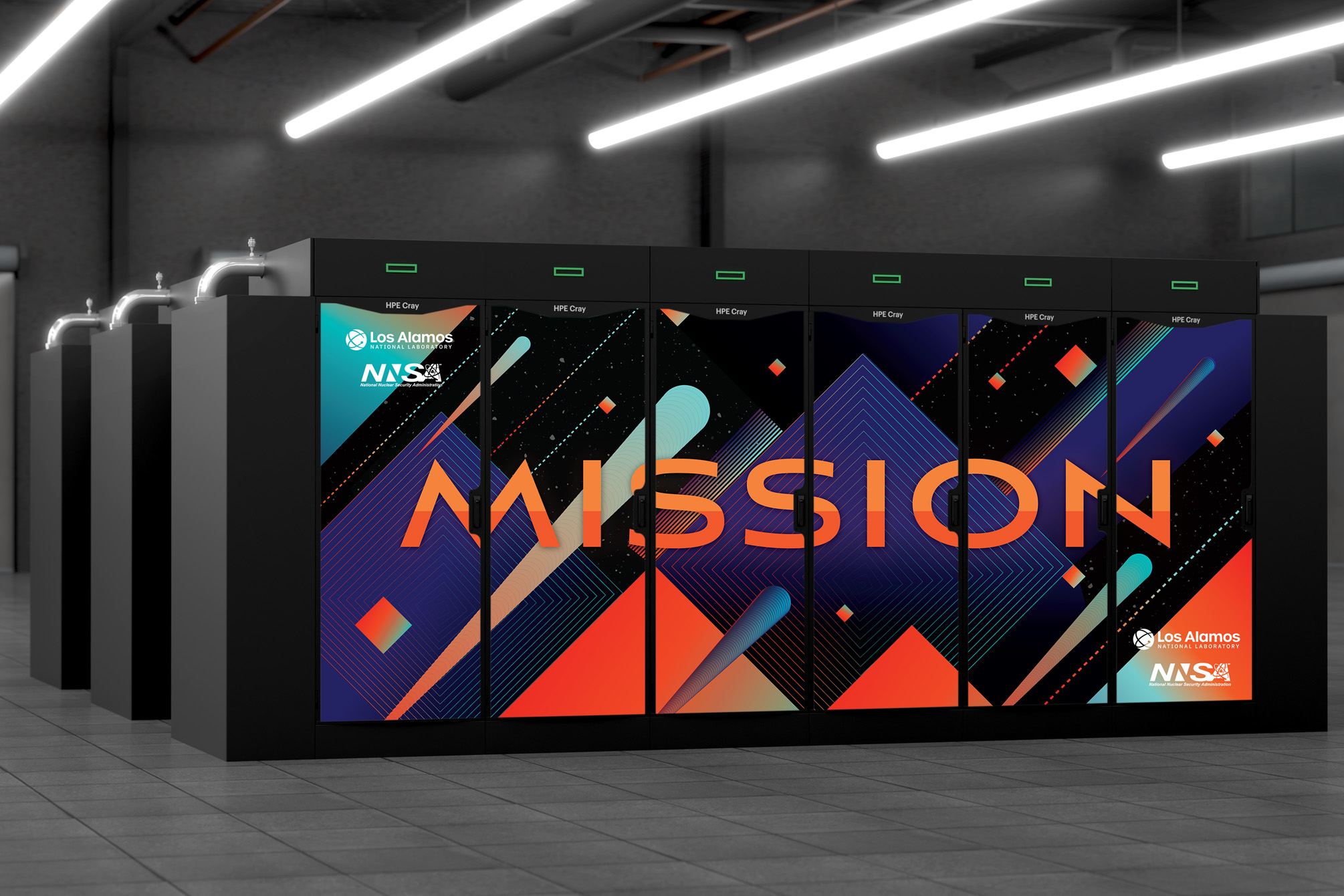
Los Alamos is partnering with HPE and NVIDIA to design two new AI-enabled supercomputers, Mission and Vision, which will enter service in 2027 and 2028. These machines will provide cutting-edge AI capabilities that support the Genesis Mission and other initiatives.
Addressing the National Science and Technology Challenges
Los Alamos is leading seven Genesis projects and supporting 18 more. These projects address Genesis’ National Science and Technology Challenges, which represent priority areas where AI could dramatically shorten discovery timelines, strengthen U.S. competitiveness, and deliver measurable benefits for the American people.