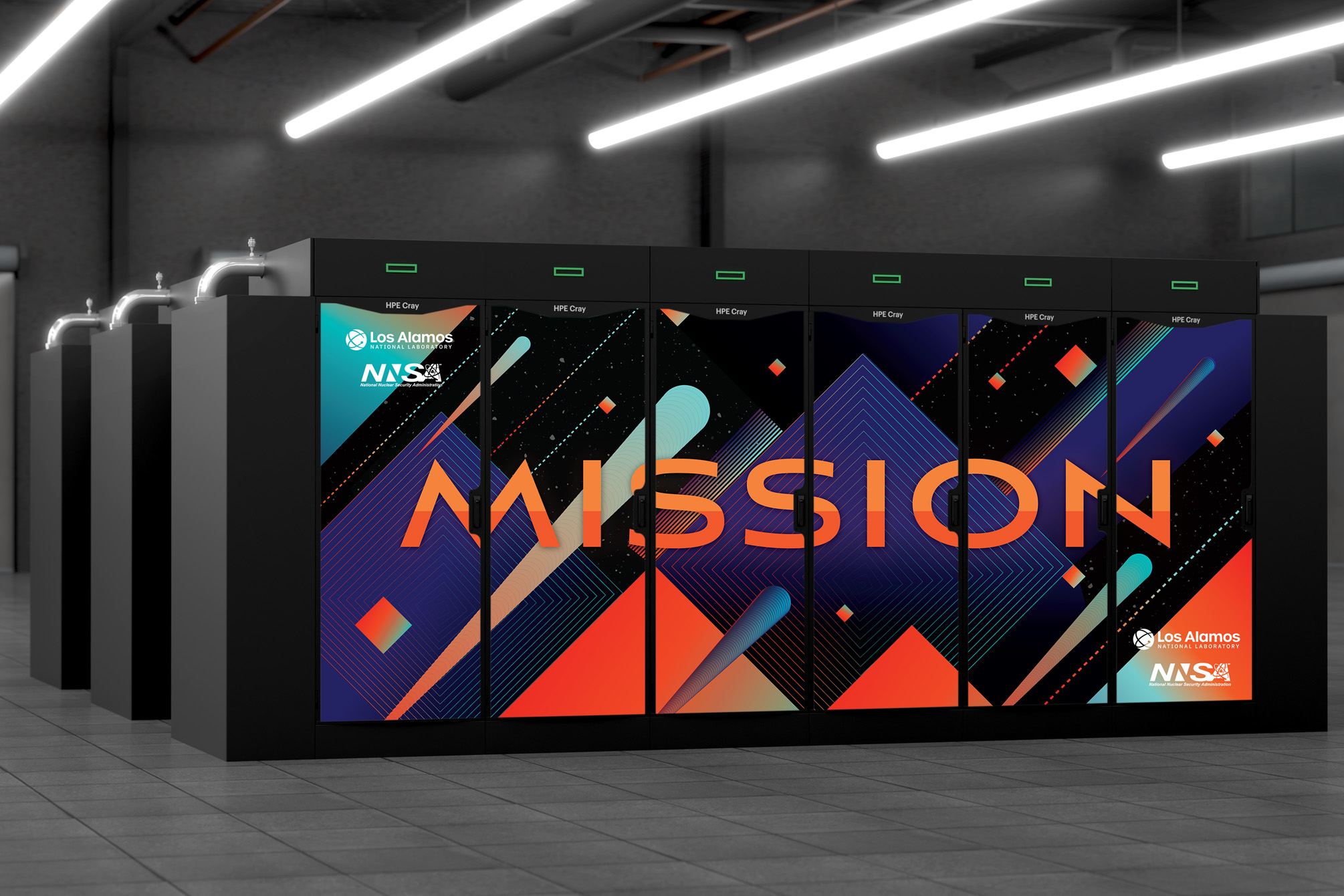
Last fall, Los Alamos National Laboratory unveiled plans for two new supercomputers, Mission and Vision, built by HPE and powered by the NVIDIA Vera Rubin platform. This summer, the first Vera CPU server arrives at Los Alamos for installation in a test bed, the result of an ongoing, rigorous codesign collaboration between Los Alamos, NVIDIA and their partners. Vera is powered by NVIDIA’s custom Olympus core, and will support both HPC and agentic AI workloads that accelerate pressing scientific and engineering efforts at the Laboratory.
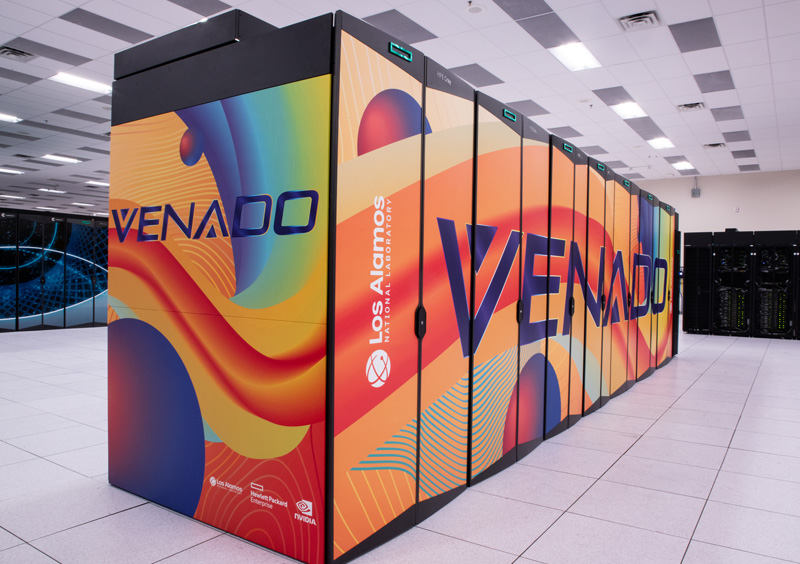
“We’ve been engaged with our partners very productively over the long term on workload characterization, evaluation of design alternatives and preproduction assessments,” said Ben Santos, HPC Platforms program director at Los Alamos. “The Mission and Vision systems are designed to deliver over three times the per-CPU performance of our current Crossroads supercomputer while providing more than four times the memory per core and lower power consumption. Each Rubin GPU of Mission and Vision is designed to deliver over 12 times the AI performance over the Hopper GPUs of Venado, and that performance aligns well with AI workloads and agentic needs and means we can be efficient and agile in how we tackle critical problems of interest to the nation.”
“Scientific discovery is entering a new era where supercomputers must bring simulation, AI and agentic reasoning together to help researchers solve problems once beyond reach,” said Dan Ernst, senior director of supercomputing products at NVIDIA. “Through our codesign work with Los Alamos and HPE, the NVIDIA Vera Rubin platform will bring Vera CPUs and Rubin GPUs to Mission and Vision, delivering the memory bandwidth, energy efficiency and accelerated AI performance needed for the Laboratory’s most demanding HPC, AI and agentic AI workloads.”
“For decades, HPE and the U.S. Department of Energy’s Los Alamos National Laboratory have collaborated to target specific mission and workload needs by designing and developing state-of-the-art systems using diverse HPC architectures,” said Trish Damkroger, senior vice president and general manager of HPC & AI Infrastructure Solutions at HPE. “We are proud to deepen our partnership on the latest codesign process for Mission and Vision to bring advanced supercomputing that will only further the Laboratory’s significant contributions to science.”
Los Alamos has a longstanding collaboration with NVIDIA and its partners on CPU technology, which provide high-memory bandwidth, low-latency compute and power-efficiency. That collaboration continues with the Arm-compatible NVIDIA Vera CPUs developed by NVIDIA and used in HPE’s build, which will support the Mission, Vision and Veritas high-performance computing systems forthcoming at Los Alamos.
“Focusing our codesign efforts on largely unmet needs, particularly high-memory bandwidth per core and strong support for irregular applications, has resulted in significant performance and efficiency improvements for our most challenging workloads,” said Galen Shipman, chief architect of advanced technology systems at Los Alamos.
AI-era supercomputing
Mission and Vision, to be built by HPE, will be based on the new HPE Cray Supercomputing GX5000 equipped with the next-generation NVIDIA Vera Rubin platform, combining NVIDIA Vera CPUs with NVIDIA Rubin GPUs, and interconnected with NVIDIA Quantum-X800 InfiniBand networking. The Lab’s Institutional Computing program will deploy a third system, Veritas, which will arrive alongside Mission and Vision and serve the Laboratory Directed Research and Development program.
Los Alamos has been an early driver of high-performance, energy-efficient CPUs, and the codesign process, in focusing on applications specific to Los Alamos, has helped accelerate the technology as it finds a larger ecosystem of users. Los Alamos was the first major customer to deploy the Arm-based NVIDIA Grace Hopper platform in the Venado supercomputer, installed in 2025 and built by HPE.
Vera CPUs mark another milestone, extending NVIDIA’s CPU portfolio into agentic AI for modeling and simulation. Agentic AI represents the deployment of AI systems that can complete tasks in a self-directed way, reducing time-to-insight in some cases from months to minutes, freeing up experts to frame new questions and allowing researchers to probe previously inaccessible regimes of physics.
The delivery of the first Vera CPU blade for initial testbed deployment is scheduled for this summer at Los Alamos. Starlight, arriving later in 2026, is the first of three purpose-built architectures for the Mission system, built with the NVIDIA Vera Rubin NVL72, a full-rack supercomputer featuring two racks, each with 18 nodes of Vera CPU, and with 72 nodes of Rubin GPUs. Full deployment of the Mission and Vision systems of Vera CPU and NVIDIA Vera Rubin NVL4 rack scale systems built by HPE will follow in 2027 and 2028.
LA-UR-26-25227