DOE/LANL Jurisdiction Fire Danger Rating:
Picture1
  1. LANL Home
  2. Science & Engineering
  3. Artificial Intelligence
  4. AI Projects

ArtIMis

Accelerating discovery with AI

Artificial Intelligence for Mission (ArtIMis) automates research workflows using intelligent agents and scientific foundation models, exploring vast parameter spaces and adapting in real time to free scientists from routine tasks and accelerate breakthrough discoveries.

What is ArtIMis?

Since the Enlightenment, scientific progress has been defined by iterative cycles of empirical observation, hypothesis formulation, and theoretical modeling in which hypotheses are tested experimentally and theories refined accordingly. This traditional discovery process is inherently slow and complicated by the demands of scheduling, cross-discipline coordination, and more.

ArtIMis uses industry reasoning models and Los Alamos National Laboratory–developed scientific foundation models to solve tasks. The thinking agents call on various lesser agents and non-language science foundation models to find scientific solutions, thereby unifying diverse data sources and allowing researchers to focus on discovery rather than setup, troubleshooting, and coordination.

ArtIMis performs as a high-level research assistant that

  • reads and synthesizes all literature relevant to a particular scientific problem;
  • designs experiments that strike an optimal balance between cost, time-to-insight, and scientific value;
  • executes computational and experimental tasks;
  • monitors results and recognizes when approaches are not working;
  • proposes alternative hypotheses based on accumulating evidence; and
  • works around the clock without fatigue to achieve new insights.

ArtIMis leverages state-of-the-art, industry-based large language models (LLMs) as the underlying foundation model for parts of its workflow. However, a scientific discovery workflow also requires non-language foundation models that have been trained on both relevant scientific literature and scientific data—a scientific foundation model or SciFM. A scientific discovery workflow based on AI agents and SciFMs also requires an extensive test and evaluation framework to validate the agentic output and the efficacy of the SciFMs. These SciFMs and test and evaluation framework are central to the ArtIMis ecosystem.

ArtIMis’s ecosystem of agents and foundation models represents a paradigm-shifting approach to scientific discovery, allowing researchers to execute multiple tasks in parallel and, in effect, to study multiple things simultaneously. With ArtIMis, the ideal research assistant is becoming a reality, setting the stage for a new era of discovery in fields such as materials science, chemical development, national security research and discovery, and more.
Artimiscartoon
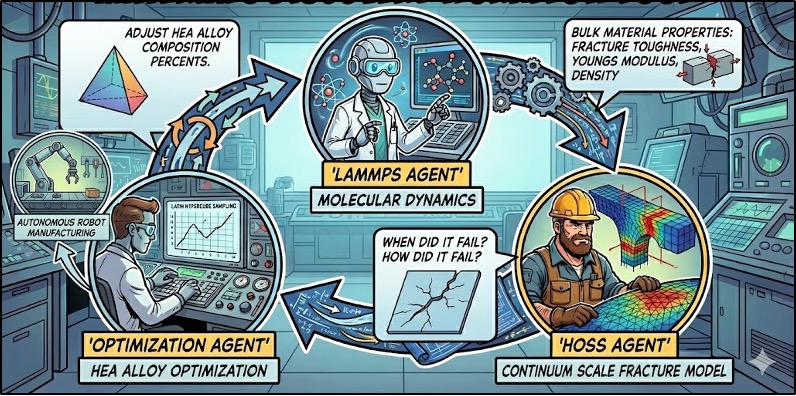
An illustration of an ArtIMis workflow that automates the development of fracture-resistant materials.

How Does ArtIMis Work?

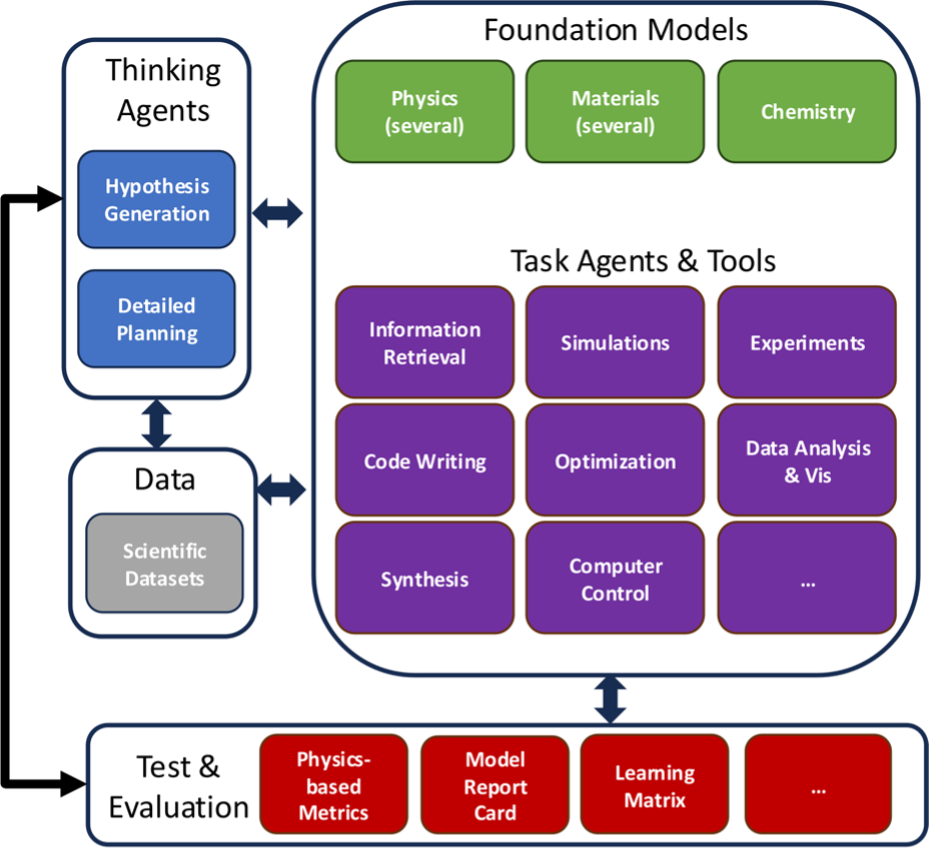
The ArtIMis ecosystem is built around an agentic framework called URSA, the Universal Research and Scientific Agent. URSA is grounded by a set of novel SciFMs developed and tuned specifically for scientific data. Its flexible framework consists of a set of agents and tools designed to accelerate scientific tasks. Each agentic tool has a specific role in the workflow, and the agents can call on frontier large language models or use one of the ArtIMis SciFMs. The many agents and tools interact with each other to pose questions, develop hypotheses, seek out information, generate code, and run experiments to produce a formalized solution. The ArtIMis ecosystem encompasses the thinking agents (URSA) and other agentic tools, the scientific foundation models, and the test and evaluation framework. The latter validates that automated outputs meet scientific standards across components.

Artimis Ecosystem
The ArtIMis ecosystem’s components.

URSA addresses a core challenge in modern science: the manual coordination of simulation campaigns that slow discovery. By taking out the scientific “grunt work,” URSA allows researchers to iterate faster, leaving bandwidth for scientists to focus on higher-level reasoning and decision-making. By automating labor and resource-intensive research activities, the system compresses iteration cycles and accelerates scientific progress.

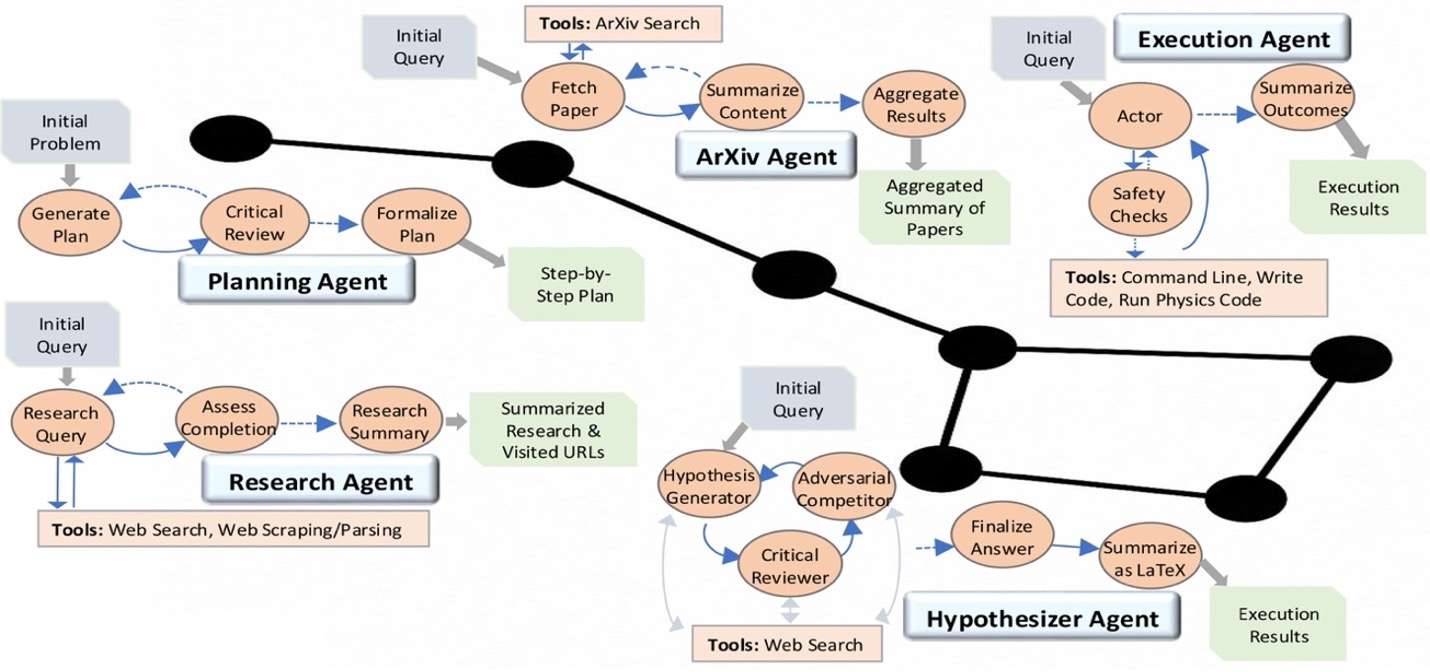
The constellation of agents that make up URSA can be configured into highly flexible workflows to address a broad range of science problems. The set of basic agents is shown below. These agents include the Planning agent, the ArXiv agent, the Hypothesizer agent, the Research agent, and the Execution agent. Additional specialized agents include those that run specific simulations, retrieval-augmented generation agents, an image acquisition agent, a data management agent, and a suite of tools to support the agents.

Artimis Constelation
The constellation of general URSA agents and workflows.

SciFMs

The ArtIMis ecosystem takes a multi-pronged approach to developing SciFMs that can learn and emulate complex physical systems. Partial differential equation (PDE)–based physics simulations are of particular interest for LANL mission problems. To create these simulations, the SciFM models learn operators that map a system’s current state to its future state, effectively replacing traditional time-stepping solvers with neural networks. A variety of architectures are used to address different research problems, including diffusion-based generative models, transformer-based sequence models, and convolutional U-Net–style networks.

Scientific Foundation Models

Test and Evaluation Capability

The ArtIMis ecosystem’s test and evaluation approach represents a shift from traditional machine learning benchmarking toward a scientifically grounded evaluation framework. ArtIMis defines evaluation as the process of predicting if a model will perform reliably on real-world scientific tasks. ArtIMis has developed a suite of physics-informed and structure-aware metrics that more accurately represent scientific validity, including correlation-based metrics that separate amplitude, phase, and spatial errors as well as topological metrics derived from persistent homology that capture connectivity and structural evolution in complex systems such as material fracture.

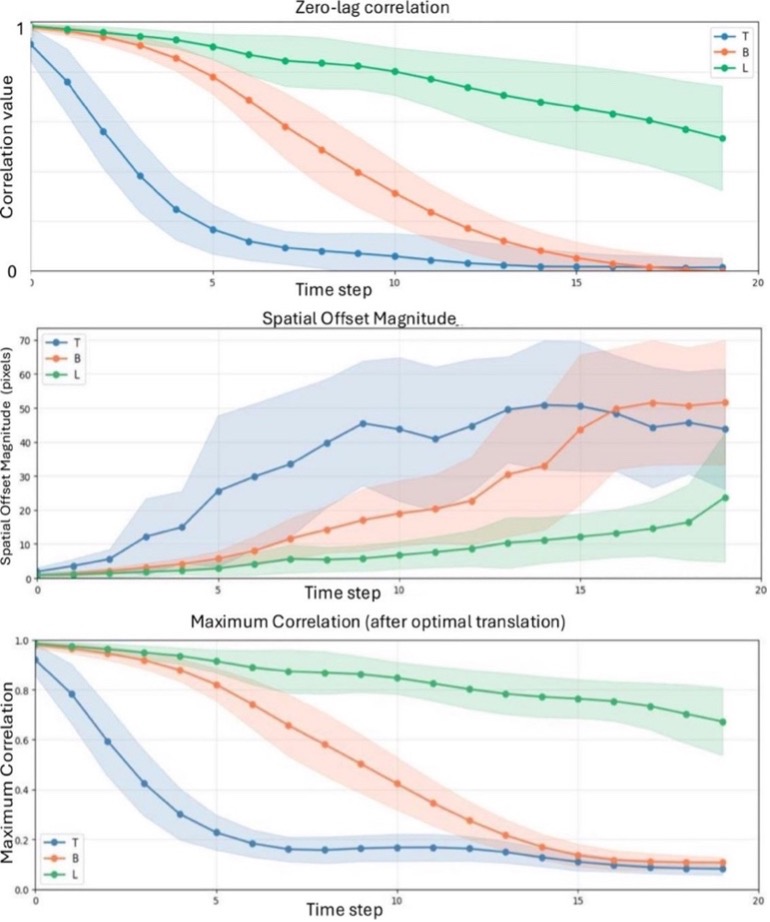
Instead of using Mean Squared Error as an error metric, ArtIMis’s Test and Evaluation team have developed a suite of 2D correlation metrics that capture both spatial and structural components. The Zero-Lag correlation quantifies the pointwise similarity without spatial adjustment, which captures the structure of the data. The Spatial Offset Magnitude quantifies the optimal rigid translation needed to optimize agreement between ground truth and prediction. The Maximum Correlation quantifies the best-achievable similarity after optimal translation.

Artimis Timestep
An example of the three 2D correlations for the PDE rollout example. Higher correlation indicates lower error between the ground truth and the prediction.

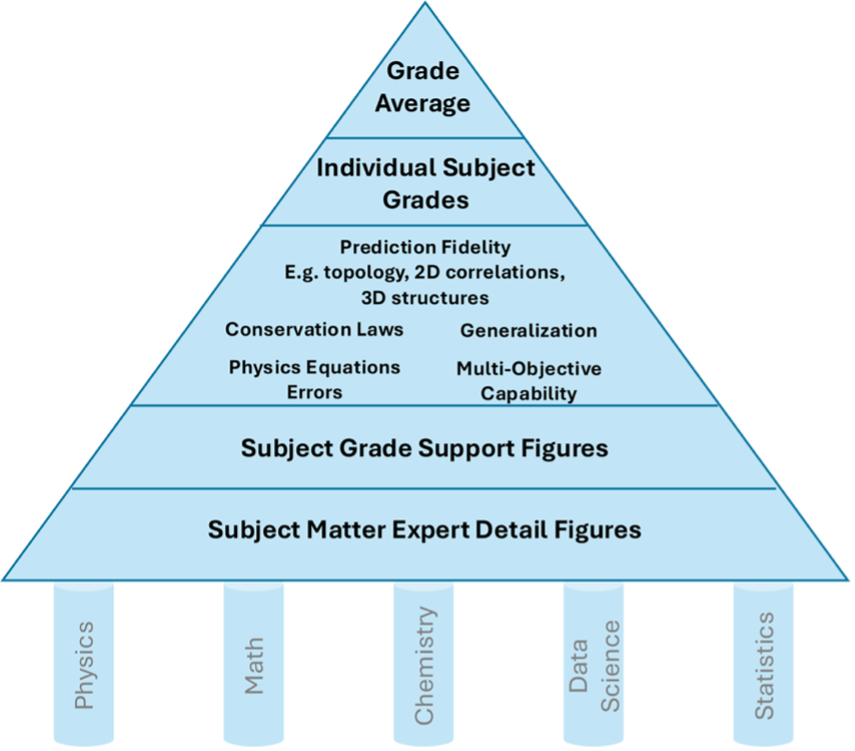
Another of ArtIMis's major contributions to the evaluation landscape is the ArtIMis Model Report Card, which provides a hierarchy of information from a high-level summary letter grade to a set of highly detailed plots, charts, and diagnostics on metric performance. Stakeholders can drill down into the details to find the right level of information for a particular application.

Artimis Model Report Card
The Model Report Card is designed to provide detail at varying audience levels—from an overall grade average suitable for high-level stakeholders to extremely detailed figures and reports—to support subject matter experts in evaluating a model.

AI for Materials Discovery and Scientific Insight

ArtIMis has been leveraged to significantly accelerate the discovery of chelators that can facilitate cancer treatments.

Targeted alpha therapy uses radionuclides such as actinium-225 to treat cancer. Molecules called chelators bind with actinium and other radionuclides to deliver the molecules to target sites. New chelators with stronger binding affinities can bolster treatment effectiveness and limit collateral damage to healthy cells. Using NVIDIA’s Nemotron LLM and ArtIMis workflows, researchers first developed interpretable hypotheses of chemicals that could serve as effective chelators. Next, researchers used NVIDIA’s GenMol to conduct A/B group sampling of chemical spaces, turning the hypotheses into molecules. Los Alamos National Laboratory's Architector complex constructor tool and high-throughput quantum calculations were used to estimate the binding affinity of complexes, and these assessments were fed back into the LLM to iteratively refine the hypotheses.

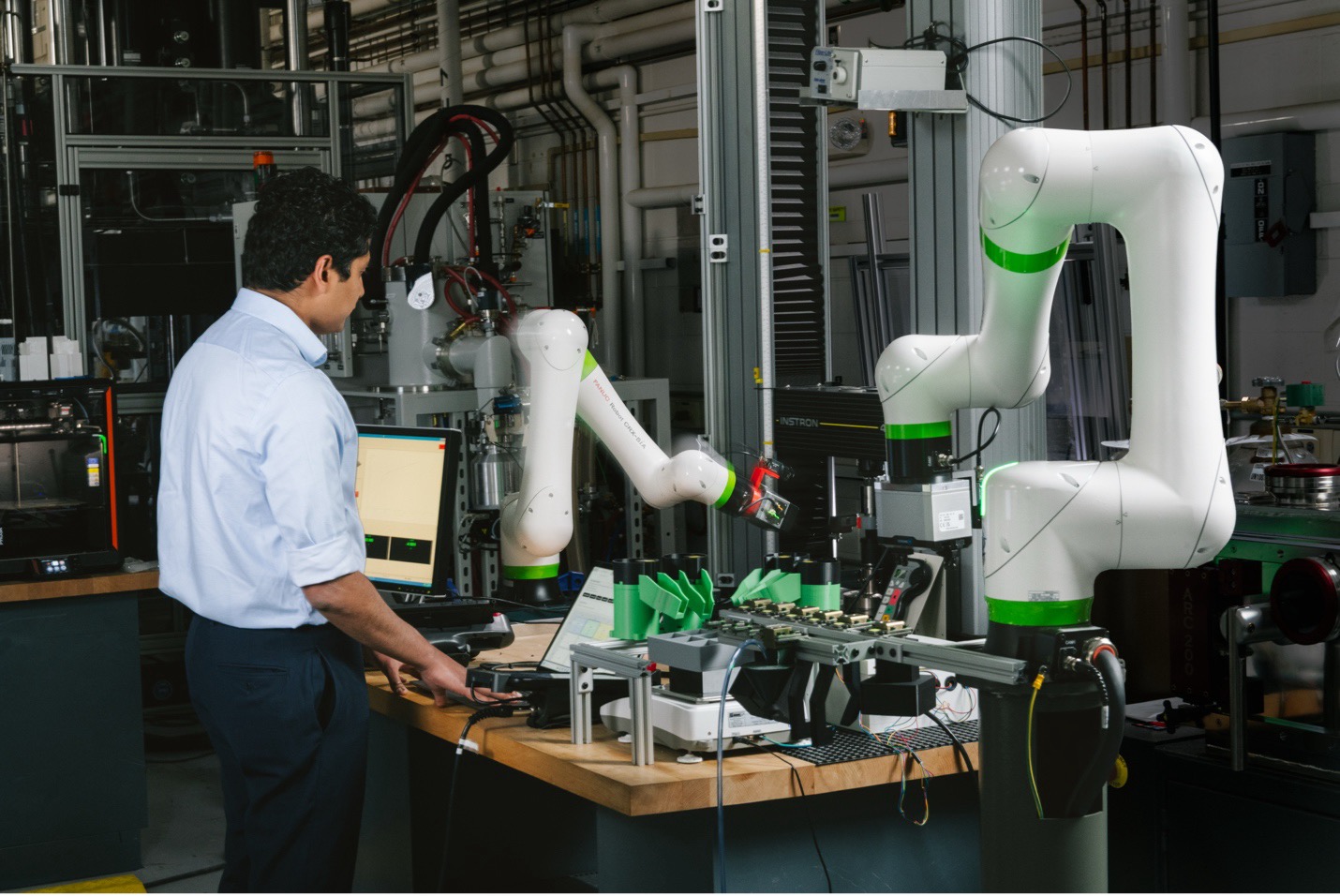
ArtIMis has also been leveraged to automate the materials discovery process. Traditionally, humans mix and match elements to try to make new alloys. Discovering and qualifying a new alloy for national security and other applications typically takes 5–10 years. To rapidly increase the rate at which alloys are discovered, researchers at LANL are using ArtIMis to link AI materials discovery workflows with robotic production and testing into a continuous discovery loop.

First, SciFMs are trained on decades of sparse experimental data to predict potentially useful alloys from scratch. Key material characteristics, such as ductility and yield strength, are optimized. The top alloy candidates are then passed through a manufacturability screening to determine the likelihood that the predicted alloy can be produced. Next, robotic systems autonomously synthesize quarter-sized “pucks” of bulk materials whose strength, stiffness, displacement, and other properties are tested using a load frame. These results feed back into the SciFMs, continuously improving predictions.

By combining agent-driven orchestration, foundation models, and rigorous evaluation, ArtIMis transforms fragmented research processes into scalable, traceable, and automated workflows—reducing manual effort, accelerating scientific discovery and insight, and enabling more efficient use of scientific expertise across complex problems.


ArtIMis Media

Ursa Card

Meet LANL’s URSA, an AI Agent Transforming How Science Gets Done

Read More
2026-04-29

Los Alamos scientists team up to advance the Lab’s AI mission

Read More

Links

  • URSA: Universal Research & Scientific Agent
  • YOKE: Yielding Optimal Knowledge Enhancement
  • MORPH: PDE Foundation Models with Arbitrary Data Modality
  • MathOptAI.jl

ArtIMis Personnel

Selected Publications

Los Alamos National Laboratory

P.O. Box 1663

Los Alamos, NM 87545

(505) 667-5061

At The Lab

  • Business Opportunities
  • Jobs
  • Organizations
  • Research Library
  • User Facilities

Information

  • Emergency
  • Ombuds
  • Reading Room
  • Resources
  • Science Museum

For Employees

  • AskIT
  • LANLInside
  • MyMail
  • Training
DOE White Seal
  • Terms of Use/Privacy

Managed by Triad National Security, LLC for the U.S. Dept. of Energy’s NNSA

Copyright 2026 Triad National Security, LLC. All Rights Reserved.

Learn about the Department of Energy’s Vulnerability Disclosure Program