Los Alamos National Laboratory scientists have forced light to change how it behaves when the positions of the source that emits light energy and the detector that measures that light are swapped, breaking the principle that governs most optical systems.
The achievement, reported in Nature Communications, required overturning what’s known as “Lorentz reciprocity,” which enforces an equal energy exchange between the source and detector.
Why this matters: Thermal radiation, radiative cooling, energy conversion and infrared sensing could be transformed by the team’s new platform for independently controlling thermal absorption and emission. The platform is applicable to both classical and quantum light.
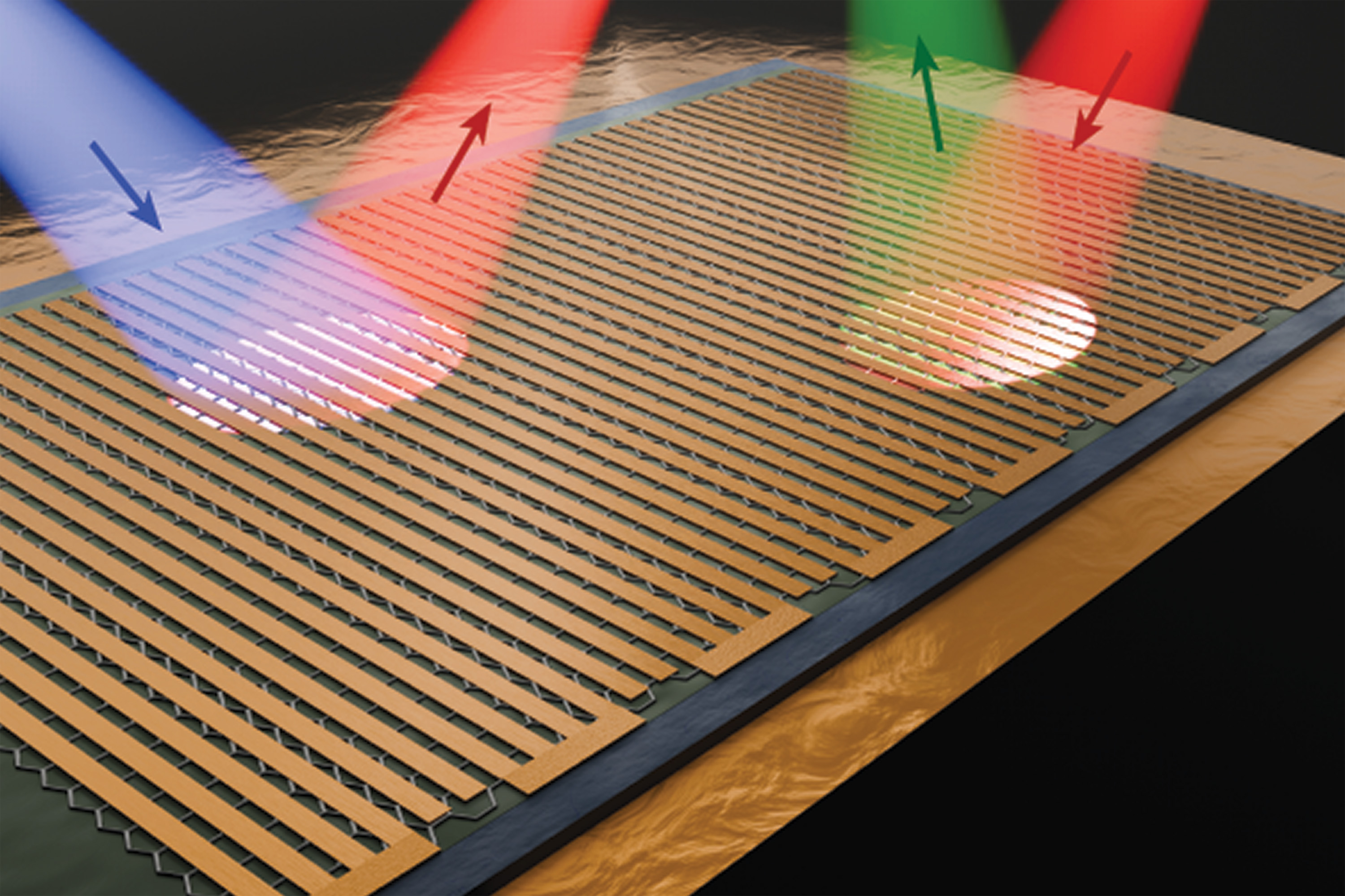
What they did: The research team built a graphene-based platform, called a “spatiotemporally modulated metasurface,” that can be programmed to change the properties of thermal and mid-infrared light across space and time. The team combined expertise from the Theoretical division’s Quantum and Condensed Matter Physics group and the Materials Physics and Applications division’s Center for Integrated Nanotechnologies group.
How it works:
- Through scattering experiments and theory, the team showed the new platform’s implications in decoupling light absorption and emission channels by breaking time-reversal symmetry at thermal wavelengths.
- They designed and fabricated an integrated photonic structure and experimentally demonstrated nonreciprocal scattering from a metasurface, modulated at gigahertz frequencies.
- They also developed a theoretical framework to link nonreciprocal scattering under spatiotemporal modulation with unequal absorptivity and emissivity, thereby breaking Kirchhoff’s law of thermal radiation.
Funding: This work was supported by the Los Alamos’ Laboratory Directed Research and Development (LDRD) program and other Laboratory programs.