Particles can switch between reversible and irreversible motion when their attractive interactions are repeatedly strengthened and weakened, according to new research from Los Alamos National Laboratory's Theoretical division. In Physical Review Letters, the authors suggest that their observations — gathered through computer simulations — demonstrate that complex, repeating particle motions can emerge without the cyclic mechanical shearing (a materials testing process) used in previous studies.
Why this matters: Understanding how particles organize under changing interactions could spur new approaches for controlling self-assembly and dynamic patterns in soft materials. For instance, the interactions of magnetic colloids could be tuned with external magnetic fields.
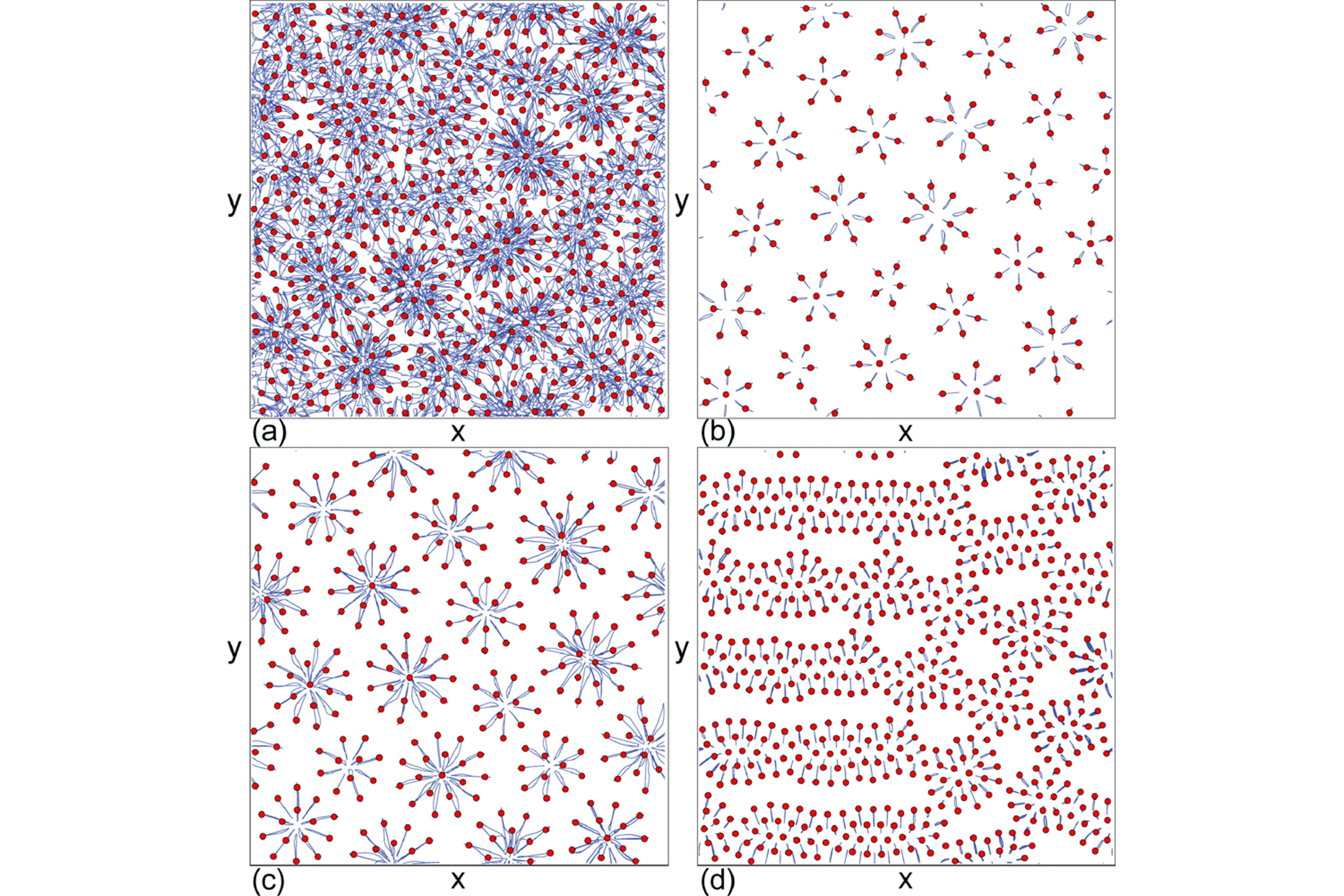
What they did: The team simulated a two-dimensional system of particles with competing short-range attraction and long-range repulsion. They systematically varied attraction strength, oscillation frequency and particle density to identify when particle trajectories repeat and when particles spread unpredictably over successive cycles.
How it works:
- When particles return to their starting positions after one or more cycles, the system exhibits reversible motion, sometimes producing intricate closed loops, stripes and bubble patterns that resemble classical discrete time crystals (a nonequilibrium phase of matter).
- When the oscillations instead allow particles to mix between clusters, motion becomes irreversible and diffusive, with distinct critical boundaries separating the behaviors and, under some conditions, a second reversible regime emerging at stronger attraction.
What's next: The researchers want to test these predictions in magnetic colloidal or magnetocapillary systems and investigate how temperature changes the transitions.
Funding: Laboratory Directed Research and Development program at Los Alamos National Laboratory.
LA-UR-26-29657