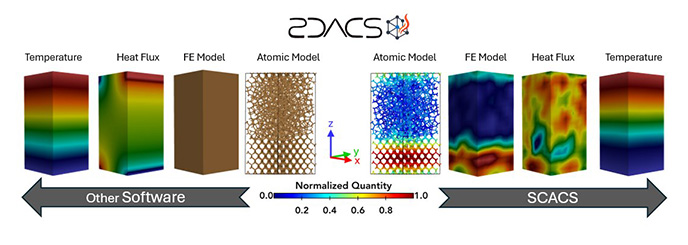
New materials simulation software from Los Alamos National Laboratory could help engineers design better electronics, semiconductors, aerospace and space technologies, biotechnology and energy systems. The Simulator Collection for Atomic-to-Continuum Scales (SCACS) toolkit predicts material properties by using artificial intelligence to connect atomic-level material behavior with device-scale performance.
In a paper chosen as an Editor's Suggestion for Physical Review Materials, the scientists described their innovation’s heat-flow capability, but their broader vision is a unified platform that also predicts electrical transport and mechanical behavior.
How it works:
- Materials can fail in harsh environments because of heat, corrosion, radiation or mechanical stress.
- The SCACS platform helps engineers understand those failures by first looking at what is happening at the atomic level, where damage and weak points begin, and then mapping that information up to the device scale, where real components operate.
- In this way, SCACS does not just explain why a material fails; it also helps predict how that failure will affect the performance of an entire part or system, so better materials and designs can be chosen before anything is built.
Why this matters: SCACS closes a longstanding gap between detailed atomic-scale physics and practical device-scale simulation. Instead of relying on oversimplified material properties in tools such as finite element models, SCACS uses advanced methods that preserve local features such as defects, interfaces and directional heat or current flow.
Funding:
- The Laboratory Directed Research and Development program at Los Alamos National Laboratory through the Director's Postdoctoral Fellowship Program and the Exploratory Research program.
- The UC/LANL Entrepreneur Postdoctoral Accelerator Fellowship.
LA-UR-26-25205