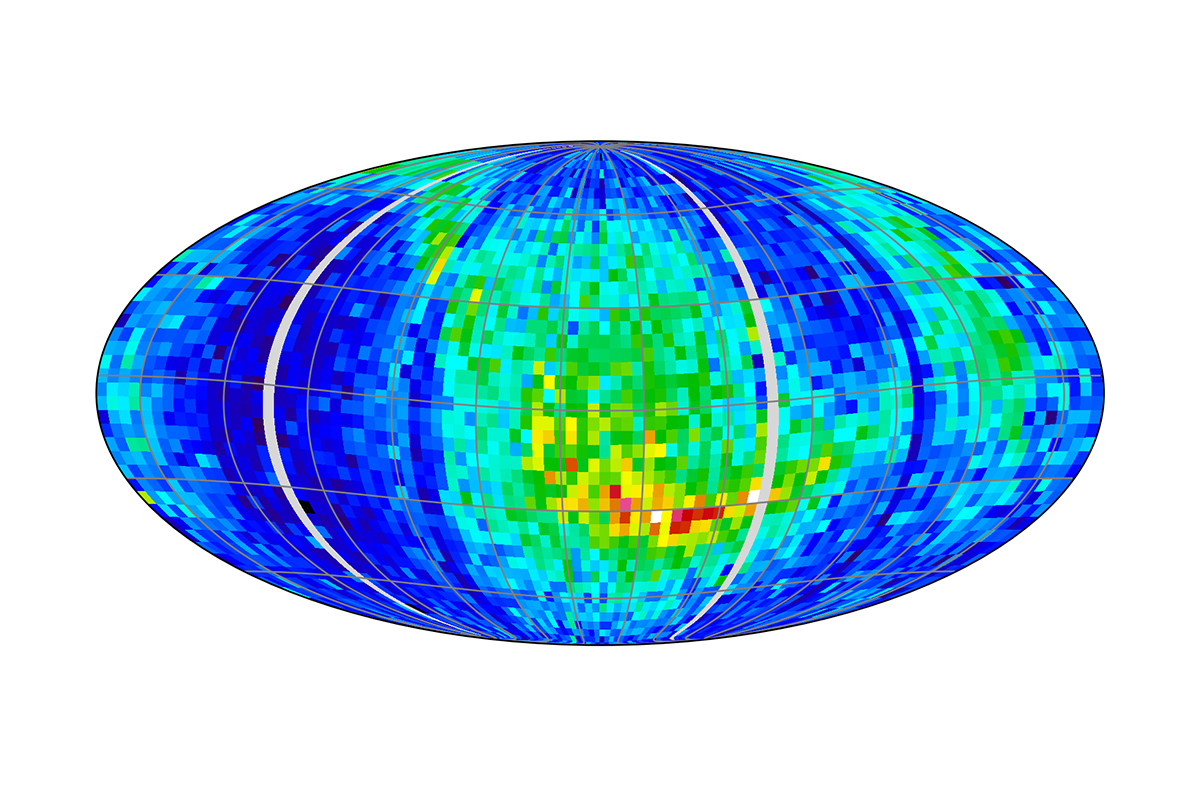
NASA’s Interstellar Mapping and Acceleration Probe (IMAP) spacecraft — positioned 1 million miles from Earth — has entered its primary science mission studying solar activity that affects satellite technology and space travel. Two Los Alamos National Laboratory–led instruments are delivering exceptional early results.
What to know:
Onboard the spacecraft are the High-Energy Energetic Neutral Atom Imager (IMAP-Hi) and Solar Wind Electron (SWE) instruments, which were developed at Los Alamos. The Lab is the lead institution for the science and operations of these instruments for the duration of the NASA mission.
Early results:
- The IMAP-Hi instrument has nearly completed collecting all the observations needed to construct the first all-sky map of neutral atoms arriving from the heliosheath — the layer of plasma that separates our solar system from the rest of the galaxy.
- The SWE experiment, led by Los Alamos scientist Ruth Skoug, captured comprehensive measurements of an intense solar flare event — so significant that it forced four other instruments on the spacecraft into safe mode — highlighting both the resilience and scientific value of the autonomously operating instrument.
Why this matters:
- Early sky maps offer a first glimpse into complex processes at the edge of our solar system and signal the potential for important discoveries in the mission’s next phases.
- Knowledge about hazards in space could inform the design of satellite instrumentation that the U.S. government relies on for national security, such as the space-based nuclear detonation detection program.
- Extreme space weather events can mimic signatures from nuclear detonations, so scientists need more precise data to tell them apart.
What’s next: Every six months, the mission will scan the full sky to create successive maps that, over time, will show how changes in the sun’s corona and the solar wind impact the space environment.
Funding: NASA
LA-UR-26-24242