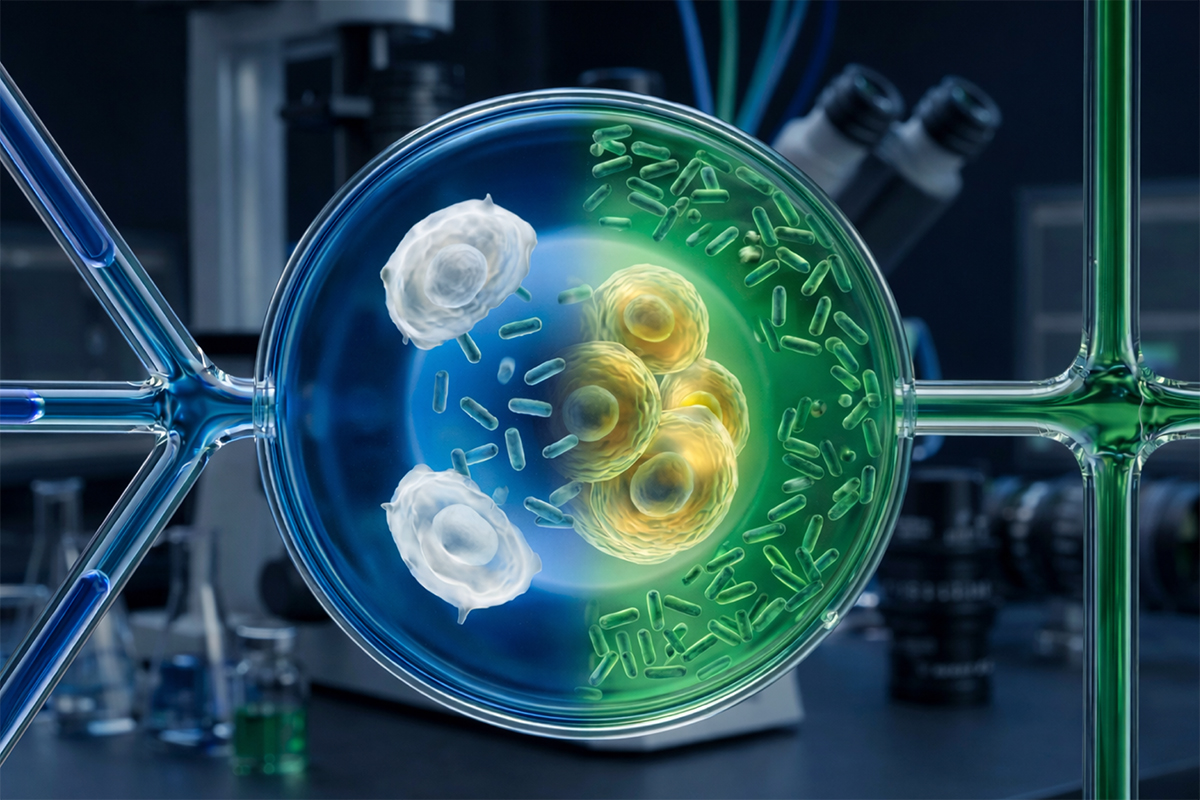
Mammalian cells naturally live in tandem with millions of microbes — the microbiome — but in a research lab, they can be impossible roommates. Mammalian cells and bacterial cells are difficult to co-culture because they have very different requirements for growth; however, growing them together is necessary for scientists to study their interactions.
To solve this problem, Los Alamos scientists developed a method for co-culturing these strange bedfellows by using microfluidics to create unique, compartmentalized microdroplets. Their work was featured on the cover of the Lab on a Chip journal and the authors also wrote a review paper in Nature’s BJC Reports.
Read the paper
Read a related review paper
Why this matters: Scientists want to know more about how bacterial and mammalian cells interact because their relationship is key to both sustaining health and understanding disease. For instance, some microbes can inhibit cancer, but other microbes are known to promote it.
- Identifying which microbes are helpful and which are harmful requires studying the microbes’ natural interactions with other cells.
- Co-culture and rapid screening are critical to facilitate investigations of cancer-promoting or inhibiting microbes.
What they did: The Los Alamos team created a new approach by designing novel multiphasic droplets that keep the two cell cultures separate, while also allowing important interactions.
- The unique “core-shell droplets” are composed of a hydrogel compartment that supports mammalian cell adhesion and culture and a liquid compartment that sustains bacterial growth.
- The multiphasic droplets are stable, customizable, able to sustain co-culture for over 24 hours, and compatible with fluorescence-based cell sorting technologies.
Funding: Los Alamos National Laboratory supported the work through its Laboratory Directed Research and Development program and a Frederick Reines Fellowship.
LA-UR-26-24242