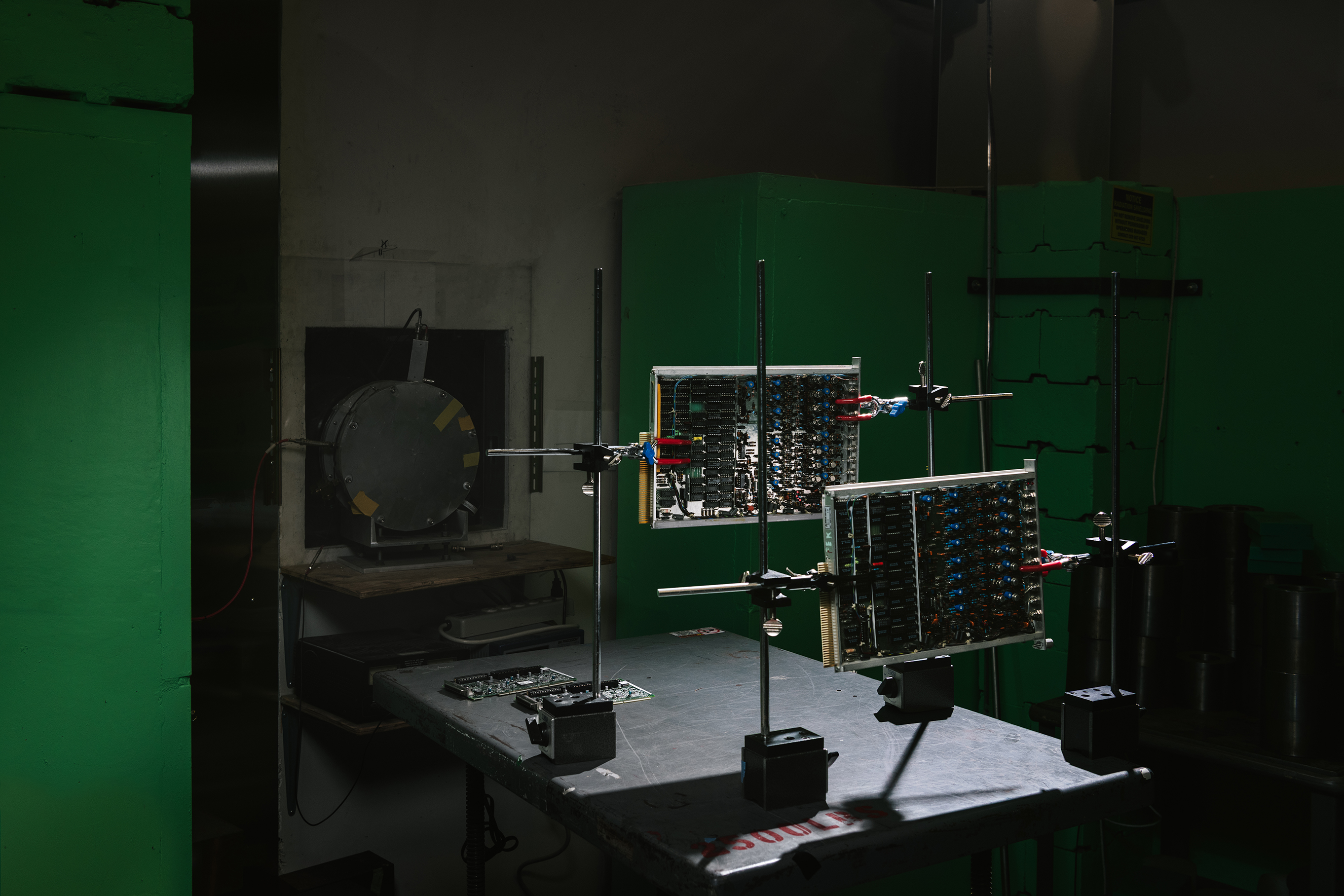
ICE-II (Target 4 Flight Path 30R) is also primarily used for semiconductor neutron irradiation research and testing.
Many industry users, national laboratories, and universities have used this facility to qualify and test semiconductor device for single-event effects. It is located on a flight path at 30° to the right of the Target 4 neutron production target.
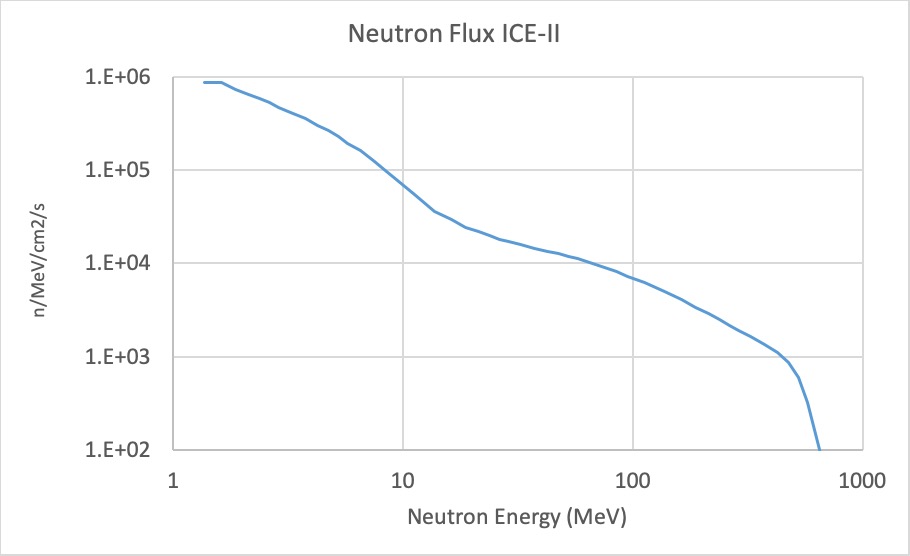
The neutron spectrum for this area is shown to the right and is very similar to the terrestrial neutron spectrum produced by cosmic rays hitting the atmosphere and ranges from approximately 1MeV up to approximately 600MeV. Because the ICE-II neutron spectra is similar to the terrestrial neutron spectrum, one can predict the failure rate of a device in a particular environment (neutron flux) by just scaling the flux intensities. The integrated neutron flux for the ICE-II area above 1(10)MeV is 4.7 x 10⁶ (2.2 x 10⁶) neutrons/cm2/sec.
The neutron flux in ICE-II is about twice the intensity as in ICE-I because the flight path length in ICE-II is shorter.
Below is a schematic layout of the ICE II experimental area. The beam area is approximately 14' along the beam axis and 11’ perpendicular to the beam axis. The work area is 5’ x 20’. The beam area is where the neutron beam enters from the top and exits the building on the bottom in the drawing. The shielding wall which separates the two area consists of 22" thick concrete and polyethylene shielding. The walls are 8 feet high. The center of the neutron beam is 49" above the floor and adequate AC power is available.
It should be noted that the work area for ICE-II is less than the one for ICE-I. Larger groups should consider using ICE-I.
It is not possible to be in the beam area while the beam is on. Experimenters usually place their devices on lift tables near where the beam enters the building and connect their devices to their control computers in the work area. Cables between the devices and the control computer are approximately 20’ long and are passed over the shielding wall. An Ethernet cable and multiport switch is provided to connect the control computers to computers in a remote data room.
The neutron beam is controlled by a “shutter” which can be opened and closed by the experimenters. The neutron spot size is determined by collimation placed upstream of the experimental area. The present spot sizes are 1", 2”, 2.5" and 3” in diameter.
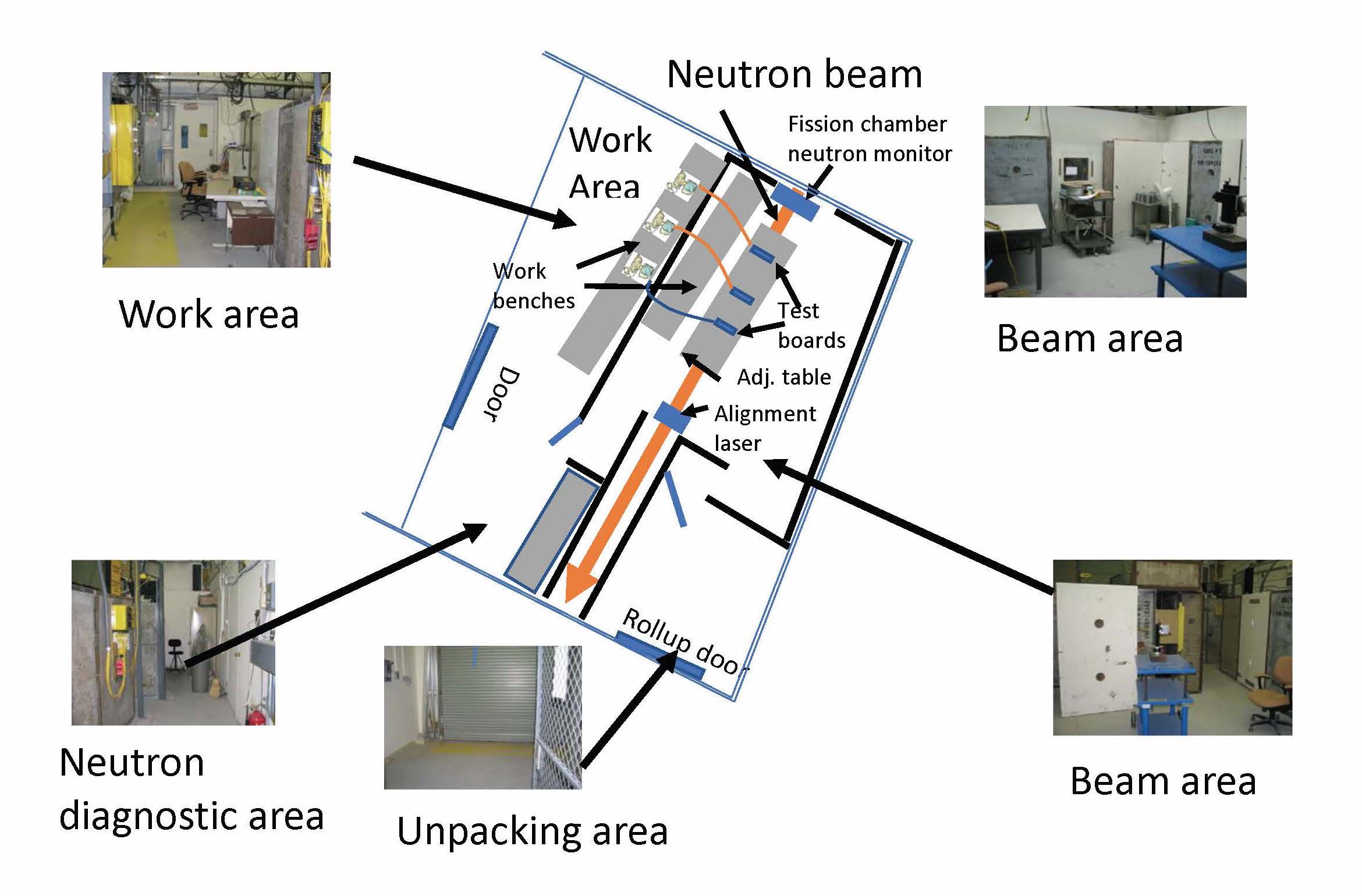
The number of neutrons/cm2 passing through the devices is measured by a fission ionization chamber operated in time-of-flight mode. The experimenters are given TTL pulses that are proportional in number to the neutron fluence through the experimental setup. The experimenter can either count the number of pulses as part of their data stream or can use our counters and record the number at the end of their irradiation. The calibration constant that converts these pulses to neutrons/cm2 is measured continuously and given to the experimenters at least once/day or when conditions change.
Parameters of the ICE-I and ICE-II Experimental Areas
| ICE-I | ICE-II | |
|---|---|---|
| Height of beam above floor | 95cm | 124.5cm |
| Distance from production target to fission chamber | 19.67m | 13.87m |
| Integrated neutron intensity above 1.25 MeV | 2.4 106n/cm2/sec | 4.7 106n/cm2/sec |
| Integrated neutron intensity above 10 MeV | 1.2 106n/cm2/sec | 2.2 106n/cm2/sec |
| Beam spots available | 1”, 2”, 3”, 4”, 4.5” diam | 1”, 2”, 2.5”,3” diam |
The shape of the neutron spectra on the 30° flight paths at the Weapons Neutron Research (WNR) facility at LANSCE are very similar to the neutron spectrum produced in the atmosphere by cosmic rays but with a neutron flux of over a million times higher. This large flux allows testing of semiconductor devices at greatly accelerated rates.
There are two flight paths devoted to neutron radiation-effects testing: ICE-I and ICE-II. The ICE-I is located at 30° to the left of the proton beam and ICE-II is located at 30° to the right of the proton beam. Both provide a cosmic-ray like neutron spectrum.
Irradiation of Chips Electronics (ICE-II) is located on the 30° right flight path at LANSCE/WNR. At this angle, the shape of the neutron spectrum is very similar to that of neutrons produced in the atmosphere by cosmic rays but with a neutron flux that is over a million times higher. This large flux allows testing of semiconductor devices at greatly accelerated rates. Companies from around the world can use this facility to characterize components and study various failure modes caused by terrestrial neutron radiation. Detailed use of these flight path is described in the Radiation Effects and Electronics Testing handbook at the below link.