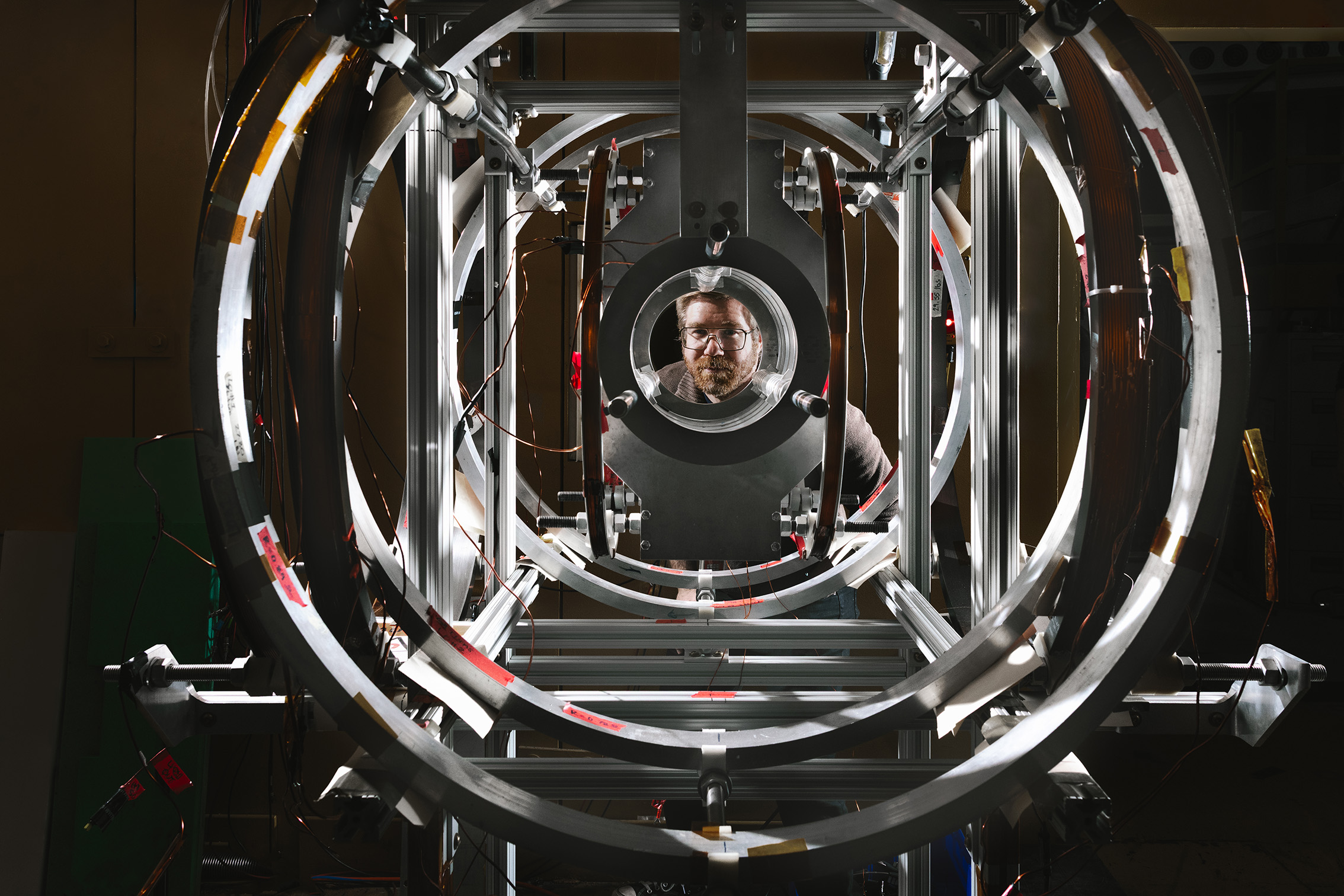
A new flight path for nuclear science that leverages the Mk-IV spallation source upgrade
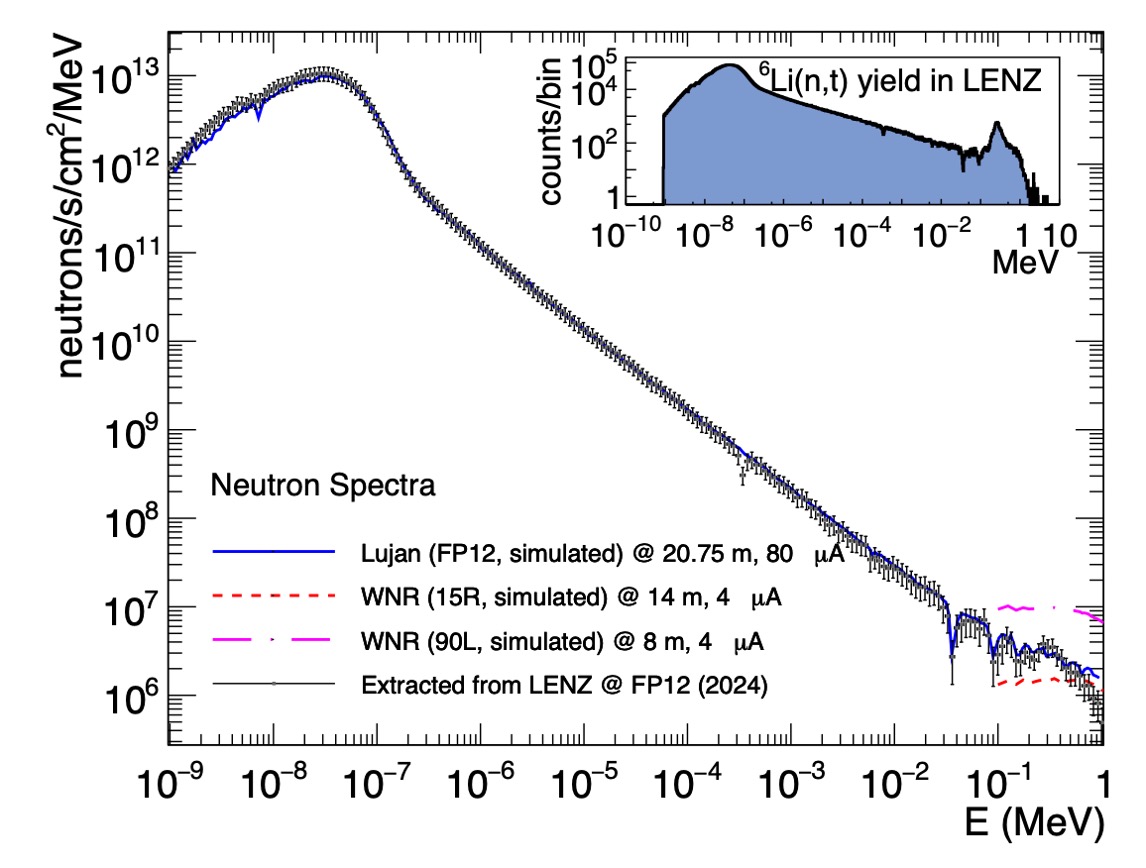
Flight path 12 has been recommissioned after the recent Mk-IV upgrade with measurements using the LENZ and SPIDER detector systems. These detector systems were originally designed for measurements with fast neutrons at the WNR facility but can also be deployed at FP12 for measurements of non-threshold reactions extending down to thermal neutron energy. This enables measurements to be made with a consistent experimental setup overlapping in the energy range between 100 keV and 1 MeV, as illustrated in Figure 1. The portable and modular nature of LENZ makes this move between facilities easy. Applications include nuclear reaction studies, nuclear astrophysics, radiochemical diagnostics, and nuclear criticality safety.
Meanwhile, the Neutron Optics Parity and Time-Reversal Violation Experiment (NOPTREX) Collaboration has developed a suite of detectors for use at FP12 to measure parity and time-reversal symmetry violation in neutron-nucleus interactions [3,4]. Testing components of the full detector suite, or other small footprint measurements, can potentially be performed parasitically with during LENZ or SPIDER measurements.
Scientific Applications
Fission product yields (FPYs) refer to the distribution of isotopes produced when a heavy nucleus, such as uranium-235 or plutonium-239, undergoes fission. They are categorized in two main ways:
- Independent yields: The number of atoms of a specific isotope produced immediately after the emission of prompt neutrons, which occurs within approximately 10-15 seconds after fission.
- Cumulative yields: The total amount of a specific isotope after accounting for the decay of precursor isotopes in the fission decay chain.
FPYs can be expressed as percentages or probabilities, describing the likelihood of producing a particular isotope. They are essential for testing theoretical models of nuclear fission and have important applications in nuclear weapons diagnostics, determination of nuclear fuel burn-up, and calculation of source terms for spent fuel and waste stream analyses.
The megaSPIDER Instrument at LANSCE
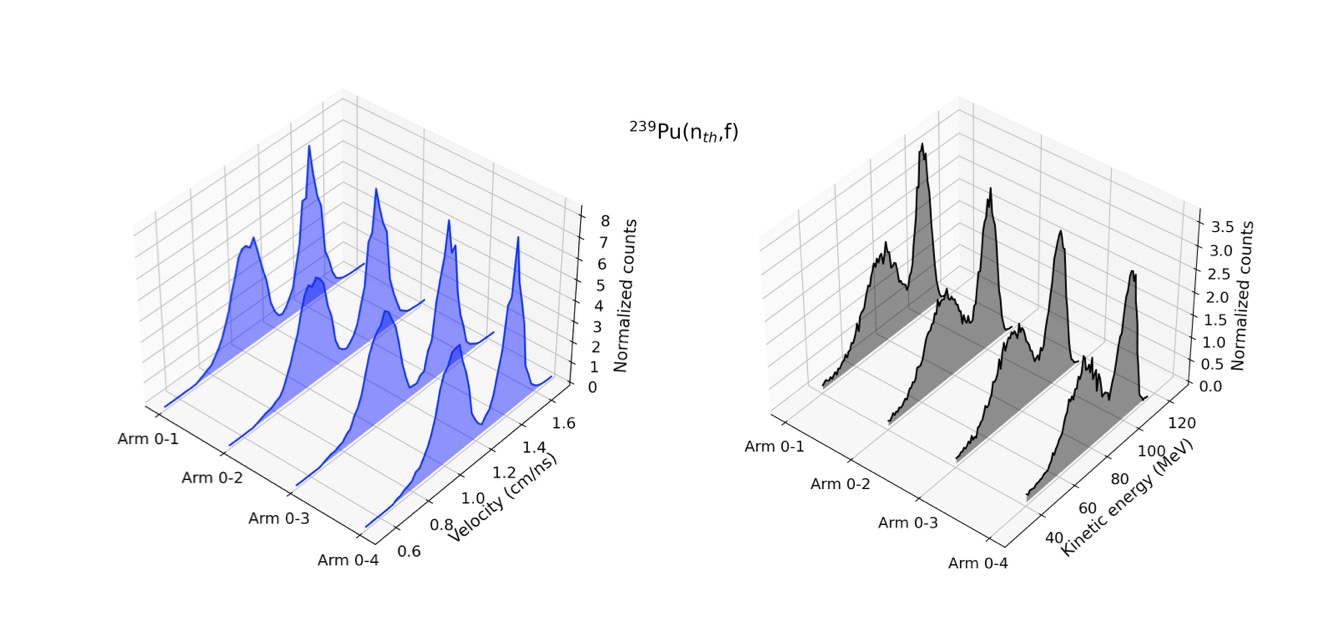
The SPectrometer for Ion DEtermination in fission Research (SPIDER) was developed at the Los Alamos Neutron Science Center (LANSCE) to measure independent fission product yields (IFPYs) in direct kinematics, with a target accuracy of better than 10% for incident neutrons in the energy range from 0.01 eV to 20 MeV. The instrument employs the double energy–double velocity (2E–2v) method, a powerful technique for measuring IFPYs with high accuracy and a mass resolution close to 1 amu FWHM for light fragments. This method combines measurements of both the kinetic energy (E) and velocity (v) of fission fragments to determine their masses using the relation:
m=2E/v2
By measuring both the kinetic energy and velocity of each fragment, their masses can be extracted with reduced dependence on theoretical models. Traditional methods that rely solely on energy measurements (e.g., twin fission chambers) are affected by neutron evaporation from the fragments, which alters the mass–energy relationship. The 2E–2v method mitigates this issue by incorporating velocity measurements, enabling more accurate mass determination and, consequently, more reliable FPY measurements.
The kinetic energy of fission fragments is measured using double-sided silicon strip detectors (DSSDs). Their velocities are determined via time-of-flight (TOF), using two microchannel plate detectors (MCPs) positioned at known distances from the target. The full-scale instrument, megaSPIDER, consists of eight detector arms, each comprising a TOF section and a DSSD. This configuration provides sufficient solid angle coverage to enable independent FPY measurements at the Weapons Neutron Research facility using fast neutron beams.