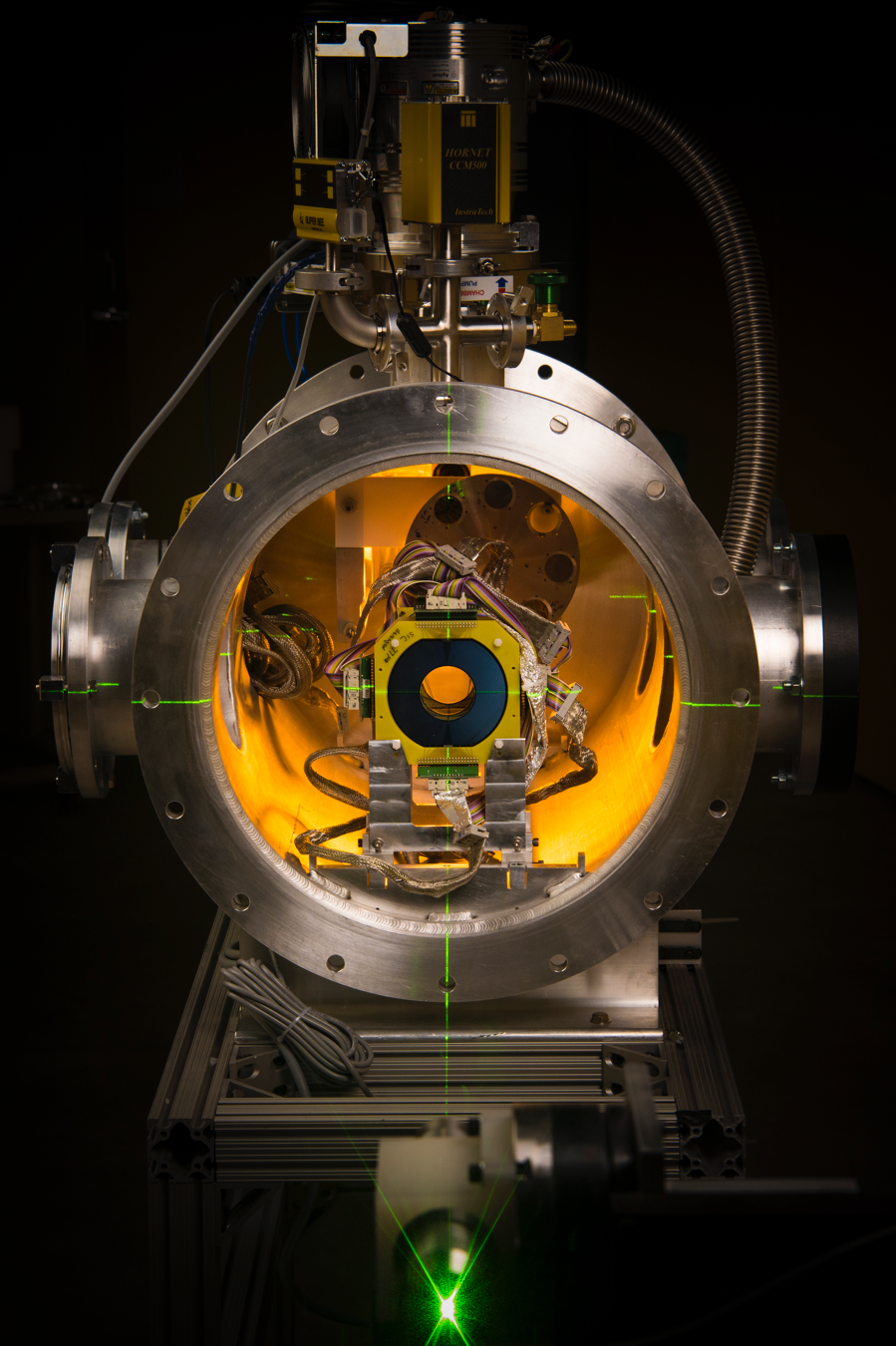
The Target 4 Flight Path 15R is in building 1302 with an available path length of 13–29m from the T4 spallation target.
4FP15R is dedicated to study neutron-induced charged particle reactions using the Low Energy NZ (LENZ) instrument with stable and radioactive samples1. Applications include nuclear reaction studies, nuclear astrophysics, radiochemical diagnostics, fusion energy, and next-generation nuclear reactor design.
The long flight path length allows for more than one experiment to be accommodated in parasitic mode if needed, for example, the total kinetic energy release experiments on actinides were performed in this mode2, 3. This length also allows transmission measurements at neutron energy higher than 1 MeV to be performed4. Sweeper magnets are located after the shutter and the last collimator in the flight path, to deflect charged particles generated from the spallation neutron target and along the flightpath in beam collimation materials. Flight path 15R has a variable jaw shutter with a maximum aperture of 4” square. This adjustable shutter aperture provides flexibility in delivered beam flux at the- sample location for the
case of detector characterization measurements.
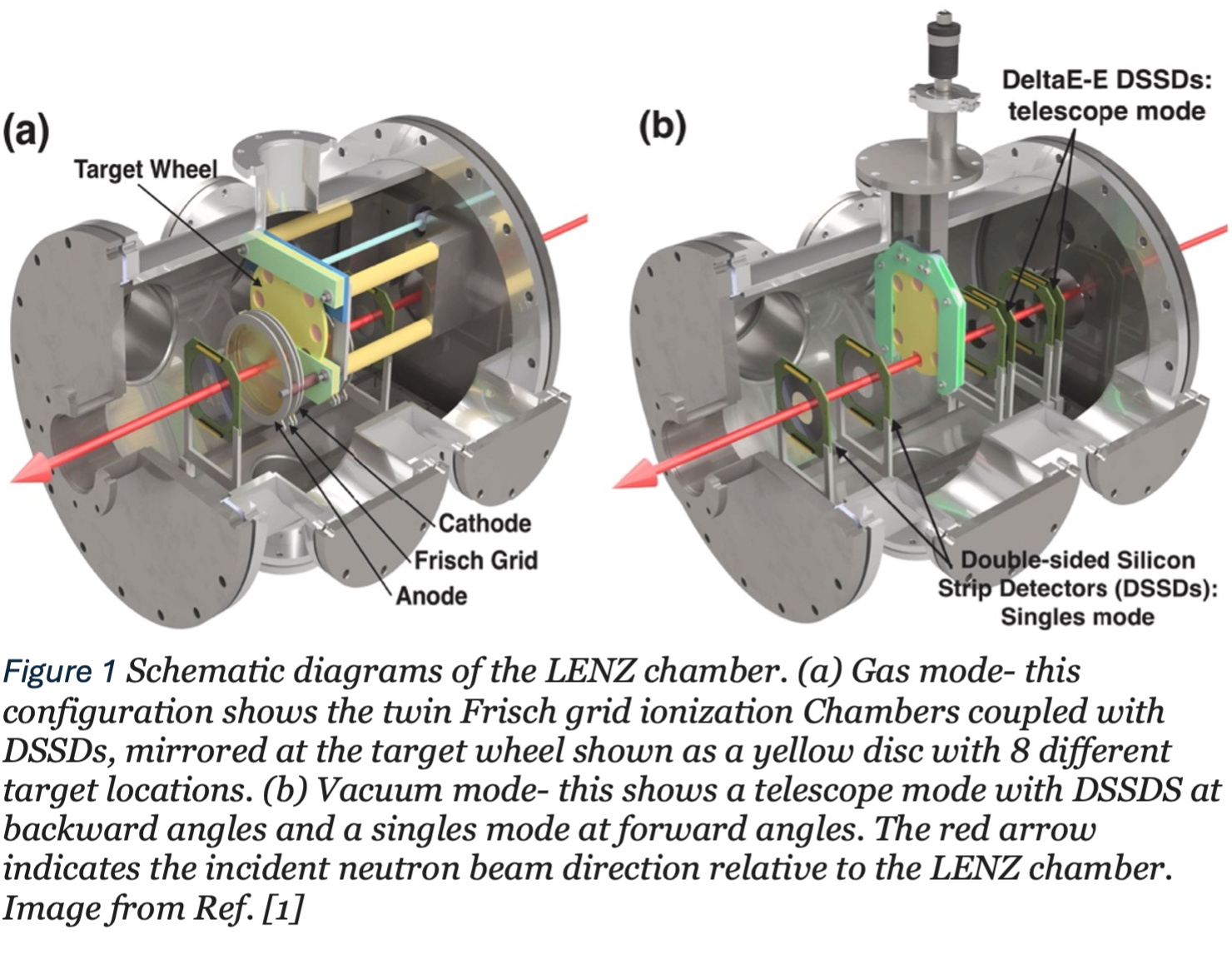
Presently, the Low Energy Neutron-induced charged particle (Z) (LENZ) instrument was designed to measure neutron-induced charged particle reactions on isotopically enriched, rare, or radioactive isotopes, with relatively high efficiency to compensate for small sample quantities5-10. Implementation of state-of-the-art waveform digitizers enhance the power of the experimental system in separating and identifying different charged particles, obtaining improved timing- and energy- resolutions, and processing high throughput rates.
As shown in the schematic diagram of detector configurations, LENZ is designed for flexibility in the detection of the outgoing energy and angle of charged particles by coupling a gas detector with silicon detectors or by successive stacks of silicon detectors. The double-sided silicon strip detectors are segmented to provide position information for reconstructing the reaction kinematics and measuring differential cross sections with respect to outgoing angle. The number of silicon detectors (detector thickness ranges from 60micron to 1500micron) can be easily reconfigured, to increase the solid angle or tune energy loss in the detectors. Now, the instrument is commissioned and well utilized, measuring (n,p) and (n,a) reaction cross sections with neutron energies up to 50MeV at the WNR facility.
The hotLENZ experimental system has been developed to study (n,p) and (n, a) reactions with radioactive samples produced from the Isotope Production Facility at LANSCE. Due to the potential for high radiation dose rates, the sample transport and manipulation are remotely controlled. The experimental system has also been designed for rapid assembly, minimizing personnel exposure while preparing for these reaction studies. Charged particle detection capabilities include double sided silicon detectors or a single crystalline diamond detector array.
The experimental system can also be utilized at T4 90L flight path to capitalize on the higher neutron flux available below 5MeV, in contrast to 15R (shown in the comparison of different neutron energy spectra at WNR). This expanded capability is useful for the case of low cross-section measurements which are typical of reaction studies of astrophysical interest.