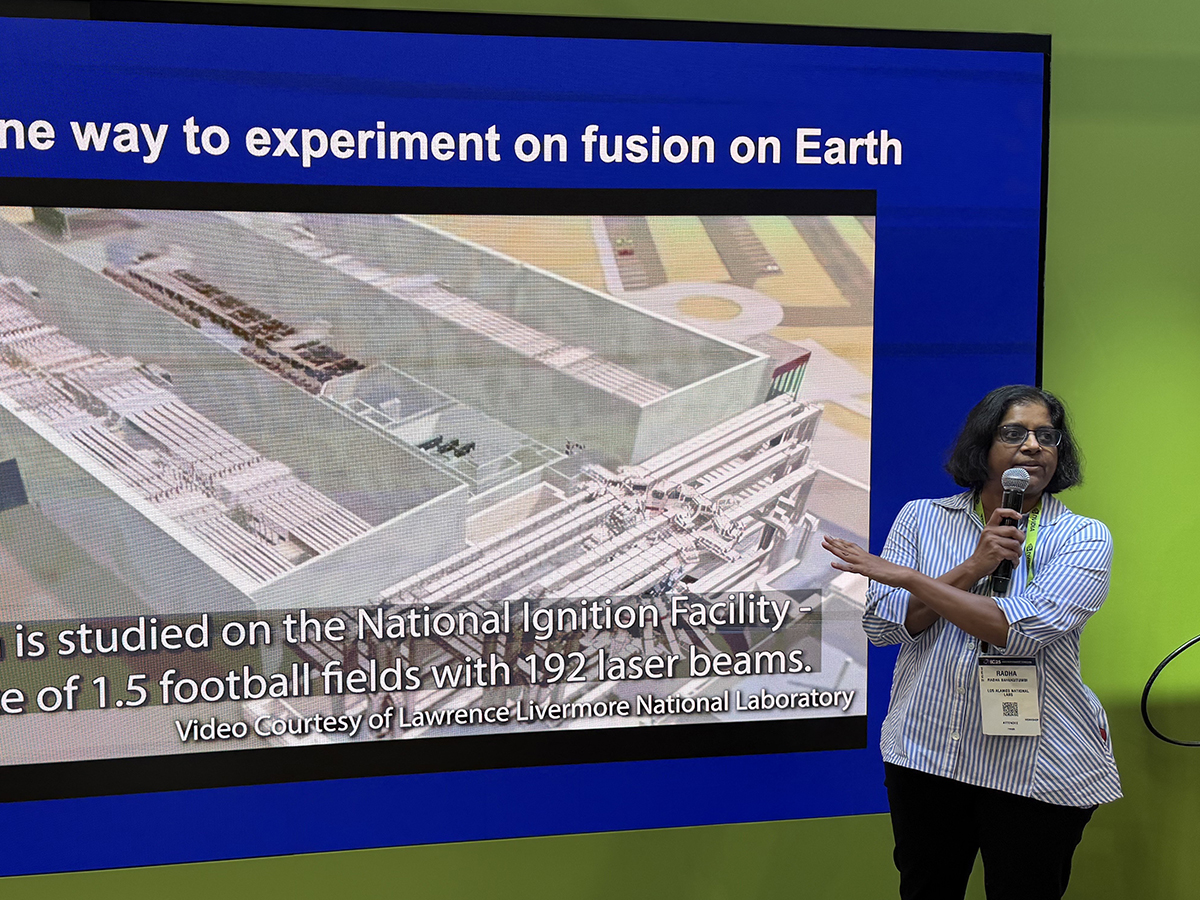
The next big fusion breakthrough could be made using artificial intelligence (AI). That’s according to Los Alamos National Laboratory physicist Radha Bahukutumbi, who is training AI large language models (LLMs) to solve problems and identify new concepts related to inertial confinement fusion (ICF). Bahukutumbi says this approach helps scientists learn more about working with AI while tackling fusion challenges at the same time.
“ICF is a perfect problem—it’s a nonlinear, highly-coupled, multi-physics problem grounded in experimentation,” says Bahukutumbi, noting that ICF is complex with many variables and available data from real-world experiments. She says LLMs can identify new concepts, improve workflow, and improve fusion target design. “We could have picked an easier problem,” she says, “but this will give us results that are relevant to the Lab’s national security mission.”
The Lab collaborated with the high-performance computing company NVIDIA to train and fine-tune the LLM, named Prospero after Shakespeare’s character known to orchestrate events and the Spanish word for success.
Training Prospero was a complex problem with multiple steps. “First, we provided Prospero with existing ICF research, feeding in 1.3 million documents containing relevant scientific reports and data,” Bahukutumbi explains. “Then, we gathered questions from fusion experts from across the Lab and, using those questions, tested its knowledge. After that, NVIDIA used a different LLM to create 33,000 ICF questions. They pulled 600 questions randomly from the pool and gave them to the Lab’s ICF experts to review and whittle down to 450. Then, the scientists analyzed Prospero’s ability to answer the questions. We have verified that Prospero can continue to understand fundamental science while becoming fusion-aware and will soon put the LLM through its paces here at the Lab. Our next major goal will be to figure out how to feed real-world experimentation data into the LLM.”
She says that the ultimate test of Prospero will be to ask it to design a novel ICF experiment. Scientists will then execute the experiment and ask the LLM to improve the result. “If we can use AI to identify new concepts, explore failure modes, test models, and improve predictability and engineering features, we can advance both LLMs and ICF.”
Bahukutumbi points out that when Prospero is trained, fine-tuned, and tested, fusion research will still rely on human expertise. “The AI serves as an assistant,” she says. “Some people will say it’s important when using an AI tool to have a human in the loop, but the truth is we have a human with an AI tool in the loop.”
Bahukutumbi agrees human feedback is essential for LLM training. “You have to keep it honest,” she says. ★