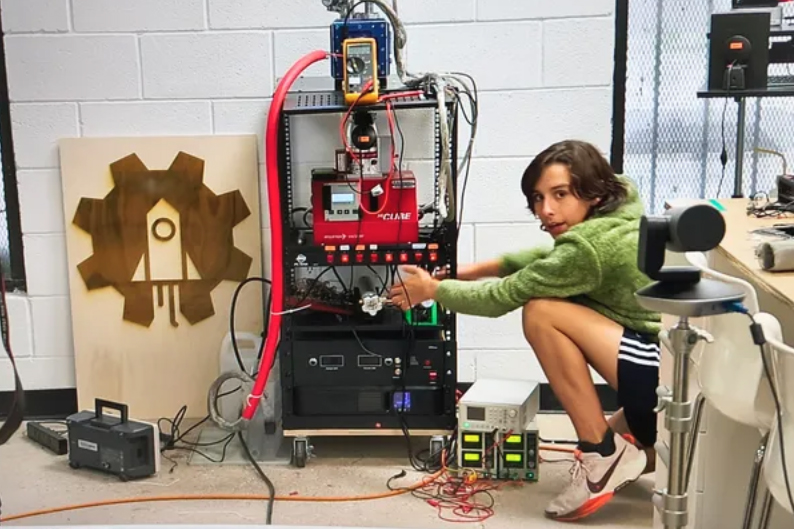
Most eight-year-olds build things out of Legos. Aidan McMillan decided to build a nuclear fusion device—under the supervision of watchful adults.
Four years later, his homemade fusor began producing neutrons—the signature of fusion—there was only one problem: proving it. For that, he turned to Los Alamos National Laboratory.
The researcher who answered the call for help, Robert Dwyer, recognized something familiar. As a teenager, he had made a similar fusion device himself. “We got an email from this kid’s mom reaching out to Los Alamos to see if there was anyone who had the expertise to verify his claim and help certify his device,” Dwyer says. “It just so happens; I had built one of these machines before.”
Dwyer started work on his fusor at age 15 and achieved fusion at 17. McMillan reached his goal by the time he turned 11 and decided to go for a spot in the Guinness Book of World Records as the youngest person to accomplish this feat. With Dwyer’s help, he verified his success just a day before he turned 13.
McMillan says setting a record was never his goal. “It was always just about finishing the fusor,” explains the seventh grader, who also enjoys hanging out with friends, playing in his school band, and going rock climbing. “I kind of just picked a project, said I want to do this thing, and then learned about it and gained a lot of skills. For me, it’s about the skills that I learned.”
McMillan and his parents live in Dallas, Texas. Neither his mother nor his father has a scientific background, but they share a commitment to helping their son learn. McMillan’s mother, Shirin Foroudi, remembers watching Aidan as a fourth grader teaching himself physics and nuclear engineering. “There were some things he read that he had to Google every word,” she says. “He spent a lot of time really understanding it conceptually before he started building anything.”
McMillan built the fusor under adult supervision at the Dallas Makers Space and Launchpad Incubator, a makerspace for teens that his parents founded. The device uses high voltage and a vacuum chamber to create the conditions for fusion. “Aidan was at the makerspace all of his weekends and holidays,” his mother says, adding that she spent a significant amount of her chaperoning time knitting. “I remember one Thanksgiving break when he was just there all day, every day, but I drew the line at Thanksgiving. I was like, absolutely not.”
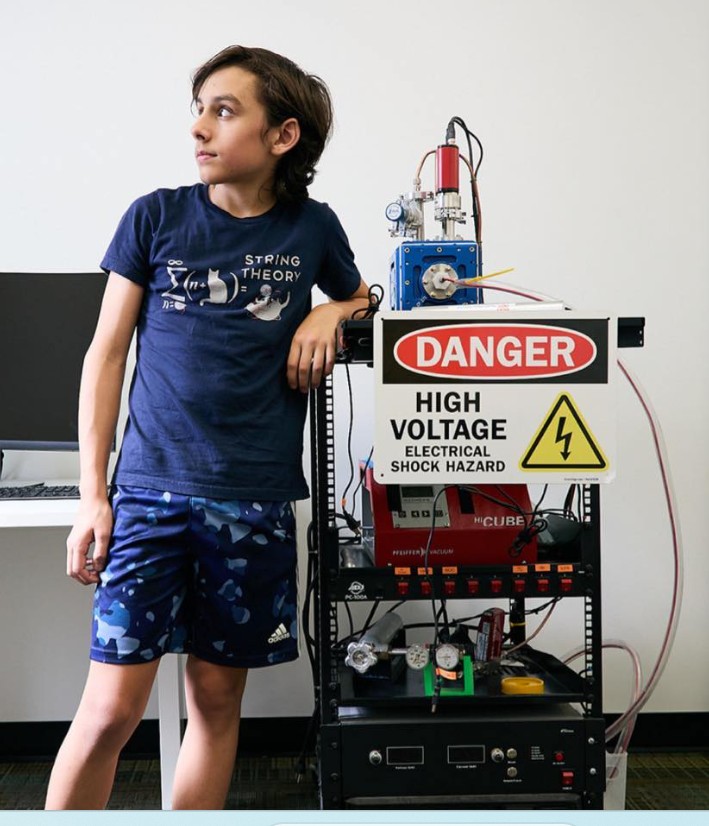
But despite that enforced break, McMillan’s parents supported the project, purchasing most of the parts for the fusor on Ebay and obtaining deuterium gas, a hydrogen isotope that serves as the fusion fuel, from an industrial supplier.
“The device uses electric fields to heat and accelerate deuterium gas to fusion conditions in which the atoms come together and combine—or fuse—producing neutrons,” Dwyer explains. “You need vacuum chambers, vacuum pumps, and a high voltage supply that creates an electric field,” he says.
When electricity passes through the deuterium, it strips away electrons, leaving behind positively charged ions and forming a plasma—a glowing cloud of charged particles. “The deuterium plasma is purple, but that purple glow doesn’t show the fusor actually works,” McMillan says. He explains that the electric field pulls the charged particles together, so they collide, slamming together to produce energy and release neutrons. “The neutron generation proves the fusor works,” he says.
To submit his achievement for a world record, McMillan needed two specialist witnesses. Dwyer knew exactly who to enlist for the second witness role. He turned to Carl Willis, the scientist who had helped Dwyer build his own fusor decades ago. Willis, a University of New Mexico nuclear engineering professor who also worked at Sandia National Laboratories, traveled to Dallas with a specialized neutron detector. As Dwyer watched remotely, McMillan flipped the switch.
“I concluded that Aidan’s fusor was producing at least 150,000 neutrons per second and perhaps as many as 220,000 per second,” Willis says. “While Aidan’s system is not close to setting any records for most efficient or highest neutron output, it did perform easily measured deuterium-to-deuterium fusion while I was visiting.”
Willis says he was happy to make the trip to Dallas to support McMillan. “I benefited from expert mentorship in my hobbies as a young person, and I believe these formative experiences were essential in developing my passion, my skill set, and my professional network as a mature nuclear engineer. Creating these opportunities for the next generation is therefore important to me because I know firsthand how valuable they are.”
Willis and Dwyer also checked to make sure McMillan understood the safety precautions needed for building and operating the fusor. “Nuclear physics is often popularly regarded as an impossible pursuit for kids—a perhaps-dangerous activity that is the exclusive domain of secure, high-budget labs,” Willis explains. Although McMillan’s device does not generate dangerous radiation, it uses high voltage electricity, which can be dangerous when used incorrectly.
“There’s significant electrical hazards associated with building what’s essentially like a mini particle accelerator,” Dwyer says. “I made sure to check that things were properly insulated and that there weren’t wires or things hanging out where people could touch them. Aidan was also working with people who had had a bit of a knowledge of those electrical hazards as well and could adequately supervise him and supervise the effort to make sure it was safe.”
As for McMillan, he describes the process of building the fusor as both fun and frustrating. “It came together, and then it was fun for a bit. Then there was more frustration and a lot of work, but it ended up being worth it,” he says. One aspect of the achievement he’s not as sure about is the attention he has received from his classmates. “Kids say things like, ‘Hey Aidan, did you split the atom today?’ and I’m like, ‘No—that’s actually the wrong thing entirely.” ★