The concept of creating fusion in the laboratory has captivated scientists for nearly a century. This quest to replicate the power of the stars ignites passion and persistence rarely paralleled in other fields. Over the decades, fusion research has played—and continues to play—a significant role in the careers of physicists and engineers at Los Alamos National Laboratory. National Security Science set out to explore what inspires some of the Lab’s most focused fusion fans.
Some scientists say they were first drawn to the field because of fusion’s potential for offering a transformational source of energy. Physicist David Meyerhofer says he began working in fusion research during his junior year in college. “I was a child of the 1970s energy crisis and decided to pursue a career in fusion as a future energy source.”
Physicist Steve Batha followed a similar path. “My passion for fusion research began during the ’70s when a lack of cheap energy began the awakening of America to our dependence on energy, especially energy created within our borders. My attention was drawn to plasma physics and fusion by my undergraduate research projects.”
Although both Batha and Meyerhofer say their careers have pivoted to focus more on the national security applications of fusion research, the drive to create fusion energy still motivates many Los Alamos physicists and engineers. “The Laboratory has a broad range of capabilities that can be advantageous to the field of fusion energy,” says chemical engineer Victoria Hypes-Mayfield. “I'm excited by the growth the Lab has seen in this area and hope to see more elevation of the efforts to bring fusion energy to the grid in future years.”
The pursuit of fusion energy also inspires physicist Mike Lively. “Fusion research spans so many diverse fields, from plasma physics and mechanical engineering to materials science and radiation safety. It’s great to work at the intersection of so many different fields and learn so many new things while driving toward a clean and sustainable energy future.”
Lively notes that Los Alamos contributes to all areas of fusion research. “Some of these areas are obvious, like plasma physics and fluid dynamics work, but some of these areas might surprise you, like the nuclear reaction measurements and data that folks use for radiation transport calculations to make sure fusion power facilities will remain safe and operational,” he says. “The Lab truly does it all!”
Hypes-Mayfield stresses the cross-disciplinary aspects of fusion research, saying, “I've always been really excited about the hugely collaborative nature of the field. The multitude of challenges facing fusion energy are closely linked, with solutions in physics causing problems for engineering, and vice versa. This really drives home the need for close communication between all areas to create the solutions the world so desperately needs. None of the problems in fusion science can be solved in a vacuum, and a whole-system approach is needed.”
That complexity inherent to fusion science attracts many researchers. Fusion is often described as a grand challenge problem that involves solving multiple scientific and engineering challenges simultaneously.
“Fusion research represents rich physics with lots of applications,” physicist Ryan Scott says. “This is big science, and there’s a lot to learn.”
Postdoctoral researcher Damyn Chipman says all his work at Los Alamos is related to fusion. “The Lab is at the forefront of inertial confinement fusion research through novel ignition platforms, advanced diagnostics, and state-of-the-art computer simulation capabilities,” he says. “It’s a complex, multidisciplinary field that makes for some very interesting problems and rewarding challenges.”
Speaking of challenges, other scientists point out that fusion research pushes their work to new levels. “I find fusion interesting because it combines so much disparate physics and really stresses our computational capabilities,” says physicist Brian Haines, who helped develop the xRAGE computer code, a key fusion modeling tool.
Similarly, Derek Schmidt, the leader of the team that builds fusion targets, says, “The work has always been very challenging in an exciting way. Our requirements push us to have the world’s highest precision machining and inspection capabilities to achieve the specifications that range from microns to nanometers.”
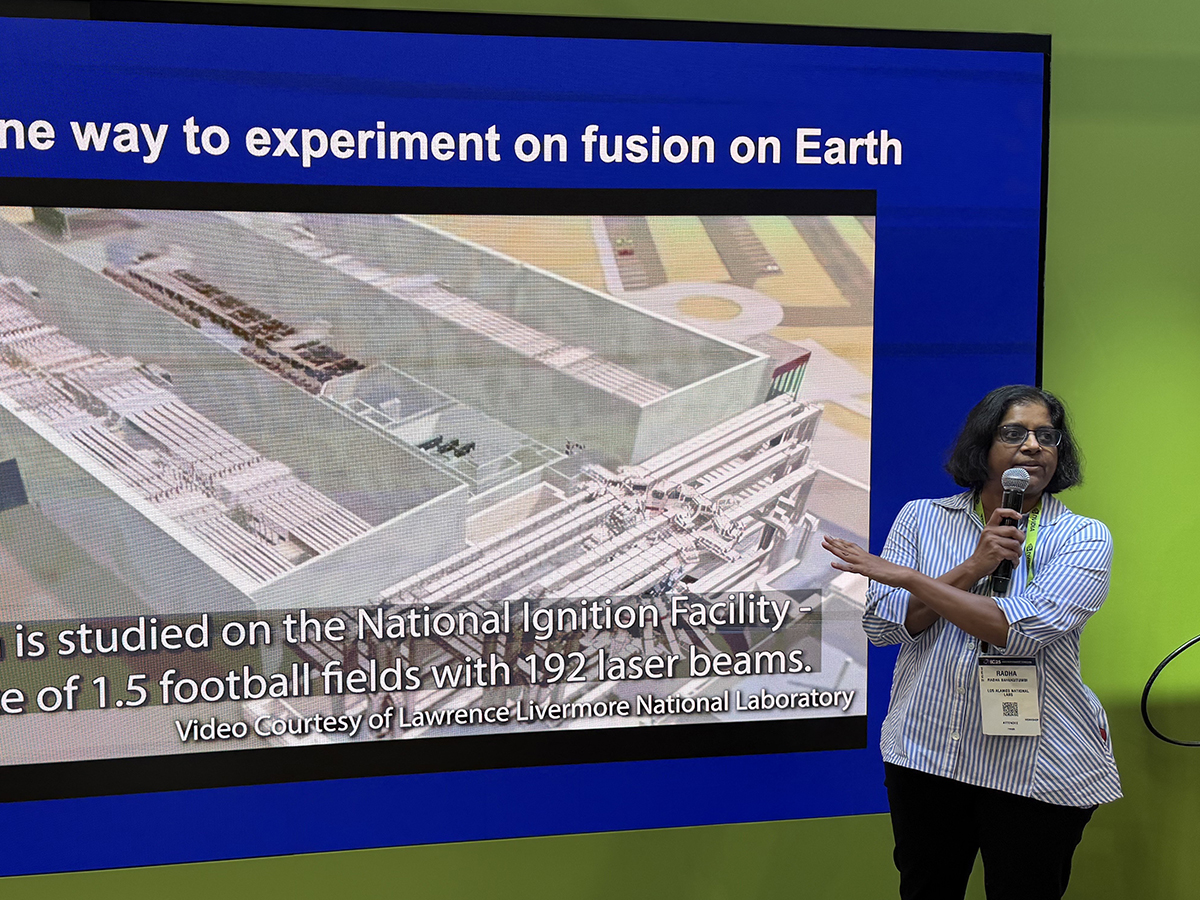
“Indeed, fusion is a remarkable field,” says physicist Radha Bahukutumbi. “To understand fusion, you can’t just be a theorist or an experimentalist. You must conduct simulations and experiments. You must go into the control room.”
For Bahukutumbi and other fusion researchers at the Lab, the field is far more than a career: it’s a calling. She says fusion demands creativity, resilience, persistence, and collaboration.
Finally, many Los Alamos scientists say they are drawn to the field due to their devotion to ensuring the safety, security, and reliability of the nation’s nuclear deterrent. “Fusion research allows us to leverage unique capabilities for the nation and ensure global security,” says researcher Robert Dwyer.
Physicist Ann Satsangi agrees. “At Los Alamos, fusion research is about embracing our national security mission.” She stresses the role that fusion science plays in designing, certifying, and assessing the nation’s nuclear weapons, but also notes the many related applications for fusion research. “At Los Alamos National Laboratory, we are accustomed to using cutting-edge science to make a difference in the world.” ★