Barreling through the vacuum of space at over 17,000 miles per hour, Earth’s reflection glinting off its solar panels, the satellite is fiercely efficient and mission driven. It has hard edges and cold surfaces. It is brand new and state‑of‑the‑art. It is an engineering masterpiece. And it’s roughly the size of an electric pencil sharpener.
Thousands of man-made satellites remain in space, dutifully reporting back or else drifting dead and dark.
Satellites are generally thought of as hulking beasts of instrumentation. They are billion-dollar machines capable of gathering and relaying huge amounts of data to and from almost any point on Earth. The first man-made satellite to orbit planet Earth was Sputnik I, launched by Russia in 1957. The first U.S. satellite, Explorer I, went up about four months later. Since then, thousands of man-made satellites have gone into space and many remain there, dutifully reporting back to Earth or else dead and dark.
Building satellites was always a long and expensive process—large satellites like those that serve global positioning systems can take a decade to complete and cost hundreds of millions of dollars (the biggest satellites can run well over a billion dollars). Their operation, too, is highly specialized and extremely expensive, so historically, space has belonged to the very few groups who had the time, money, training, and perhaps importance to justify the enormous costs. Among those privileged few, Los Alamos has been involved in numerous U.S. satellite projects, almost since the beginning. Starting in the early 1960s with the Vela watchdog satellites following the limited nuclear test ban treaty, many of today’s key satellites, such as NASA’s Swift satellite (a space observatory dedicated to the study of gamma-ray bursts and the concomitant birth of black holes), carry Los Alamos-designed and Los Alamos-built hardware. Leveraging decades of experience and Department of Energy investment, Los Alamos is now leading the way in a different direction, with some of the smallest, most affordable satellites ever sent into space.
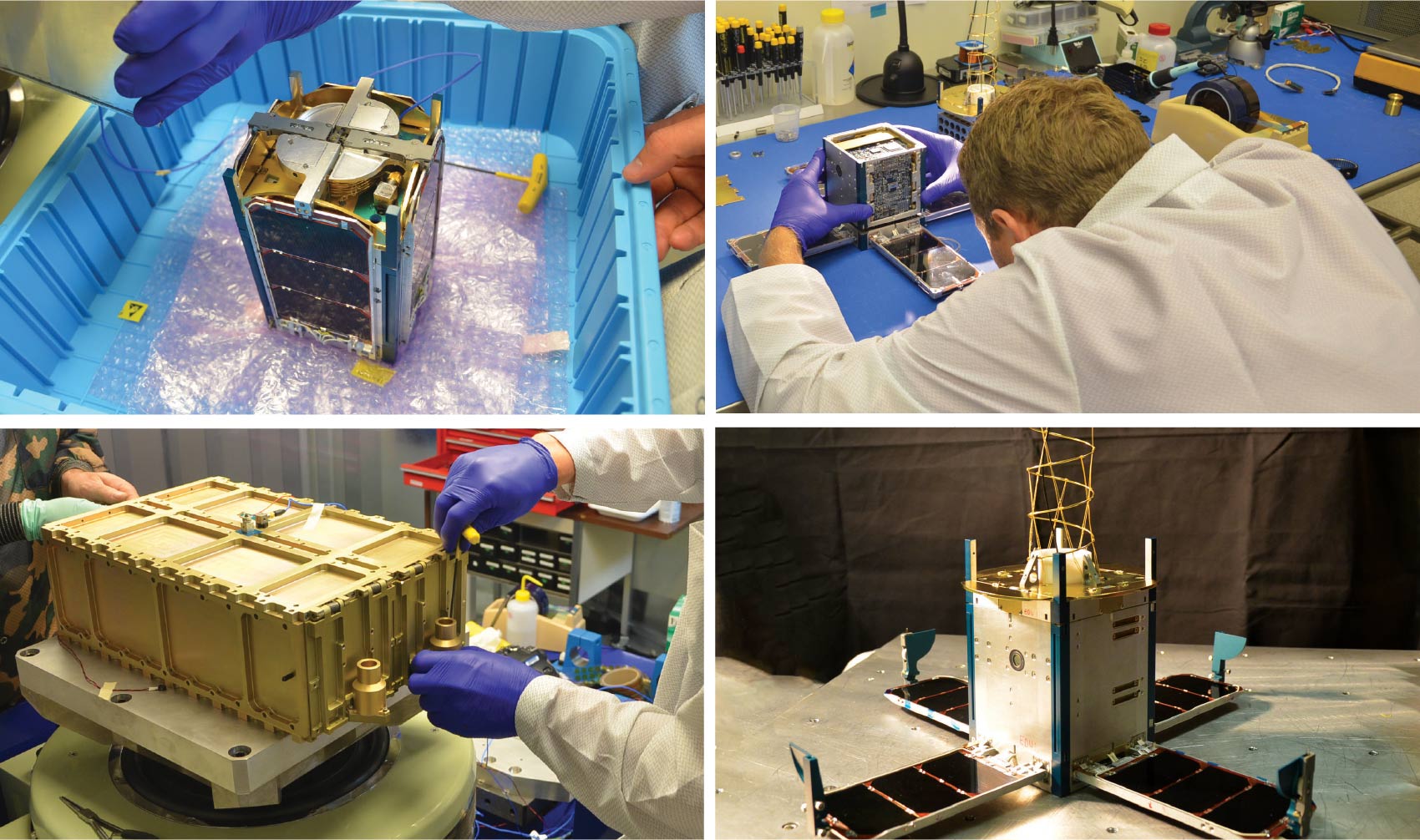
When tiny satellites, called CubeSats (referring to the shape of the original model’s stowed configuration, which was a cube measuring 10 centimeters on each side) were first invented in the late 1990s, they were seen as cheap, cute, and novel. They brought space within reach of everyone. Typically something that a college or graduate class might build together, with a modest budget over the course of a semester, a CubeSat could hitch a ride into space without much ado on a rocket primarily dedicated to larger, flashier cargo. But it could never be a contender for serious science. Or could it?
Perseus takes flight
A rapid-response satellite capability that is quick to build, easy to operate, and orders of magnitude lower in cost than traditional systems would enable many different types of missions and customers. For example, real-time data exfiltration from remote locations is an important mission, but has simply never been worth the astronomical costs, so to speak, of a dedicated satellite system.
In the spring of 2008, Andy Erickson, then in the Laboratory’s Intelligence Community Program Office, began wondering if CubeSats might be the answer to a particular rapid-response nut he and his colleagues were trying to crack. Yes, CubeSats were thought of as basically toys, but that didn’t mean their only uses were simple or trivial. Maybe with a little guidance CubeSats could step up and meet the challenge of modern national security needs. Spearheading the project, Erickson recruited Los Alamos colleague Steve Judd as project leader, and they spent the summer in a hot flurry of funding proposals, customer pitches, and preliminary research. By the fall they had secured initial funding, and the Los Alamos CubeSat effort, dubbed Perseus, was underway.
CREDIT: NASA/Chris Perry
Having been handed a particular mission, Judd and the Perseus team quickly decided that miniaturizing a large satellite was the wrong tack and they needed an alternative, nontraditional approach. A breakthrough came when they realized that by building the entire system in-house at Los Alamos, from solar panels to circuit boards to software, using commercial off-the-shelf parts, they could drastically slash the time and money involved. In-house manufacture is rare in the satellite world; typically each component comes from a different specialty lab or collaborator, which can take cost and complications sky-high. The satellite that Erickson, Judd, and their small team built took just six months and had a jaw-dropping reproduction price tag of under $20,000—that’s more than a thousand times less expensive than the lowest-budget traditional satellite.
Their motto became “design to the mission, design as a system, and keep it simple.” In other words, include only what’s necessary to do the task at hand and design all components simultaneously. The basic machine they designed consisted of one circuit board, containing a radio, flash storage, and a microprocessor. With a quick software change it could be configured as a satellite, a ground station, or a field unit. When connected to a custom solar panel charger and a small monopole antenna, the satellite and the system were complete in a single stroke.
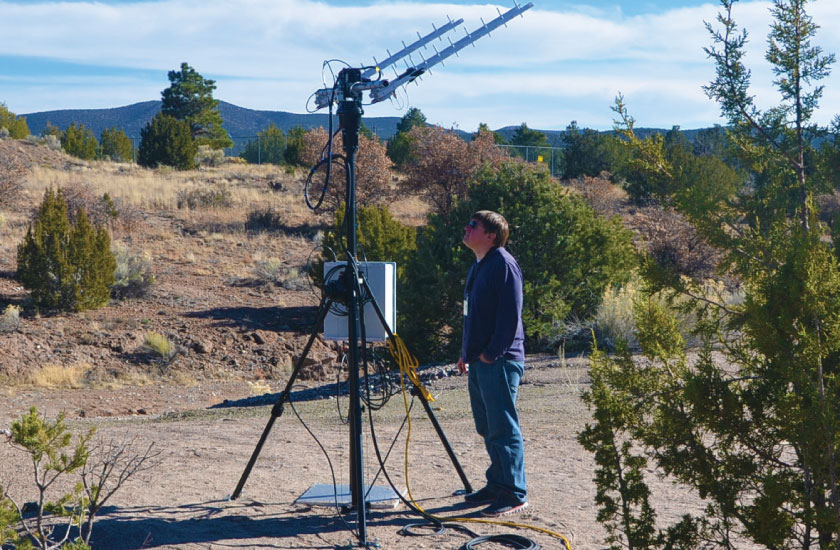
A radical departure from the norm, the Perseus system, consisting of satellites, ground stations, and field units, was so simple and seamless that non-expert users could operate it with just a few minutes of training. The ability to communicate from far away places in near-real-time was the main driver for the ground station design criteria of being low-cost, transportable and easy to set up. In the end, it too was shocking in both price (less than $5000) and in profile. Small enough to be transported anywhere in the world by car or plane, a ground station could be set up and operational in about an hour. And since it contained the same custom-designed hardware and software that went into the CubeSat, the two were literally made for one another.
It’s not a matter of miniaturizing a big satellite, it’s a matter of building the simplest satellite for a particular job.
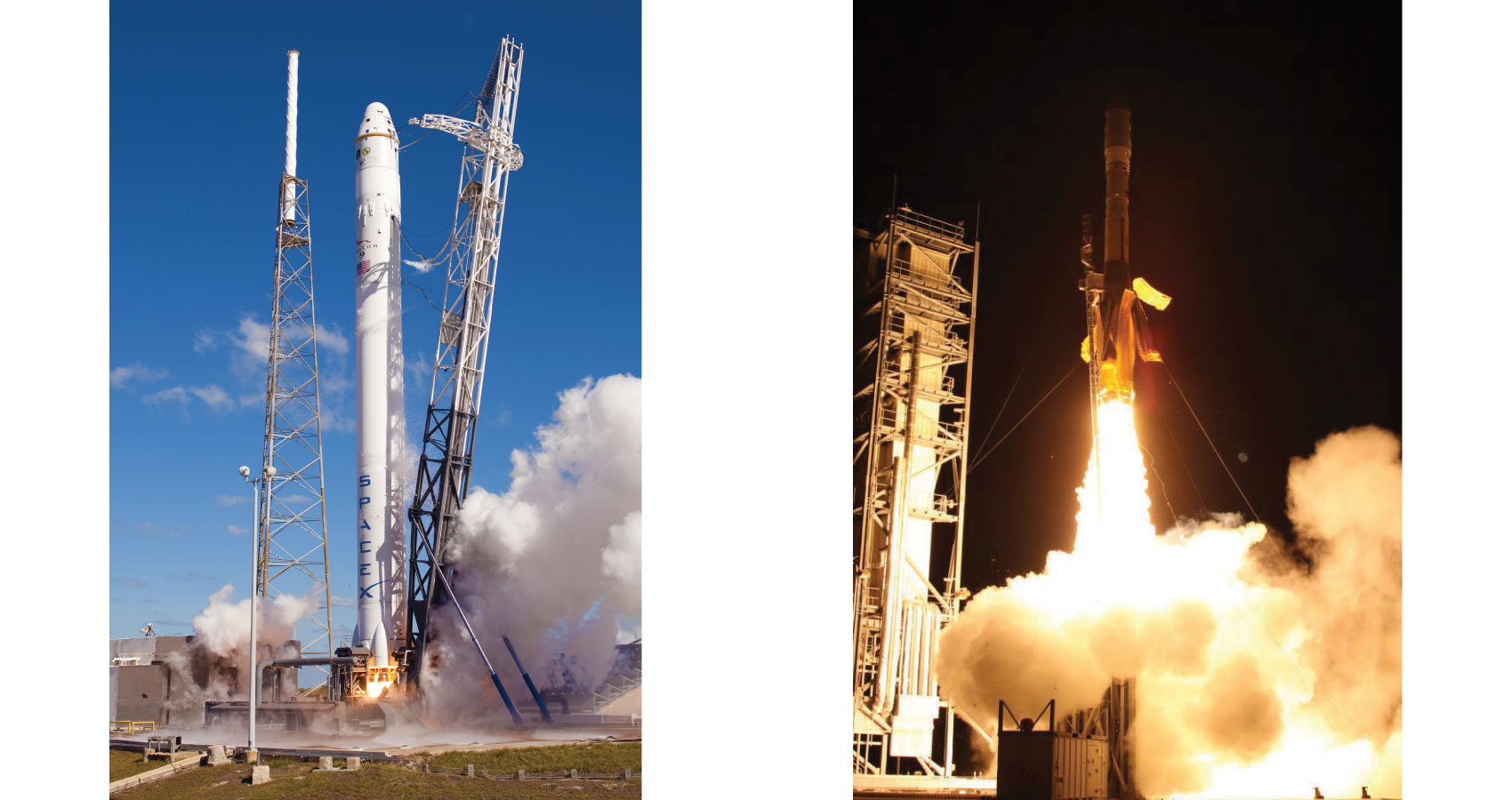
The first Los Alamos CubeSat went aloft in 2009 on a weather-balloon-type device to an altitude of 100,000 feet (more than twice the cruising altitude of a large commercial airliner). The balloon was launched in one location while teams in separate cars carried ground stations north, south, east, and west, to test communication capabilities from various distances as far as the next state over. After working out the bugs identified during the balloon test, four small Perseus flight units were chauffeured by sport utility vehicle to California for their reserved ride on a SpaceX Falcon 9 rocket, which launched in December 2010. Perseus was in flight.
“A lot of people said it wouldn’t work,” remembers Judd. The temperature extremes, energy demands, and size restrictions associated with traditional space components bred skepticism about how well these little satellites would actually work in space. But they did work. All four satellites deployed properly, linked to the ground station successfully on day one, and talked to the Perseus team daily for three weeks before leaving orbit and being destroyed—as planned—upon re-entry. (The “vacuum of space” mentioned at the beginning of this article, though illustrative, isn’t technically accurate. The Perseus CubeSats were in an orbit about 300 kilometers above Earth’s surface, which is on the outer fringe of its upper atmosphere. The drag created by atmospheric particles is what causes the CubeSats to leave orbit and fall toward Earth, gradually at first and then effectively all at once.)
The team, having been cautiously optimistic, was elated by the success. “It’s still a satellite,” says Judd, recounting his relief, “all the things that can go wrong with a big satellite can go wrong with a little satellite. Simple is not necessarily easy.” Of course there were small glitches, but there were no fatal flaws. After proving successful at two-way and three-way communication, as well as the collection and relay of telemetry data, the proof of principle that CubeSats could provide a useful, cost-effective strategy for rapid response was official, and it was time to take it to the next level.
Prometheus unboxed
The second-generation Los Alamos CubeSat project, called Prometheus and led by Nicholas Dallmann, is considerably more sophisticated than its predecessor. The team too has expanded, now including more than 70 dedicated scientists from 13 Laboratory divisions. The Prometheus CubeSats are built on the basic Perseus architecture and are the same size as the Perseus CubeSats, 10×10×17 centimeters, or 1.5 U. (CubeSats typically range from the original 10-centimeter cube at 1.0 U up to 3.0 U.) But Prometheus units carry an increased power budget, higher-performance radio, bigger antenna, and more processing power, plus an attitude control system, magnetometer, gyroscope, and sun sensor.
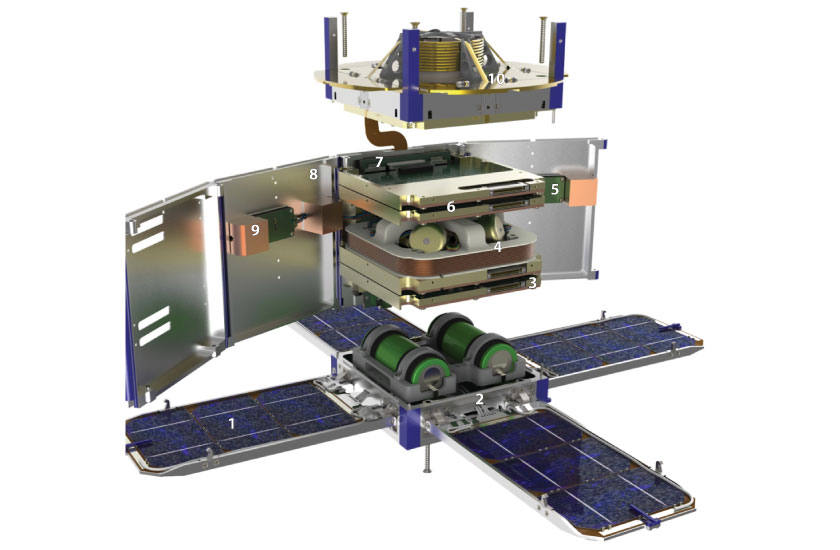
For a project like this, the devil truly is in the details; every single component has to be meticulously designed. For example, there is a tiny motor for the CubeSat’s attitude control (which direction it’s pointing) that involves a tiny wheel. The axle hole must be precisely (but precisely) centered, otherwise the whole thing wigs out like an unbalanced washing machine. And the grease—they had to find a grease to lubricate the tiny wheel that wouldn’t freeze but wouldn’t evaporate in a vacuum either. All it takes is one element to fail for the whole device to fail—it can’t be retrieved and fixed once it’s been launched. (Though CubeSats are far more disposable than traditional satellites, there are still considerable resources at stake and it’s important to get it right.)
In November of 2013, eight Prometheus CubeSats went up on an Orbital Sciences Minotaur 1 rocket, and once again, all deployed and established contact on day one. They went to a significantly higher orbit than Perseus, about 500 kilometers from the earth’s surface, which gives them a considerably longer life expectancy of about three years before re-entry. That’s good because with all the improved instrumentation, the price tag has crept up to almost $150,000 per unit. That may seem high compared to Perseus’s $20,000 price tag, but for a sophisticated spacecraft it’s still peanuts, and Dallmann is confident they can bring it down even more in the near future. With low overhead and 12 successful satellites over three years, compared to the historical average of about one small traditional satellite every five years, the CubeSats are definitely proving their worth.
The Prometheus system is clearly a product of the technological times. Numerous aspects of it have only recently been made possible: some parts are custom-made by 3D printing; the system interface is on a web page; the ground station basically runs itself, sending a text message to its operator’s cell phone if there is a problem; software updates transmit automatically when the CubeSat passes within range of its ground station, so there’s no chance of missing the window; and the use of “cognitive radio,” which automatically adjusts its parameters according to its environment, allows for very secure transmission encryption. There is more computing power among the eight tiny Prometheus flight units than on most active satellites as a result of the very modern parts used to make them. The evolution of off-the-shelf components, most of which are getting stronger, smaller, cheaper, and more easily integrated every year, has enabled a true satellite revolution.
CubeSat constellation
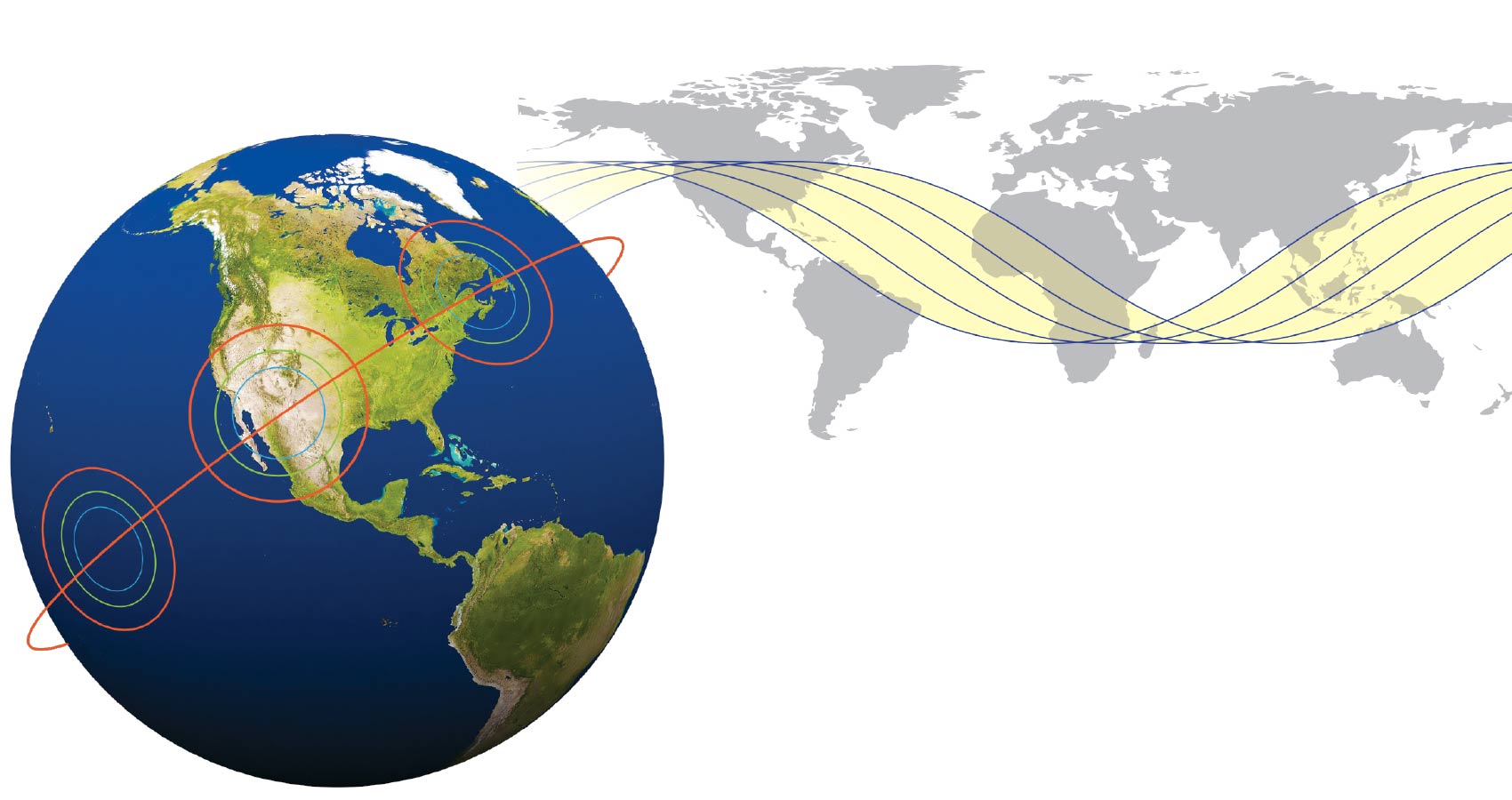
The Prometheus team refers to its array of CubeSats as a constellation of satellites. From this definition, their strength and novelty is evident: together they form a set of unique, specialized, highly compatible, and synergistic tools. They encircle the planet in single file, with each satellite completing a lap around Earth every 90 minutes. Although they travel within a fixed plane, the earth is rotating underneath the plane, so the satellites don’t trace out the same ground path with every lap. When a CubeSat’s path takes it within range of a ground station it’s called a pass. The best passes are when the CubeSat travels almost directly over the ground station, thereby minimizing the distance between the two. A poor pass is one in which the CubeSat passes just above the horizon at maximum still-visible distance from the ground station—any further and it would be out of range. Every time a CubeSat comes around to a given ground station, the first pass (approaching) is usually poor, followed some time later by a mediocre pass, then the best pass (closest to directly overhead), then another mediocre pass on the other side, and finally another poor pass as the CubeSat’s orbit travels out of range of the ground station. It takes roughly eight hours, with a 10–15 minute pass every 90 minutes, for a CubeSat to travel first into and then out of range of a ground station or field unit.
Over-the-horizon communication is one of the main functions of the Prometheus system. There are two ways in which it fills the bill. The first is called store-and-forward. In this mode, a sensor in the field (e.g. a camera) sends information to a CubeSat as it passes within range. The CubeSat then holds on to the information until the receiving ground station comes into range, at which point the ground station downloads the information from the CubeSat. This mode is unconstrained by distance—the CubeSat can hold the data for as long as it takes to arrive at the right ground station—but it isn’t the most expedient because the data can only travel as fast as the CubeSat itself.
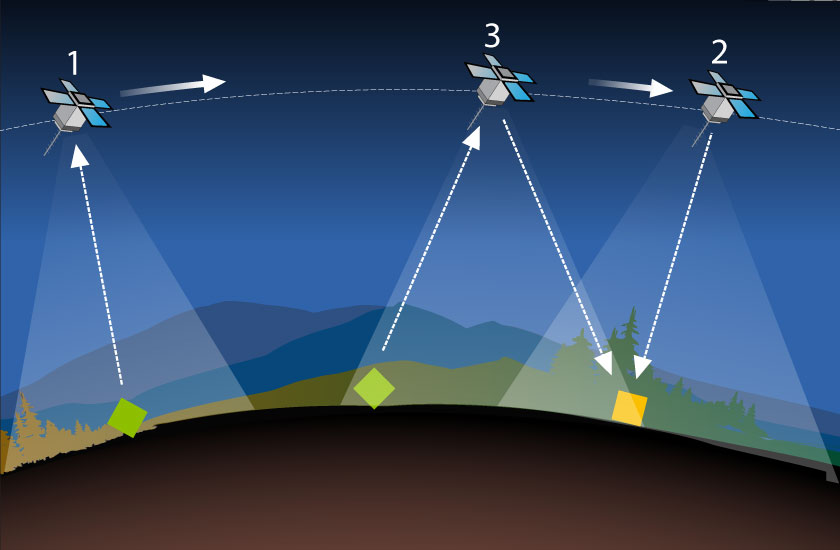
A faster mode is called near-real-time and basically uses the CubeSat to bounce information over the horizon. For near-real-time communication, the field sensor and ground station have to be in approximately the same region—a sensor in Norway and a ground station in Nebraska won’t work, but a sensor in Los Angeles and ground station in Los Alamos will work well. When the field sensor and ground station are regionally close but still out of range of one another (over the horizon), a CubeSat passing within range of both can relay information almost instantaneously. This method is faster than store-and-forward, but it’s constrained by distance. However, with considerable effort and creativity, the team got their CubeSat’s range up to 1700 miles, or almost half the distance across the continental United States. And since the ground stations are low in cost and high in user friendliness, they can be popped up as needed just about anywhere. So the distance constraint too was made manageable by the mission-driven CubeSat team.
Above and beyond
Although the Prometheus CubeSats are still going, Dallmann and the Prometheus team are already hard at work on the third generation of Los Alamos CubeSats, which they refer to as Prometheus block 2. With the block 2 CubeSats will come even more refinement and efficiency. Many things will be similar, but practically nothing will be identical—it will all be better. The solar panels will be twice the size (but cleverly won’t increase the volume of the stowed CubeSat), attitude control will be improved, and additional sensors will be added. The ground stations, too, will be similarly upgraded. “There are marvelous electronics now,” muses Judd, now a consultant on the project. “With the reliability of modern techniques they can really crank them out, making 20, 30, or even 40 in a year.” The team could make 40 CubeSats this year alone, but they probably won’t need to; block 2 is projected to consist of 10 CubeSats slated for launch sometime in the summer of 2016.
The ability to mass-produce its CubeSats was a key goal for the Prometheus team from the get-go. And an important step toward that goal, now underway, is the transfer of its unique CubeSat technology to industry. The team’s minimalist, in-house approach has opened up a whole new set of potential missions and customers, with all of the U.S. armed services and numerous private companies now investing in CubeSat research. One way that block 2 CubeSats will be competitive in the private sector is the plug-and-play aspect of their new hosted payload option. The payload is a special compartment that can be connected to the CubeSat and customized to a particular mission through modification of the contents. What type of technology or sensor goes in the payload will be decided by the customer, who can then focus on its desired data product and skip worrying about the nuts and bolts of the satellite itself.
CubeSats are reliable, practical, malleable little tools.
As if all of their empirical successes weren’t accolades enough, the Prometheus team was chosen this year to receive the U.S. Department of Energy Secretary’s Honor Award. This is the highest internal non-monetary recognition that Department of Energy employees can receive for their service and contributions to the mission of the Department and to the benefit of the nation.
The Prometheus effort is part of a larger program at Los Alamos, the Agile Space Program, which is concerned with new, low cost, rapidly deployed space systems. While CubeSats are the smallest satellites in this program, they aren’t the only ones. Most of the systems that have been perfected for Prometheus can be easily scaled up to larger (but still small) satellites. Having already invested the time and effort to develop CubeSat technology, the Agile Space Program stands to reap tremendous reward from other small satellite applications.
When CubeSats first came on the satellite scene, nobody knew that they could bring about a revolution in space-based communication (and, by extension, to the intelligence, surveillance, and reconnaissance tools that rely on that communication). But with some out-of-the box (inside the box?) thinking, they have stepped up as reliable, practical, malleable little tools ideal for nontraditional jobs. And since their lifespans are limited, they will always be new, always be modern, and never become dark hunks of space junk, drifting through eternity. CubeSats, it seems, have proven their mettle and earned some respect. So too has everyone on the Prometheus team. As Dallmann emphasizes, “We are a team; there is no member who is more important or deserves more credit than the others.” So, in a way, the team itself is like a fleet of CubeSats. With each member doing a specific task, quickly and competently, the team comprises a machine that is much, much greater than the sum of its parts.