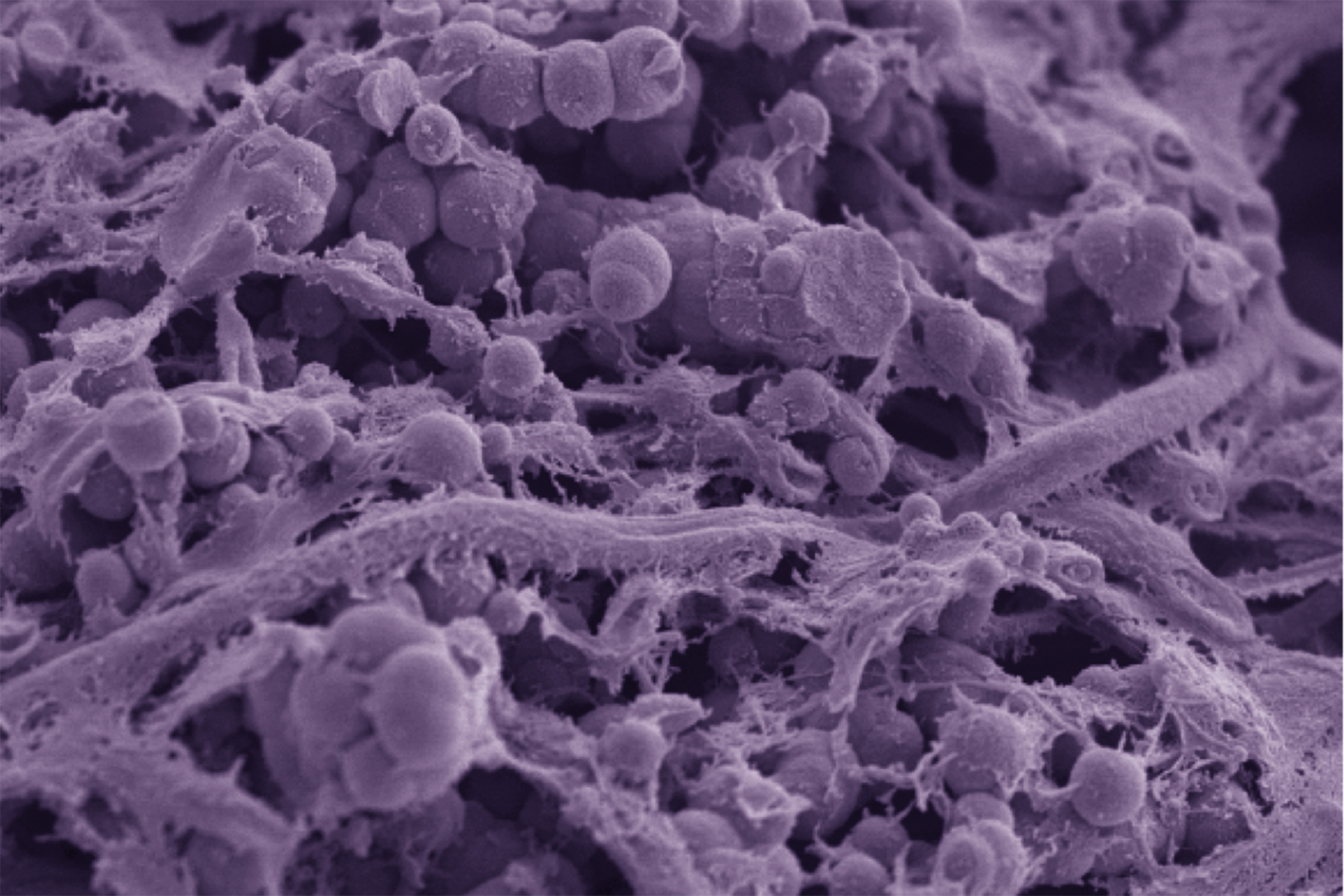
Many organisms in the natural world rely on each other and their surroundings for safety. Microorganisms, including bacteria and fungi, take this reliance one step further by sticking together—quite literally. They secrete proteins, DNA, and sugars to create a slimelike substance that helps them adhere to one another and to a surface. Together, the organisms and their slime are referred to as a biofilm.
Biofilms are great for microbes. They provide a secure environment in which the organisms are physically protected from dangers, such as antibiotics or drying out, while being able to communicate and network with each other by sending chemical signals. This ability to persist in various conditions allows biofilms to form anywhere—they comprise the slime lining on the inside of a glass fish tank or the plaque that accumulates on one’s teeth.
Unfortunately for humans, when biofilms are made of nefarious organisms, they can be a significant problem. In fact, biofilm-protected bacteria account for about 80 percent of total bacterial infections in humans and are 50 to 1000 times more resistant to antibiotics than their free-floating counterparts. Specifically, it is difficult for antibiotics to penetrate biofilms to kill the bacteria inside. To make matters more complicated, bacteria in this protected environment can develop antibiotic resistance and even confer the resistance to other members of the biofilm community.
Much research over the years has been centered on trying to physically disrupt and destroy biofilms, but often the successful treatments (such as bleach or the removal of dead tissue) are quite toxic and painful to humans and therefore tend to be used as a last resort. Recent work by Los Alamos biochemist David Fox and his collaborators at the University of California, Santa Barbara, Dixie State University, and Northern Arizona University has shown that an innocuous substance, a molten salt called choline-geranate, can be used to physically
disrupt biofilms as well as facilitate drug delivery. Specifically, this room-temperature liquid was found to completely eradicate the biofilm-forming pathogenic bacterium Pseudomonas aeruginosa in addition to physically penetrating the skin. The observation that the molten salts were able to both disrupt biofilms and kill disease-causing bacteria is a result with a lot of promise for therapeutics.
“Like a Trojan horse, we expected the salt to act as a carrier, delivering antibiotics to the bacteria inside the biofilm,” says Fox. “The surprise was that the salt acted as an antimicrobial itself that was nontoxic to the other cells around.” The molten salts were found to be at least as effective, if not more so, as bleach in breaking up the biofilm and killing the bacteria. But surprisingly, unlike bleach, there was no marked deleterious effect on a skin-wound model.
Molten salts are a type of ionic liquid—meaning they are made up of positively and negatively charged atoms. The exact mechanism by which they break down the biofilm is still being worked out; however, there are a couple of hypotheses. For one, it is thought that the ions interfere with the hydrogen bonding network that helps hold the biofilm matrix together. And when it comes to killing the bacteria themselves, Fox explains that it is possible the liquid also physically disrupts the cell membrane, bursting the cell or causing enough stress to the cell that it commits suicide. The mechanism by which the liquid seamlessly penetrates the skin, however, remains a mystery. Fox and his collaborators are hoping to find out more about the disruption mechanisms from a current trial using live mice in a collaborative effort with Andrew Koppisch and Nate Nieto at Northern Arizona University.
In tissue-culture experiments, choline-geranate was tested (in comparison to bleach) on established biofilms of Salmonella enterica and Pseudomonas aeruginosa. The salt increased delivery of the antibiotic cefadroxil by more than 16-fold into the deep tissue layers of the skin without inducing skin irritation. In the new trial, healthy mice will first be tested for inflammation or other adverse affects from the ionic liquid. If successful, mice infected with the flesh-eating bacteria, Methicillin-resistant Staphylococcus aureus (MRSA), will be given choline-geranate to determine its effectiveness.
If the studies continue to show success, this ionic liquid could be a promising treatment for skin infections. Since both molecular components of the molten salt are already generally recognized as safe by the by the Federal Drug Administration, it is reasonable to hope that this new compound would advance quickly through clinical trials.
Biofilms often persist in the periphery of a wound, beneath an intact, healthy skin layer. This makes them a major cause of chronic wounds and wound degradation. “What’s exciting is that choline-geranate is able to penetrate through the skin and effectively carry antibiotics to the deepest layers,” says Fox. Since bacterial infections in the skin are among the most common diagnoses in hospital patients, accounting for some 10 percent of all hospital visits, a new treatment that gets them deep in their hiding places may be just what the doctor ordered.