A new material is only useful so far as it suits a particular application. Is it strong, stretchy, or soft? Is it a great electrical conductor or insulator? Can it withstand heat, pressure, or radiation? There are two general ways a novel material with useful properties might come about: either it is engineered with a particular feature in mind, like steel, or it is created first, often by happenstance, then explored to discover what it can do, like Teflon®. (Teflon was invented accidentally in the pursuit of new refrigerants and quickly became the gold standard of household nonstick cookware.) Regardless of the way a new material comes about, materials scientists, like Los Alamos’s Blas Uberuaga, are continually discovering new things about them.
Originally, Uberuaga wanted to understand the role of interfaces in the evolution of radiation damage. At material interfaces there are a high number of defects, or structural irregularities, which help the material absorb radiation. He was mostly working with simple oxide-oxide interfaces, that is, interfaces between two oxygen-containing compounds, each side of which is a lattice that matches up fairly well with the other, so he didn’t have to deal much with misfits. Then Pratik Dholabhai, a theoretical chemist working with Uberuaga, began wondering about more complex oxide-oxide interfaces, and in short order the misfits, or instances of poor fit, took center stage.
Most of the earth’s crust consists of solid oxides of one type or another. When oxygen forms a compound with another element, it is called an oxide; two of the most familiar ones are dihydrogen monoxide (H2O) and carbon dioxide (CO2). Oxygen is by far the most abundant element on Earth by mass and readily reacts with most of the others. (Notable exceptions are the precious metals gold and platinum, whose general inertness is part of why they are prized.) When oxygen reacts with a metal, like strontium or titanium, it forms a metal oxide. Metal oxides are common in nature and frequently participate in the formation of composite materials, such as granite and marble.
Composite materials are made up of more than one substance. When the individual pieces of material that make up the composite are quite small, on the order of nanometers, the material is called a nanocomposite. The nice thing about nanocomposites is that, because their grains are so small, there are a lot of interfaces that contain defects, which, besides absorbing radiation, can do some other interesting things, like act as fast ion conductors in batteries and fuel cells.
But what about the misfits?
Crucial choice
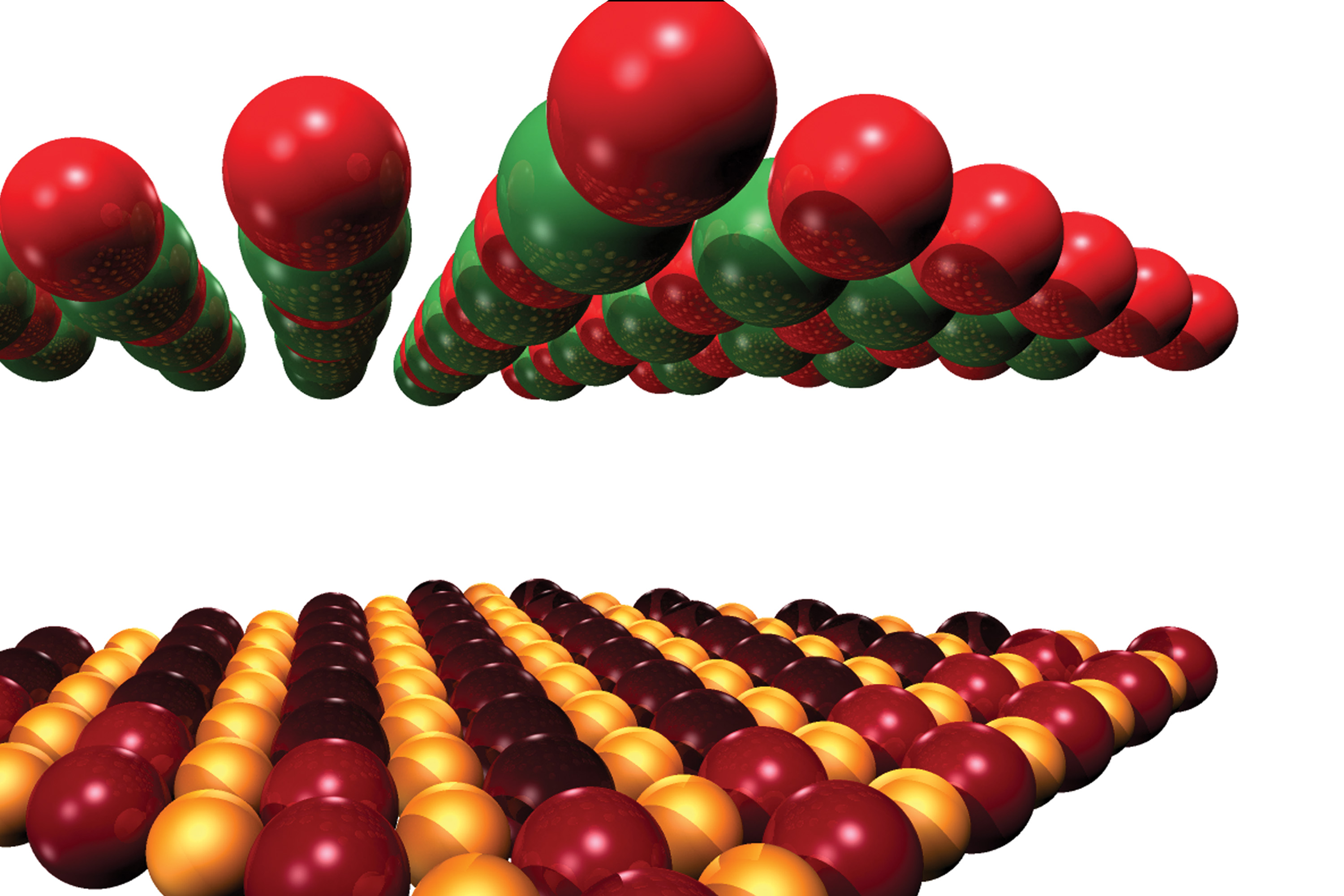
Heteromaterials, as their name suggests, are blended materials comprised of multiple different substances, similar to composites. For example, a layer-cake arrangement of alternating planes of strontium oxide (SrO) and titanium dioxide (TiO2) comprises the ceramic strontium titanate (SrTiO3), which, until cubic zirconia (also an oxide) came around, was a leading diamond simulant. When a stack of strontium titanate abuts a chunk of another metal oxide, such as magnesium oxide (MgO), a heteromaterial is formed. A choice exists that can affect the heteromaterial’s properties: Which of the strontium titanate’s cake-like layers will be the terminal layer? In other words, will it be a strontium oxide layer or a titanium dioxide layer facing the magnesium oxide? Through simulation and experimentation, Uberuaga and his team have found that the behavior of the material as a whole is largely influenced by this choice.
The most common defects in ceramics like strontium titanate are oxygen vacancies. These are, not surprisingly, locations where an oxygen atom is missing. Oxygen vacancies are ubiquitous, formed either intentionally through doping (a chemistry technique for changing a material’s properties by adding small amounts of impurities during synthesis) or as a consequence of synthesis conditions. They are also all-important because, for many applications, they provide the material’s functionality. This is particularly true for fast ion conduction. But how can the scientists control when and where a wayward oxygen atom will go missing to create an oxygen vacancy? By telling it to, that’s how. Uberuaga’s team built a computer-simulated heterointerface between strontium titanate and magnesium oxide, atom by simulated atom, including oxygen vacancies, to test how the terminal layer choice changes the material’s capabilities.
And so, what about those misfits?
Modeling misfits
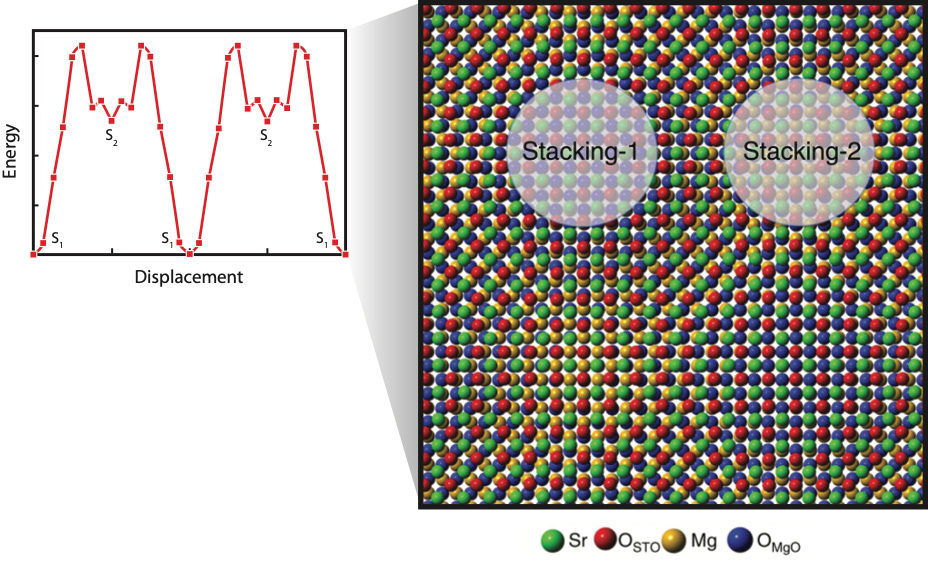
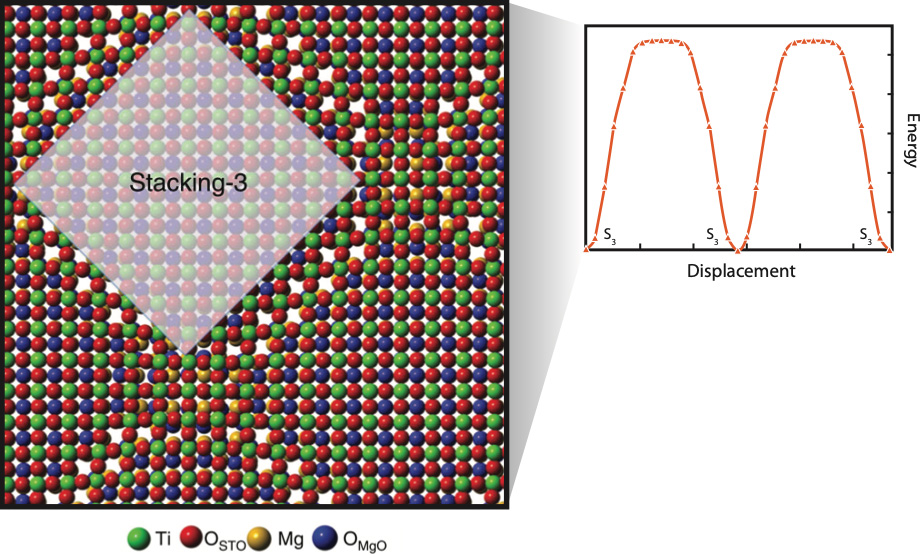
“Misfit dislocation density”—unpack that phrase and what you’re talking about is the pattern of atomic interactions that forms when two non-identical materials are placed in contact with each other. Imagine two translucent checkerboards, one with 1.0-inch squares and the other with 1.2-inch squares. When stacked, with a black square at the center of each board aligned with the other, the alternating patterns of the boards won’t align. Moving outward from the center, every five squares of the larger board will cover the same distance as six squares on the smaller board, but because of the alternating colors, it will take another five and six squares, respectively, to reach another instance of black squares lining up on both boards. And then the pattern begins again. For a simple metal, that would be the end of the story. But for these metal oxides, it’s just the beginning. There is a whole other layer. Switch them around and it could be a matter of lining up a checkerboard with a hexagonal board, or something equally divergent. As long as both patterns are regular, as is the case with oxide crystal structure, a pattern of interaction will emerge when they are placed in contact. “Misfit dislocation density” is just a fancy term for that.
Misfit dislocations, or misfits, form to relieve the strain that would otherwise arise when forcing two materials with dissimilar sizes together. The greater the initial mismatch, the higher the misfit dislocation density. Also, misfits tend to attract oxygen vacancies. So, because oxygen vacancies provide much of the material’s functionality, and because they frequently occur in the misfits, the density and pattern of misfits at the material interface is of utmost import when looking at new materials and what they can do.
Strontium titanate/magnesia is a model system for oxide heterointerfaces, similar in concept, if not in scope, to Mendel’s flowering peas serving as a model for plant genetics. “This work is really the initial approach toward understanding the chemistry that happens at the interface,” says Dholabhai. By studying misfit dislocation structures, he and Uberuaga can extrapolate a more general understanding of how to tweak heteromaterials to better perform a given task. For acting as a radiation-damage sink, more misfits are best, as they can lead to more defects. For ferroelectric applications, higher strain and fewer misfits are preferred.
The surprising result from the computer simulations is that the pattern of misfits is dictated by the chemistry of the terminating layer. “If you change the chemistry, you change the functionality,” says Uberuaga. But there are limits to the “tunability” of the model. The terminal layer can be altered or the component crystals can be rotated, relative to the other side of the interface. These modifications are considerably easier to make in computer simulations than in the laboratory. But Uberuaga, being somewhat of a misfit himself, sees no reason why that should stop them. “This is the kind of discovery that can make the foundation for an academic career,” he says. “It is the beginning of a whole new avenue of exploration.” Who knows? Tomorrow’s Teflon-caliber materials discovery could be just around the corner, and Los Alamos scientists don’t intend to wait to stumble upon it by accident.