The fact that we exist in a universe dominated by matter is a cosmic mystery. Because antimatter annihilates matter, these words you are reading, the clothes on your body, and your body itself are all evidence of there being more matter than antimatter in the universe. Los Alamos experimental nuclear physicist Takeyasu Ito and nuclear theorist Vincenzo Cirigliano want to know how this imbalance could have come about, so they and their teams of experts are working together to learn more.
For every particle, there exists a corresponding antiparticle: protons and antiprotons, electrons and antielectrons, quarks and antiquarks, and so on. The broadly accepted Standard Model of particle physics, which describes all the elementary particles and their interactions, implies that interchanging particles and antiparticles (which have the same mass but opposite charge), in an operation called charge-parity (CP) is, to a very high degree of accuracy, a symmetry of nature. The small amount of asymmetry, or CP violation, that is allowed by the Standard Model is not enough to explain the imbalance.
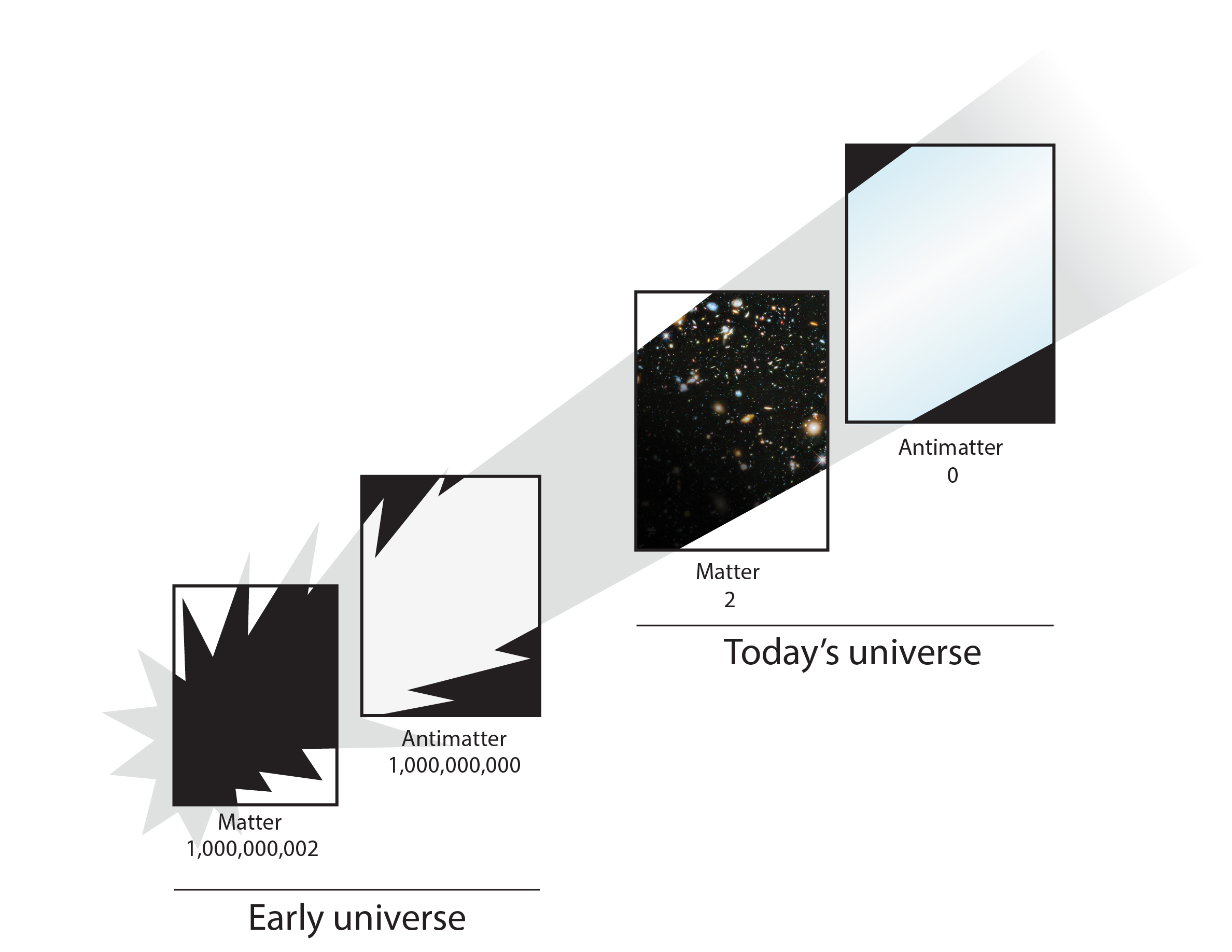
The Standard Model also provides a rule that says particles and antiparticles must be created together, in pairs, and likewise for their destruction. If, in keeping with this rule, there were precisely equal quantities of matter and antimatter in existence in the very early universe, they would have exactly canceled each other, or mutually annihilated one another, and there would have been no matter left over. So amidst the maelstrom of the very early universe, CP violation allowed the survival of enough matter to form galaxies, planets, people, and every other tangible thing. But it’s not obvious why CP violation exists in the first place.
“If a neutron were enlarged to the size of the earth, there would be less than a tenth of the diameter of a human hair’s separation between the centers of negative and positive charge within it,” Ito explains. This is the elusive, still theoretical, neutron electric dipole moment (nEDM), which, if proven to exist, would signal CP violation at levels much higher than those predicted by the Standard Model, and maybe enough to solve the mystery. When searching for such a small thing, scientists can rarely say, “It’s right here”; more often, they say, “It’s definitely not here, here, or here, so let’s look over there.” The Standard Model predicts that a nEDM, if found, would be found at a particular, albeit infinitesimal, size. Without a way to look exactly where the model predicts, scientists must narrow in on it, exploring a range of numbers around the predicted one. Presently the upper limit of that range remains five to six orders of magnitude larger than the size predicted by the Standard Model. Now Ito and Cirigliano, along with many collaborators, are poised to shave one or even two orders of magnitude off.
A neutron is like a magnetized spinning top with electric and magnetic poles aligned. Imagine a gyroscope spinning about its internal axis of rotation and swiveling in a very smooth sort of wobble, around the center of the stand on which it is balanced. A neutron behaves similarly, spinning about a central axis and rotating around such that the orientation of the axis oscillates. The oscillation is called precession, and the rate of precession, or how long the gyroscope takes to make one revolution about its stand, is what Ito is measuring.
For the past 60 years, scientists have been looking for the nEDM in essentially the same way: Place slow neutrons in an electric field and measure their rate of precession. The difference, if there is one, in precession rate for parallel and antiparallel fields reflects the nEDM. But it’s slow going. Increasing the strength of the electric field, the number of neutrons, or the time to decay can improve the sensitivity of this method. Ito and the experimental team are developing a new experiment with an increased number of neutrons, which is enabled by the ultracold neutron source at Los Alamos (one of only a few in the world). At the same time, as part of a large international collaboration, they are working on an experiment based on a completely new method involving liquid helium that is expected to raise all three variables simultaneously. So far they have shown that they can increase the electric field strength and the time to decay.
As if that weren’t tricky enough, there’s another hitch. Far enough back in time, the very early universe contained no neutrons; it was too hot and dense. Instead it contained quarks (and antiquarks). Since quarks are the particles that make up matter (including neutrons), a disparity early on could be the answer to the current preponderance of matter. Measuring neutrons in the laboratory today, however, and extrapolating implications for quarks (and antiquarks) 13.8 billion years ago requires quite a bit of theoretical calculation. Cirigliano and the theory team are performing the intricate calculations needed to interpret either a positive or null experimental result in terms of quark-level sources of CP violation. No matter what the number is when it’s finally measured, they want to know what it means.
The benefit of experimentalists, like Ito’s team, and theorists, like Cirigliano’s team, working together on these types of problems is that they whittle down and refine the scope of each other’s work. The team has its short-term endeavor as well as the longer-term international collaborative experiment—
which will be installed at the Spallation Neutron Source facility at Oak Ridge National Laboratory—both aimed at homing in on the nEDM. If they are successful in either or both, a popular family of theories referred to as supersymmetry, designed to address the deficiencies in the Standard Model, could be largely invalidated.
“We are agnostic when it comes to supersymmetry,” says Cirigliano. “It could be right or it could be wrong. If it’s right, and the nEDM doesn’t exist, we’ll just have to come up with a new explanation.” They aren’t pursuing a specific agenda after all; they are just studying new interactions beyond the known ones, beyond the Standard Model.