At a glance
- 2022: In a groundbreaking paper, Roxana and her team exposed flaws in Erwin Schrödinger’s mathematical theory about color perception — a widely accepted framework that had influenced how color models were developed for over a century.
- 2025: Doubling down on the geometry of color, Roxana’s team formalized Schrödinger’s definitions of hue, saturation and lightness in a paper they presented at the Eurographics Conference on Visualization.
- Today: Roxana is excited about using AI reasoning to turn datasets into images, and she has a new paper ready to present at this year’s EuroVis conference in June. A pioneering effort with principal investigator Aric Hagberg, this project could lead to AI-driven autonomous visualization methods to accelerate scientific discovery.
How can something so familiar — color — be so elusive for artists, physicists and mathematicians? And what’s the fallout when color assumptions are fudged to fill in spaces?
In her data visualization career at Los Alamos National Laboratory, Roxana Bujack’s journey to find answers drove her to rewrite color theory, taking the world by surprise in 2022.
Not satisfied with that feat, she’s now planning more research on perception and color, this time getting into the minds of observers to understand what’s happening when they look at an image of a 3D object — what cues they use to reconstruct the 3D scene.
“From that, we want to learn which visualizations produce a more accurate mental model and which are misleading or not informative enough,” Roxana says.
Art or math? Why not both
While the human eye has three types of color-sensing cone cells, our experience of perceiving the color spectrum in a real-world scene is a complex process.
“I have been interested in color for as long as I can think back,” says the computer scientist, who is now practically famous for disproving a 100-year-old theory of how people see color differences. “The first scientific question I had was in art class.”
Roxana remembers her attempt to embed all the colors she could see in a 3D space for an assignment. She was a teenager in East Germany then.
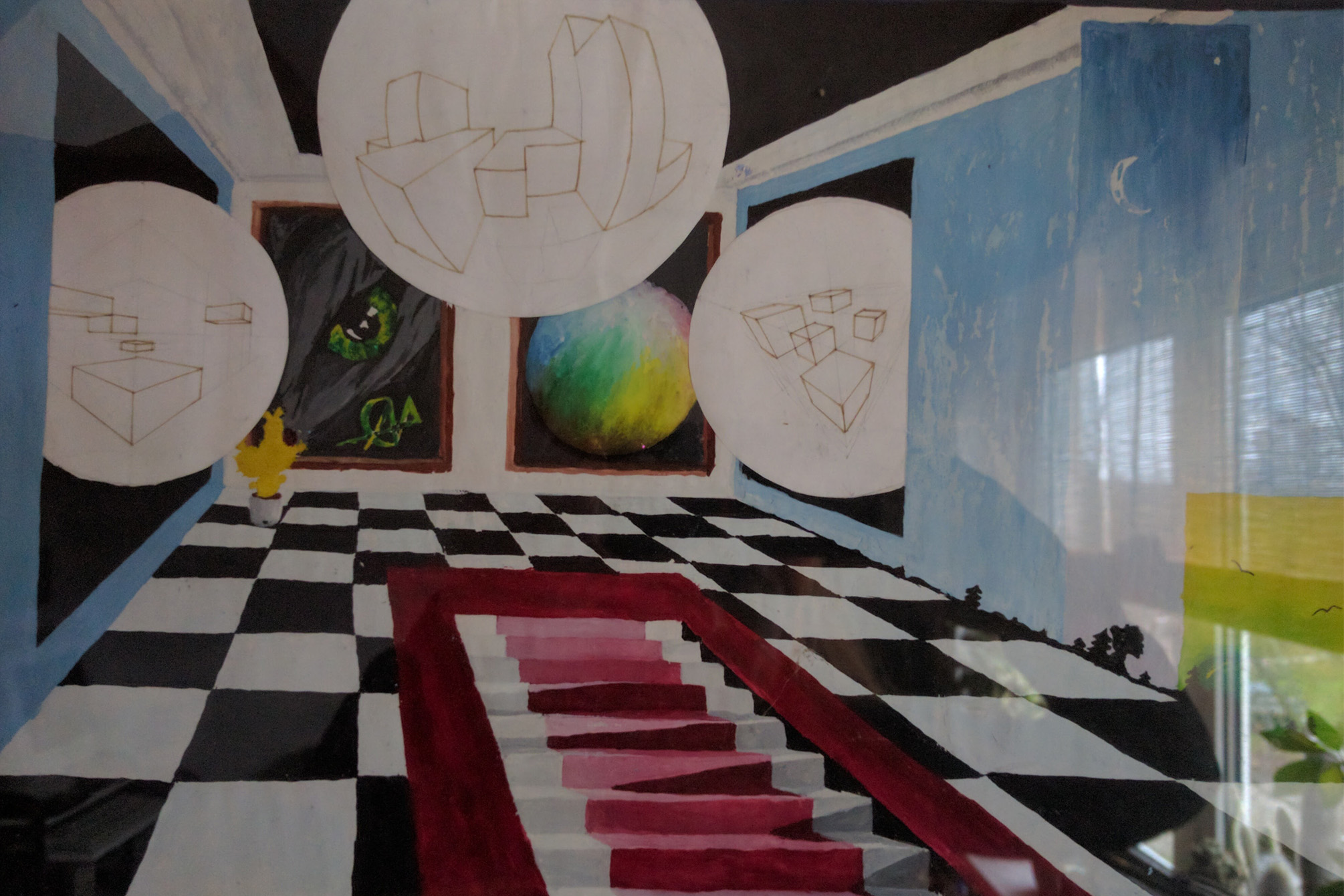
In that painting (above), Roxana struggled to represent the framed picture of the ball on the back wall. “I thought the neutral color was brown because red and green made brown in my liquid paints,” she says.
She now knows the precise color for the neutral space was gray.
Although Roxana majored in mathematics, not art, at Leipzig University, she was inspired at a lecture on image processing to pursue a doctorate in scientific visualization. The field combines math, computer science and art to help people to get an understanding of the processes and patterns underlying their data.
Without her math acumen, however, Roxana might not have questioned color theory so boldly.
Color warps
The Lab used to have artists turn data into colormaps for scientists. But now that work is automated, and Roxana took a job here in 2016 to advance that capability.
In Computer and Artificial Intelligence division’s Information Sciences group, Roxana creates colormaps using the CCC-Tool. Colormaps can then be used in visualization tools, like ParaView, which the Lab developed in 2000. Users can choose from 188 color profiles in ParaView. “Rainbow,” for instance, is often used to colorize data of Earth systems, like the range of temperatures seen on nightly TV weather maps.
So where does math come in? All human perception can be measured, including how humans see color. Mathematical code in widely used models assign value to different colors to provide a good approximation of how users will see them. Roxana is dedicated to improving these color perception models so she can create better colormaps.
While the models do a “good enough job” of mimicking how humans perceive color for most tasks, Roxana knows the shortcomings can be problematic when scientists are making important decisions about their research based on the data visualizations.
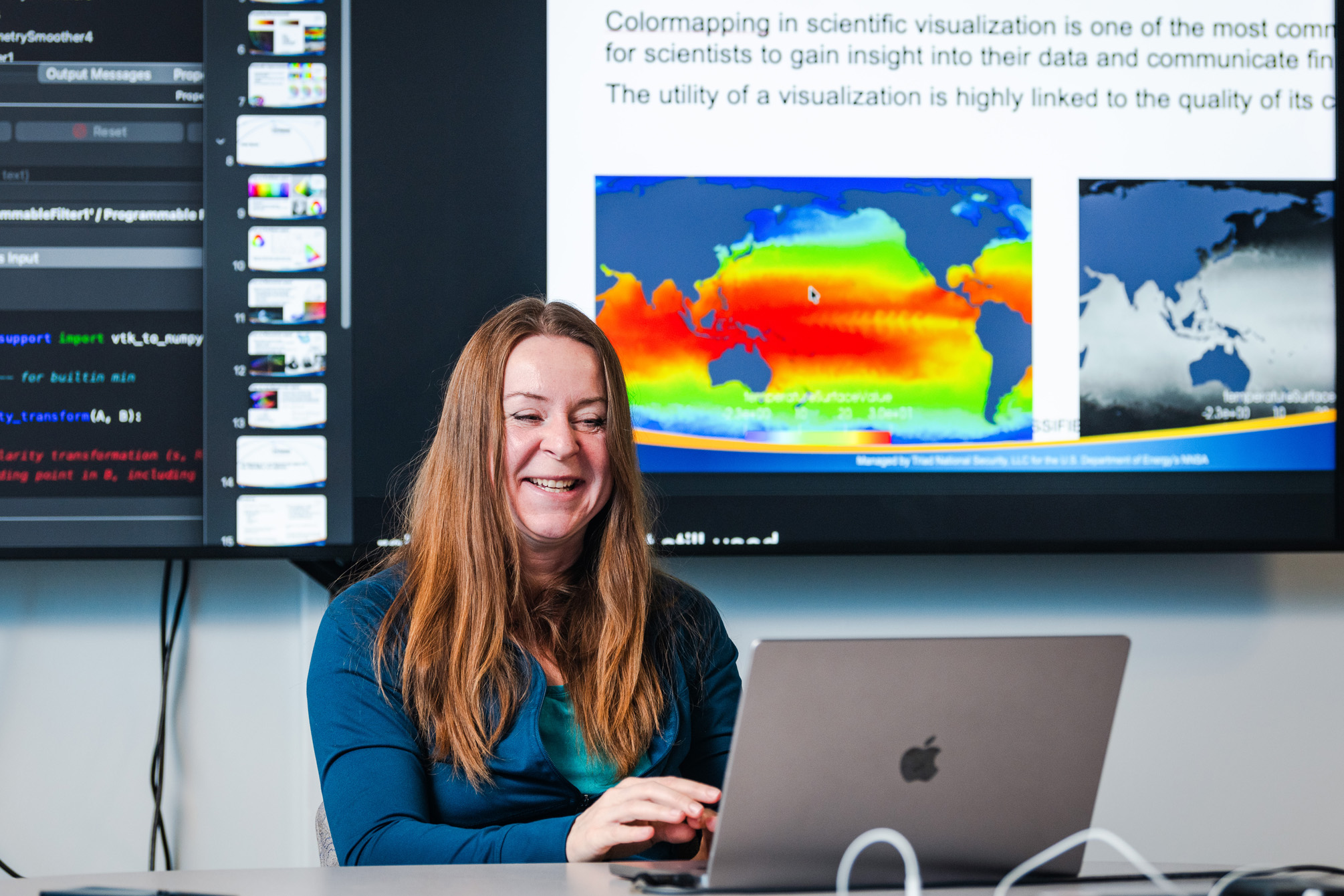
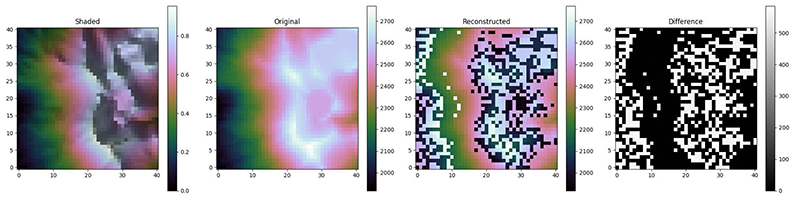
Roxana presents two colormaps of ocean temperatures. In the map using the Rainbow profile, a band appears that displays a rapid jump from orange to yellow to green. (The blues and greens denote cooler temps while yellow to red mean warmer degrees.) In other maps using the Grayscale profile, the band does not appear.
“When you look at the Rainbow example as a scientist, you think you need to investigate this, because you think there is a huge drop in temperature,” Roxana says. “But the problem isn’t in the data, it’s in the colormap.”
The color-data connection
For years, Roxana’s team pushed the limits to develop a mathematically accurate model of color perception, and the results have been hailed as correcting and completing physicist Erwin Schrödinger’s color theory.
The drive to depict data with precise color representation has broad appeal. Consuming visual content is part of modern life, and entire careers are built on representing numerical data with colors, from scientists to filmmakers to illustrators.
Many digital display devices rely on algorithms to “make up” colors, creating a smooth transition between similar colors by filling in the gaps of missing color data. It’s common for calibrating LED television sets, design and photo software, filmmaking and, in Roxana’s line of work, visualizations of datasets.
“It matters because improving our understanding of color can enhance data visualization, display calibration, image processing and video compression,” Roxana says. “A model of color is the basis of a model of perception.”
Curved or straight: Geometry matters
A form of geometry named after 19th-century mathematician Bernhard Riemann was used by physicists Hermann von Helmholtz and Schrödinger to describe how humans perceive color differences in 3D space. They used a curved Riemannian space to represent color, because it could explain phenomena observed in experiments that the previous Euclidean model could not. Their paradigm, based on the premise that the distance between two colors is the length of the shortest route, influenced how color models were designed ever after.
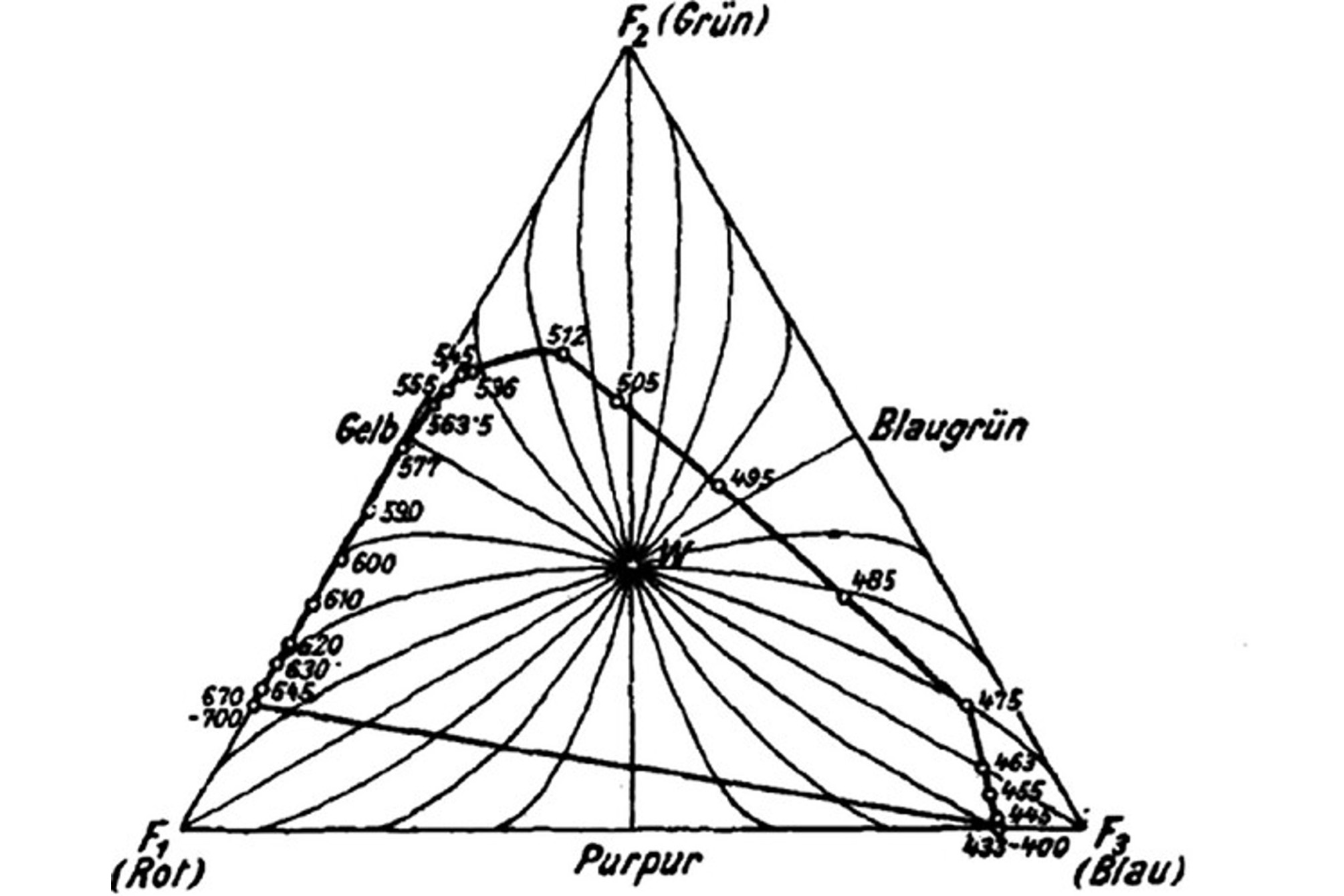
They’d be shocked to know that a mathematician/computer scientist named Roxana accidentally discovered flaws in their work. Her team’s 2022 groundbreaking paper bucked the current standard recognized by the International Commission for Weights and Measures.
The assumption that perceptual color space is a three-dimensional Riemannian space “overestimates the perception of large color differences because large color differences are perceived as less than the sum of small differences,” according to Roxana’s paper.
That effect is called “diminishing returns,” and it somehow slipped through the cracks because everyone kept clinging to Riemannian geometry.
(If you’re overwhelmed by the math stuff, you’re not alone. Roxana suspects this “blind spot” might have been missed because an experimentalist didn’t truly understand the math concepts!)
The steppingstones (in her own words)
One day, Roxana was researching mathematical models of color perception, when a paper put her on a discovery path that lasted several years, marked by periods of excitement and fear, she says.
- I read a 1963 David MacAdam paper and noticed that the phenomenon that he observed (diminishing returns) was in conflict with the Riemannian model. Since that paper was 50 years old, I assumed everyone knew that.
- For about a year, I searched for a paper or book that would state the fact explicitly and could not find one. I started to wonder if nobody had noticed the contradiction but thought it was absurd and I was just being too full of myself.
- Then one day on my search, I came across the 1979 MacAdam paper (where he writes that there is no reason to question the Riemannian model) and thought: Well, if not even the guy who discovered diminishing returns sees the contradiction, maybe it is indeed true that nobody has…
- So, we decided to write the paper. But I totally expected that one of the reviewers or one of the readers would point out the place where the contradiction had been stated, and that we had just not been able to find it. But, well, so far so good...
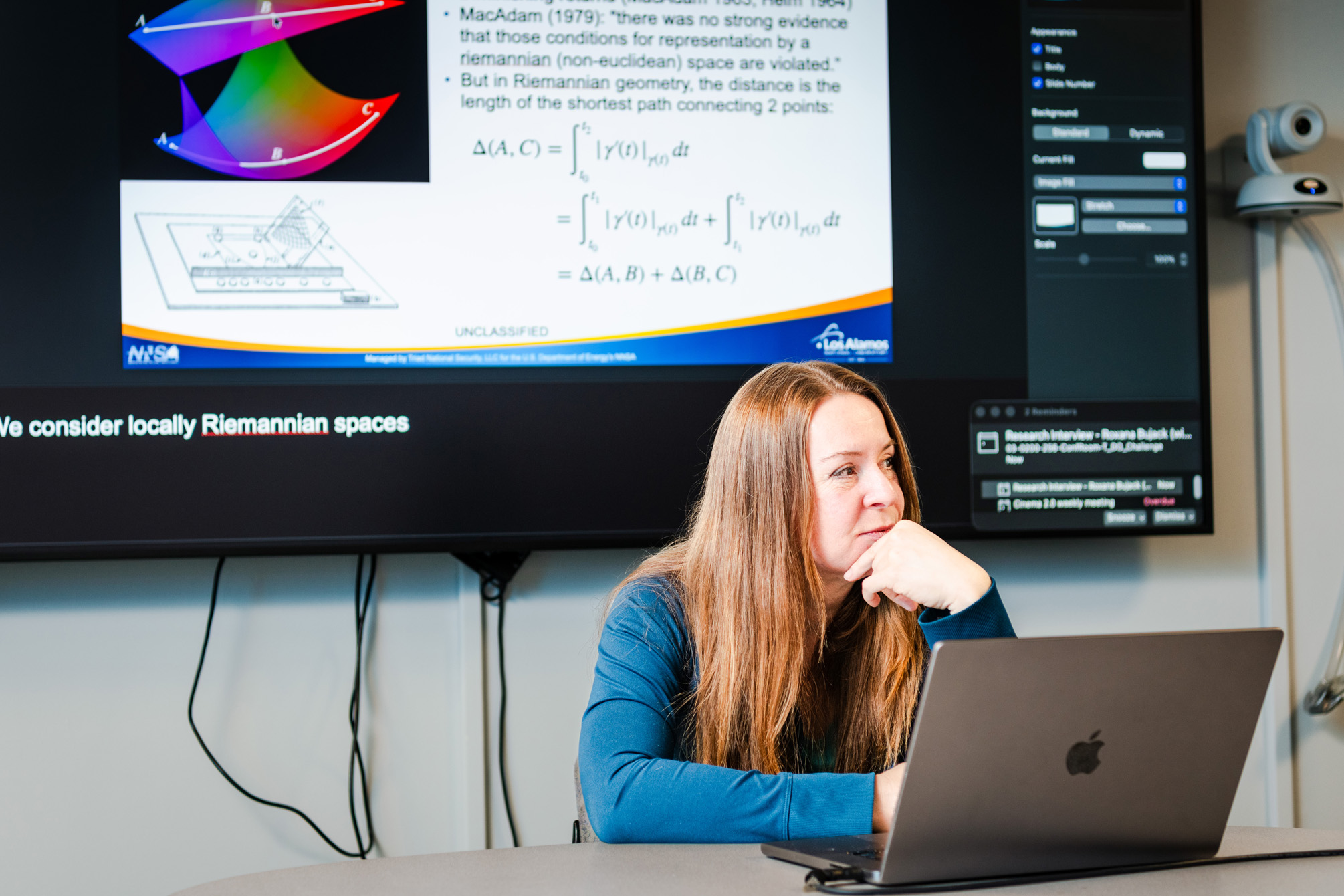
Roxana realized the field must have absorbed the geometry of color but dismissed its implications. “No one had recognized that color space is intrinsically non-Riemannian,” she says.
The existence of diminishing returns was controversial when MacAdam reported it, and so she thought she needed an experimental leg to stand on if she was going to challenge a century of color theory even though MacAdam had done experiments.
Roxana set out to prove that color space was not Riemannian. To test whether adding up small perceived color differences along a path between two colors gives the same perceived difference as jumping directly between those two colors, Roxana’s team ran a series of crowd-sourced, online experiments with 1,400 participants.
The joy of spearing accepted theory
Roxana’s team went to the Proceedings of the National Academy of Sciences journal with their results. Their paper outlined the math shortcomings of what Schrödinger had carried forward in his theory, and it was accepted for publication.
Only then did Roxana believe her “aha moment” was real.
“It sounds mean but breaking with an old idea is what scientific progress is all about,” Roxana says. “I have always dreamed of proving someone famous wrong because it means I would be able to further the ideas and theories of brilliant and important minds.”
She doubts the feeling is hardly unique to her.
“Schrödinger’s work is all about the central topic of proving Helmholtz wrong,” she says. “And I think he, too, did it with a certain delight that is born from deep respect.”
Back to the basics: Hue, saturation, lightness
Last June, the team showed up at a conference in Luxemburg with new findings: they had finished what Schrödinger had started, filled the gap and completed the geometric definitions of hue, saturation and lightness. Popular Mechanics reported, “By plugging these experimental holes, the researchers were able to produce a paper that represents the most accurate mathematical representation of how our eyes see color yet — the culmination of more than three centuries of science.”
Roxana now believes perceived hue is a “pure and logical phenomenon” without learned classification, cultural bias or personal preference.
Schrödinger was not only one of the first to suggest a metric for color; he also used it to define hue, saturation and lightness.
“Since Schrödinger had built his definitions of hue, saturation and lightness on the theory of a Riemannian color space, it was the first thing I wanted to revisit after we saw that this basic assumption was not true,” Roxana recalls. “I expected it to be a quick minor fix of simply replacing Riemannian metric with non-Riemannian metric. But digging deeper, we noticed that it was not like that at all.”
Roxana’s team found that Schrödinger had stopped short before completing his mission because he used the “neutral axis” as a reference point without defining it. The neutral axis is the central, achromatic line of grays connecting black to white in 3D color space, serving as the foundation for measuring color saturation and hue.
“The 2022 discovery allowed us to define hue, saturation and lightness purely geometrically for the first time,” she says. “That was Schrödinger’s big goal, but it was not possible in a Riemannian space.”
LA-UR-26-24414