Everything checked out when a Los Alamos National Laboratory space research team recently sent simulated operational commands to the Autonomous Ion Mass Spectrometer Sentry (AIMSS) instrument. A critical milestone, the test demonstrated the team’s ability to provide real-time commanding of the new instrument when it’s delivered to the International Space Station.
Commands were transmitted from the Lab’s Payload Operations Control Center ground station to the Space Test Program – Houston 11 mission via NASA's Telescience Resource Kit (TreK) pipeline. Using TreK for real-time command and data acquisition established a capability the Lab will use for future payloads destined for the International Space Station.
Why this matters: The AIMSS instrument can monitor space weather that might disrupt electronics systems in satellites. Also, it can make measurements that account for ionospheric plasma and human-caused contamination (thruster plumes from spacecraft) at the International Space Station where crews conduct scientific experiments.
What they did:
- Leading up to the actual test, the team worked with technical network security teams from NASA and the Lab, making adjustments to ensure a smooth communications channel between them.
- The day of the test, the team verified the NASA voiceover software and communications processes. This is key for running mission commanding after launch when they will use the same setup to schedule and establish commanding during the window for ground communications. They called into a NASA central command center in Huntsville, Alabama, and used special, predetermined communications protocols to establish approval for commanding the Lab’s payload during the testing window.
- After the team received the green light to run commanding, they used TreK software to establish a link to the test server and sent and received data. They showed they could use the specialized commanding software and that their commanding could be understood in both directions.
Funding: U.S. Department of Defense Space Test Program, NASA and the Laboratory Directed Research and Development program.
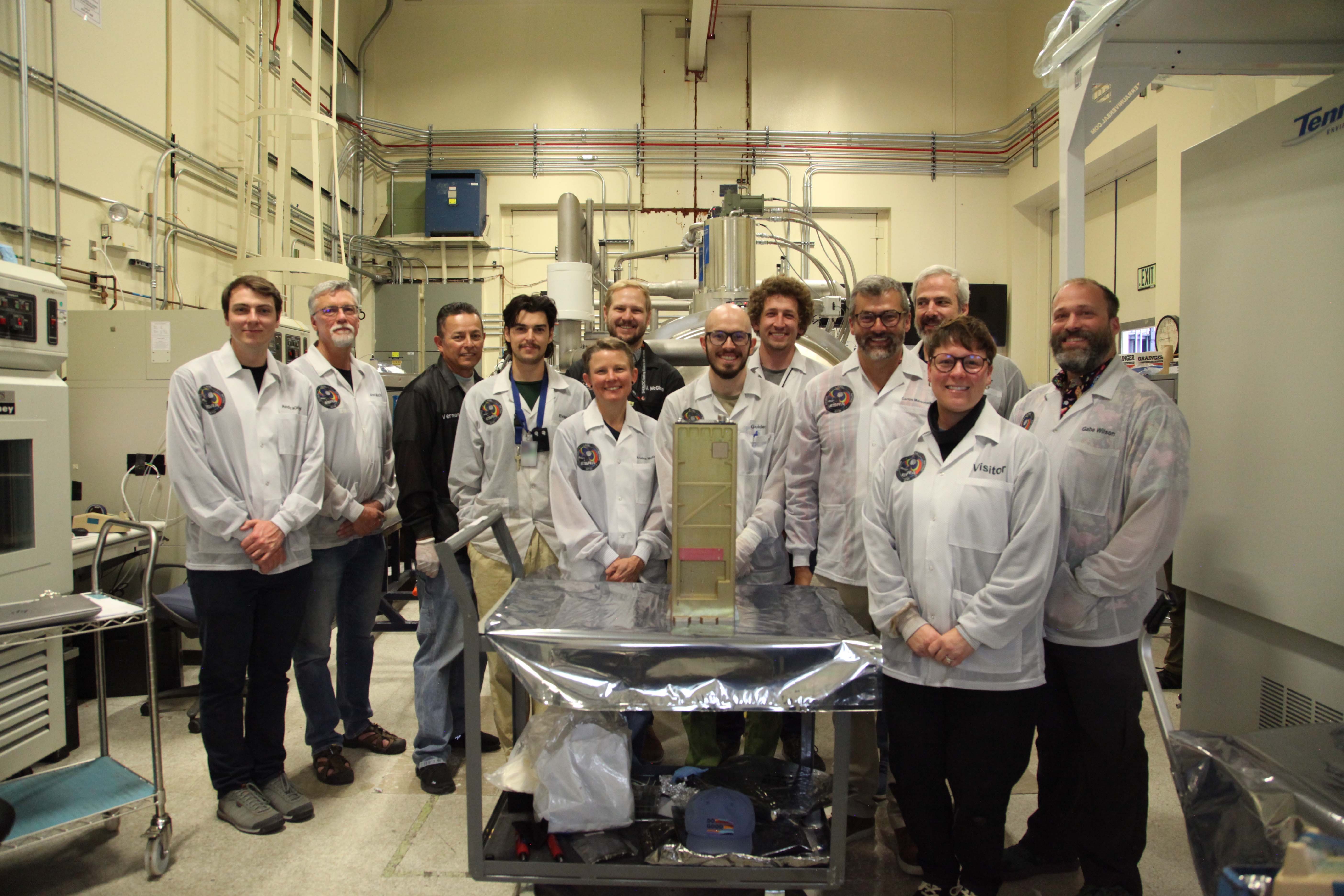
The collaboration: The command test was led by payload operations expert Tracy Gambill and project software lead Sam Larsen of the Lab’s Global Security organization. Supporting members were Steve Buck, Landon Colston, Anatoliy Frishberg, Amy Herrera, Mark Lorenc, Thomas Ludwig, Matt Mahoney, John Michel, Aaron Morrison and Erin Powers.
Update: The AIMSS space flight payload launched May 15 onboard SpaceX's 34th Dragon Commercial Resupply Services mission.
LA-UR-26-23132