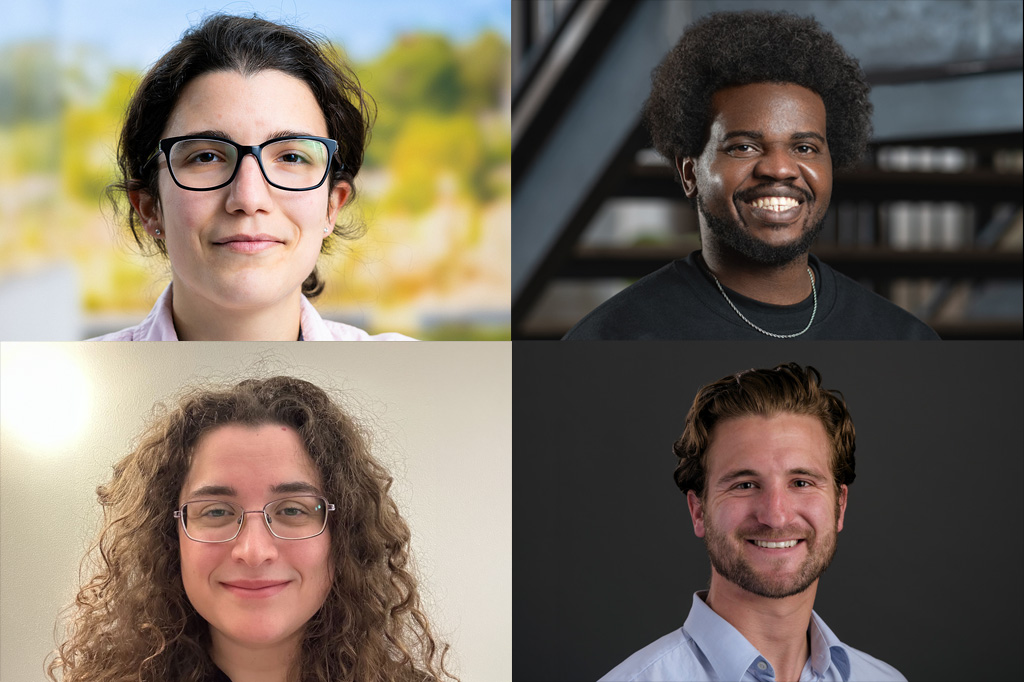
Four young scientists from Los Alamos National Laboratory were selected to participate in the 75th Lindau Nobel Laureate Meeting in Germany with support from the University of California. During the weeklong event (June 28-July 3), they’ll hobnob with about 75 Nobel laureates and discuss complex problems spanning interdisciplinary sciences with other early-career researchers from around the world.
How it works: Travel and expenses are covered for UC President’s Lindau Nobel Laureate Meeting Fellows, a cohort of campus students and young scientists from UC-affiliated national labs vetted through a rigorous process.
Meet the Lindau fellows:
John Ortiz, of the Earth and Environmental Sciences division, has a doctorate in environmental engineering from Johns Hopkins University and is a previous Director’s Postdoctoral Fellow at Los Alamos.
- Ortiz is interested in multiphase fluid flow and transport, geomechanics, planetary science, nuclear monitoring and hydrogeology.
- Now a staff scientist, he supports the Lab’s global security mission by developing models at the intersection of subsurface gas migration and rock fracture mechanics to improve remote detection of underground nuclear explosions — plus, his work has applications to planetary exploration on Mars and Titan.
Afroditi Papadopoulou, of the Physics division, is a J. Robert Oppenheimer Distinguished Postdoctoral Fellow who holds a doctorate in physics from the Massachusetts Institute of Technology.
- Papadopoulou studies neutrino interactions by looking at the particles produced after neutrinos collide with nuclei, aiding progress relevant to national security science and fundamental science.
- Her research focuses on analyses using datasets from international collaborations, as well as testing the performance of simulation predictions against neutrino and electron datasets (both existing and new).
Stella Schindler, of the Theoretical division, is a Darleane Christian Hoffman Distinguished Postdoctoral Fellow who received her doctorate at the Massachusetts Institute of Technology Center for Theoretical Physics.
- Schindler researches the structure of matter and the forces binding it together — particularly the strong nuclear force that’s responsible for 99% of the mass of ordinary matter in the universe and the fusion that powers the sun.
- Schindler is strengthening analytic and numerical techniques for understanding quantum chromodynamics (QCD), the theory of the strong force.
Chinonso Ugwumadu, of the Theoretical division, is a Director’s Postdoctoral Fellow who received his doctorate in physics from Ohio University. He’s also part of the 2026 UC/LANL Postdoc Entrepreneur Accelerator cohort.
- Ugwumadu’s current research interests are electronic, thermal, mechanical and transport properties in materials at extreme conditions.
- For "Bridging Simulations to Protect Spacecraft in Extreme Conditions,” he was a 2025 winner in the Postdoc Program’s Science in 3 Research SLAM.
LA-UR-26-23132