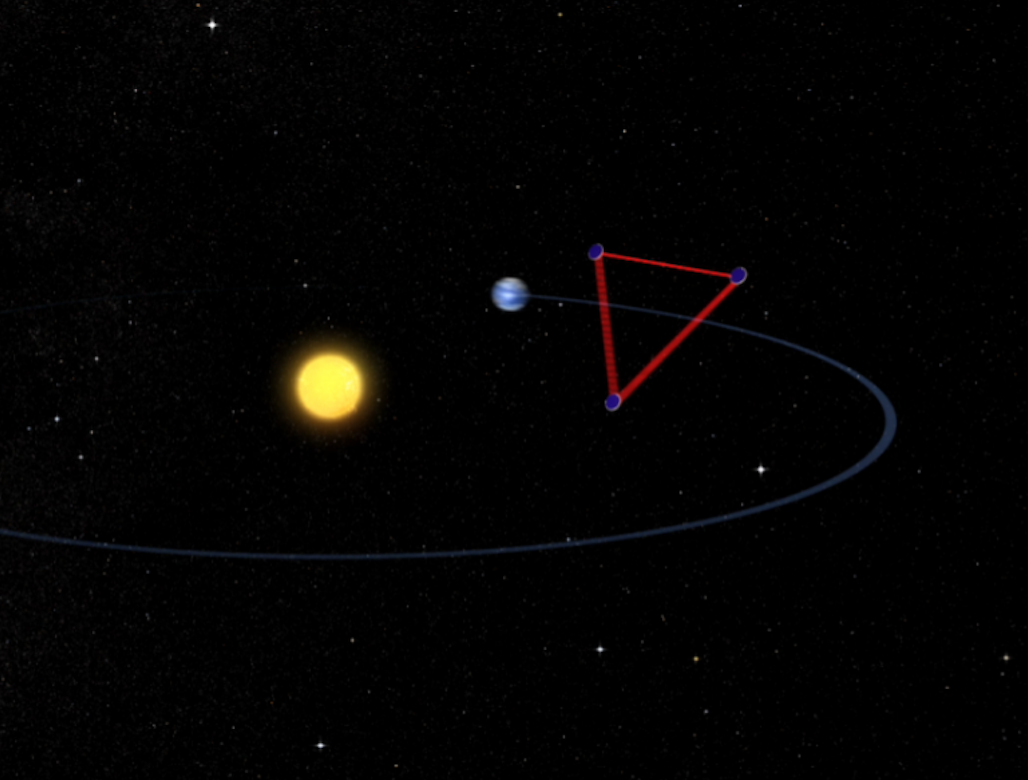
Los Alamos National Laboratory physicist Grant Meadors was selected as a co-investigator on a NASA-funded project supporting the Laser Interferometer Space Antenna (LISA). This space-based observatory is poised to uncover a part of the gravitational-wave spectrum that cannot be observed by ground-based detectors. Understanding invisible ripples in space caused by cosmic events will help scientists explain the physics of the universe.
Collaborating with principal investigator Michael Coughlin (University of Minnesota) and co-investigator Michael Katz (Jet Propulsion Laboratory), Meadors will contribute to Preparing for Galactic Science with LISA. In anticipation of the 2035 space mission, this project focuses on integrating electromagnetic and astrophysical data into comprehensive gravitational-wave analyses.
How it works:
- This effort builds on prior work at Los Alamos in which Meadors and collaborators developed efficient algorithms for characterizing gravitational-wave sources, leading to the release of the open-source APRICOTS (Averaged-Polarization Resampled Integrated Correlated Omnidirectional Test Statistics) code earlier this year.
- By leveraging these advancements, the Preparing for Galactic Science with LISA team aims to significantly accelerate the identification of astrophysical sources, allowing timely multi-messenger and time-domain observations of transient events before they fade.
The big picture: Led by the European Space Agency with NASA as a partner, the LISA mission may see black holes swallowing stellar-mass objects and binary white dwarfs (the end stage of stars like our sun).
LA-UR-26-22419