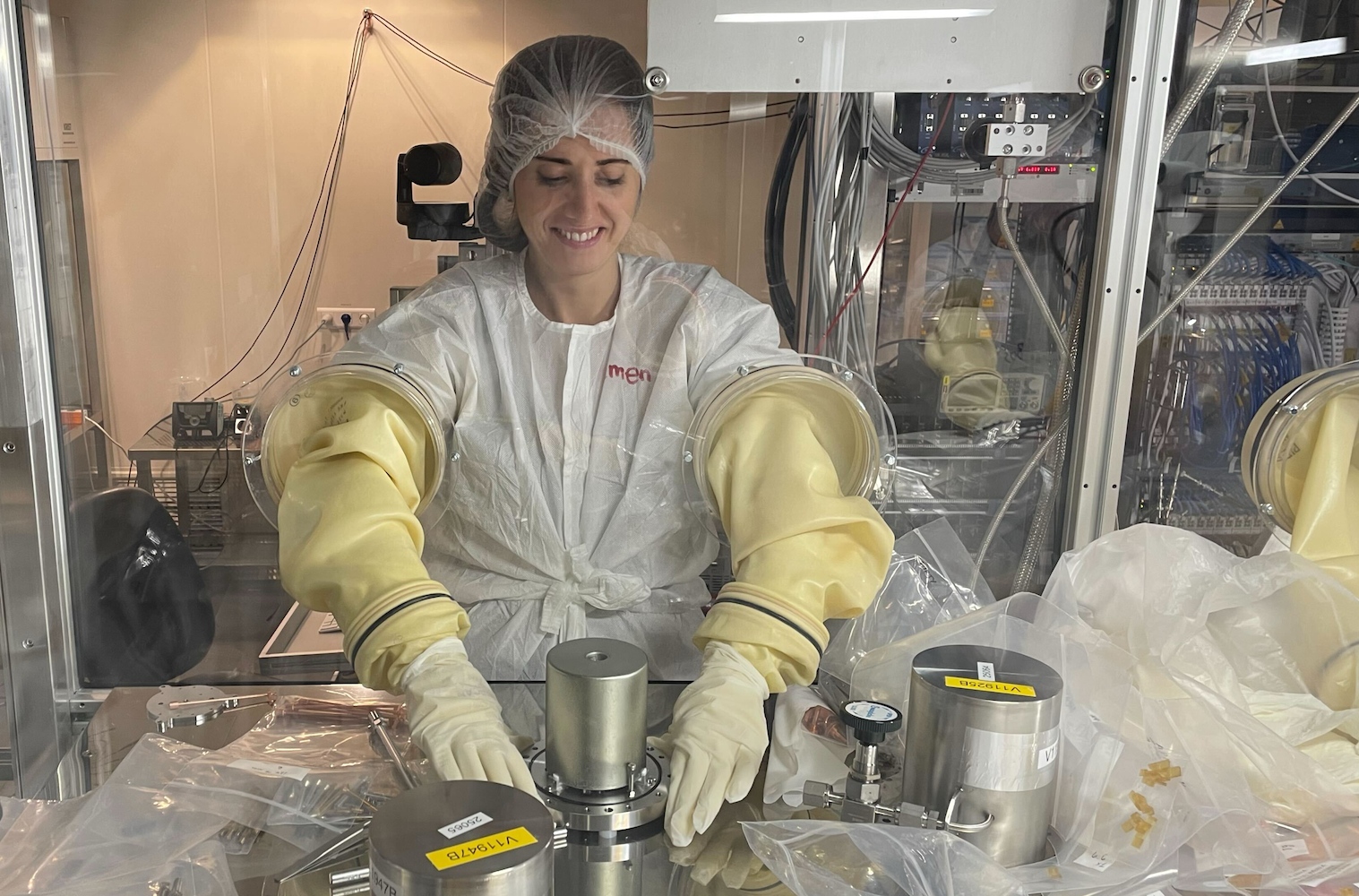
The quest to observe a radioactive decay process predicted over a century ago continues in earnest. An international collaboration, which includes Los Alamos National Laboratory, plans to design detectors that would be 100 times more sensitive to this hypothetical process than detectors used in previous experiments. Results from the first stage of the Large Enriched Germanium Experiment for Neutrinoless Double Beta Decay program, known as LEGEND-200, are now detailed in Physical Review Letters.
Why this matters: If a future LEGEND experiment does detect neutrinoless double-beta decay (i.e., an atomic nucleus emitting two electrons without accompanying antineutrinos), the discovery could help settle questions about the origin of our matter-dominated universe.
What they learned: LEGEND-200 published the first results of the new apparatus after one year of data collection.
- The results set new limits on the neutrino mass and on the half-life of this decay process, representing an important step toward the development of the ton-scale LEGEND-1000 detector. This sensitivity was achieved with only a fraction of the total time compared with LEGEND’s predecessor experiments, GERDA (GERmanium Detector Array) and the Majorana Demonstrator.
- LEGEND-1000 is the only ton-scale project approved to apply for Critical Decision 1 funding to advance to the planning and construction stages through the U.S. Department of Energy’s project management process.
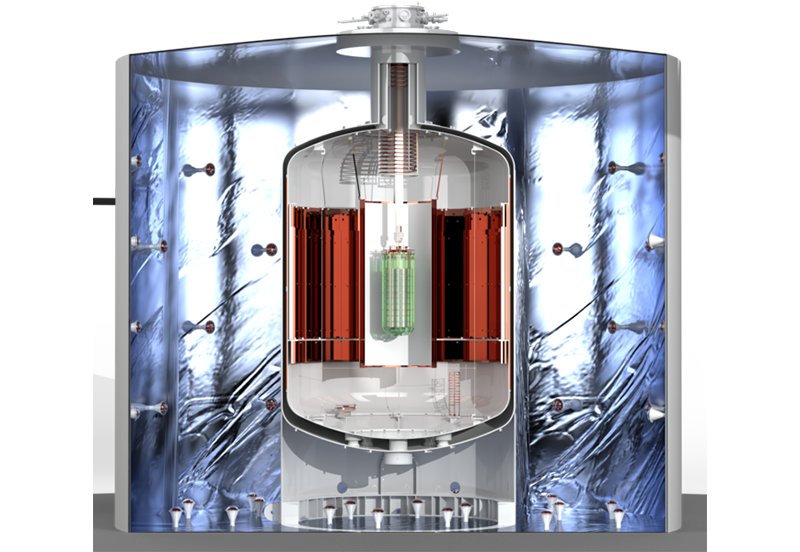
How they did it: Heavily shielded detectors were deployed deep underground at Italy’s Gran Sasso National Laboratory, and the data in LEGEND-200 were taken using 142.5 kg of high-purity germanium detectors enriched in germanium-76.
Global security connection: The Lab’s neutrinoless double-beta decay program enhances detector technologies, background-reduction techniques and analysis methods that are also useful for nuclear forensics to thwart the spread of nuclear weapons.
Funding: Los Alamos work on LEGEND-200 was supported by the U.S. Department of Energy, Office of Science, Office of Nuclear Physics and the Los Alamos Laboratory Directed Research and Development program.
LA-UR-26-21283