Predictions and observations of neutron star properties have advanced considerably since the rogue star’s discovery in 1967. In a Reviews of Modern Physics paper invited by the editor, Los Alamos theoretical physicists and collaborators grapple with some of the challenges new frontiers of exploration may bring.
Read the paper
Why this matters: Second only to black holes in density, neutron stars push the limits of physics with their extreme behavior. They are considered an important benchmark for understanding nuclear structure. Models used in computer simulations that describe the crust and the outer core of neutron stars are connected to low-energy nuclear physics.
- For this reason, terrestrial experiments that measure nuclear properties, combined with neutron star observations, provide strong constraints to test theoretical models of nuclear physics.
- Beyond fundamental science, neutron star research can inform nuclear weapons science and other fields.
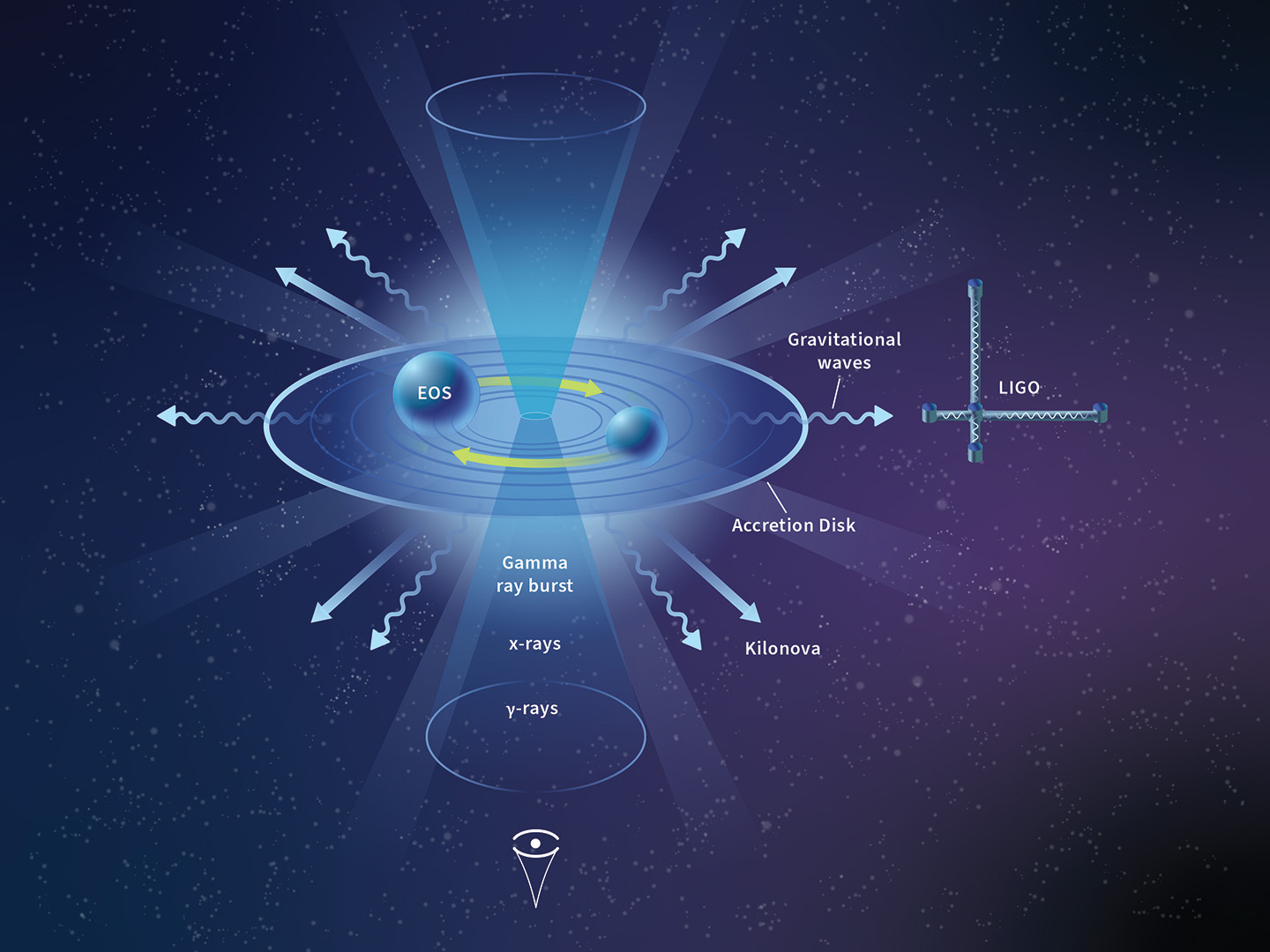
How it works: Observations of neutron stars, which are hundreds of light-years away from Earth, can be performed by measuring the light they emit and the particles they eject, or by analyzing the gravitational waves generated when two neutron stars orbit each other. Such systems in which two neutron stars interact are of particular interest to scientists because of the energy released and the heavy elements produced.
Funding: The Los Alamos work was supported by the U.S. Department of Energy’s Office of Nuclear Physics (Nuclear Theory Program and Scientific Discovery through Advanced Computing, Nuclear Computational Low Energy Initiative) and by the National Science Foundation’s Physics Frontiers Centers (Network for Neutrinos, Nuclear Astrophysics and Symmetries).
LA-UR-26-21283