Seven Los Alamos National Laboratory-led technologies won 2026 R&D 100 Awards. The winning technologies advance chemical design, space monitoring, robotics, nuclear reactor testing, neutron detection, coordinated sensing and industrial separation. Often called the “Oscars of Innovation,” the R&D 100 Awards recognize new technologies for their ingenuity and potential commercial impact.
Six received an R&D 100 Award, and one received a Gold Medal Special Recognition Award in the market disruptor category.
“These R&D 100 Awards reflect the innovation, expertise and dedication of our workforce,” Laboratory Director Thom Mason said. “These technologies turn Los Alamos science into practical solutions for national security, industry and society. Congratulations to our staff and collaborators whose creativity and hard work made these achievements possible.”
Los Alamos 2026 R&D 100 Award winners
- Architector
- Autonomous Ion Mass Spectrometer Sentry (AIMSS)
- Autonomous Robot Control Hierarchy (ARCH)
- Deimos: Advanced Reactor Testbed
- ICONS: Integrated Composite Optical Neutron Sensor
- Persistent DynAMICS
- UltraSep Acoustic Separation Platform
The R&D 100 Awards
The R&D 100 Awards honor 100 of the year’s most innovative, proven and commercialization-ready technologies developed by industry, academia and government-sponsored research organizations. Projects are recognized across six categories: Analytical/Test, IT/Electrical, Mechanical/Materials, Process/Prototyping, Software/Services, and Other.
In addition to the primary R&D 100 Awards, qualifying technologies may receive Special Recognition awards in three categories: Green Tech, Corporate Social Responsibility and Market Disruptor. Presented at the Gold, Silver and Bronze levels, these distinctions recognize innovations with exceptional environmental benefits, positive societal impacts or the potential to transform established technologies and markets.
This year, national laboratories took home most of the awards — 51 out of 100. Since 1978, Los Alamos has earned more than 200 R&D 100 Awards for innovations that make the world safer, strengthen national security and support U.S. competitiveness.
The 2026 R&D 100 Award winners will be formally honored at the R&D 100 Awards Gala Banquet on Nov. 19 at the Grand Hyatt Scottsdale Resort in Arizona. The annual celebration brings together representatives from industry, academia and government-sponsored research organizations to recognize the year’s leading technological achievements and the teams behind them.
More information about the winners
Architector
Architector is a software platform that automatically builds and evaluates 3D models of chemical compounds containing metals. These compounds can take many possible shapes, and their shape affects how they behave. By ranking the most likely structures, Architector helps researchers identify promising candidates for new materials, catalysts and energy technologies before moving to laboratory testing. It can also model compounds important to nuclear science that have traditionally been difficult to study.
Autonomous Ion Mass Spectrometer Sentry (AIMSS)
AIMSS is a space-based scientific instrument operating aboard the International Space Station. It measures ions, atoms or molecules that carry an electrical charge and sorts them by energy and mass, much like a prism separates light into different colors. The instrument provides clearer information about space weather, which can affect satellites, communications and power systems. It can also help identify spacecraft contamination and possible propellant leaks. AIMSS was co-developed with the United States Air Force Academy and Plasma Controls LLC.
Autonomous Robot Control Hierarchy (ARCH)
ARCH is a software framework that provides reusable tools for controlling different types of robots. The tools help a robot understand its surroundings, plan its actions, navigate and control its movements. Because the same tools can work across different robot designs, developers do not have to recreate these basic capabilities for every machine or mission. ARCH can shorten the time needed to develop complex autonomous systems.
Deimos: Advanced Reactor Testbed
Deimos is a reconfigurable experimental testbed for evaluating advanced nuclear reactor technologies. It allows developers to test fuels and other parts of a proposed reactor under realistic conditions without building an entire reactor. The resulting measurements can help researchers confirm computer predictions, improve reactor designs and provide information needed to move a new reactor toward licensing.
ICONS: Integrated Composite Optical Neutron Sensor
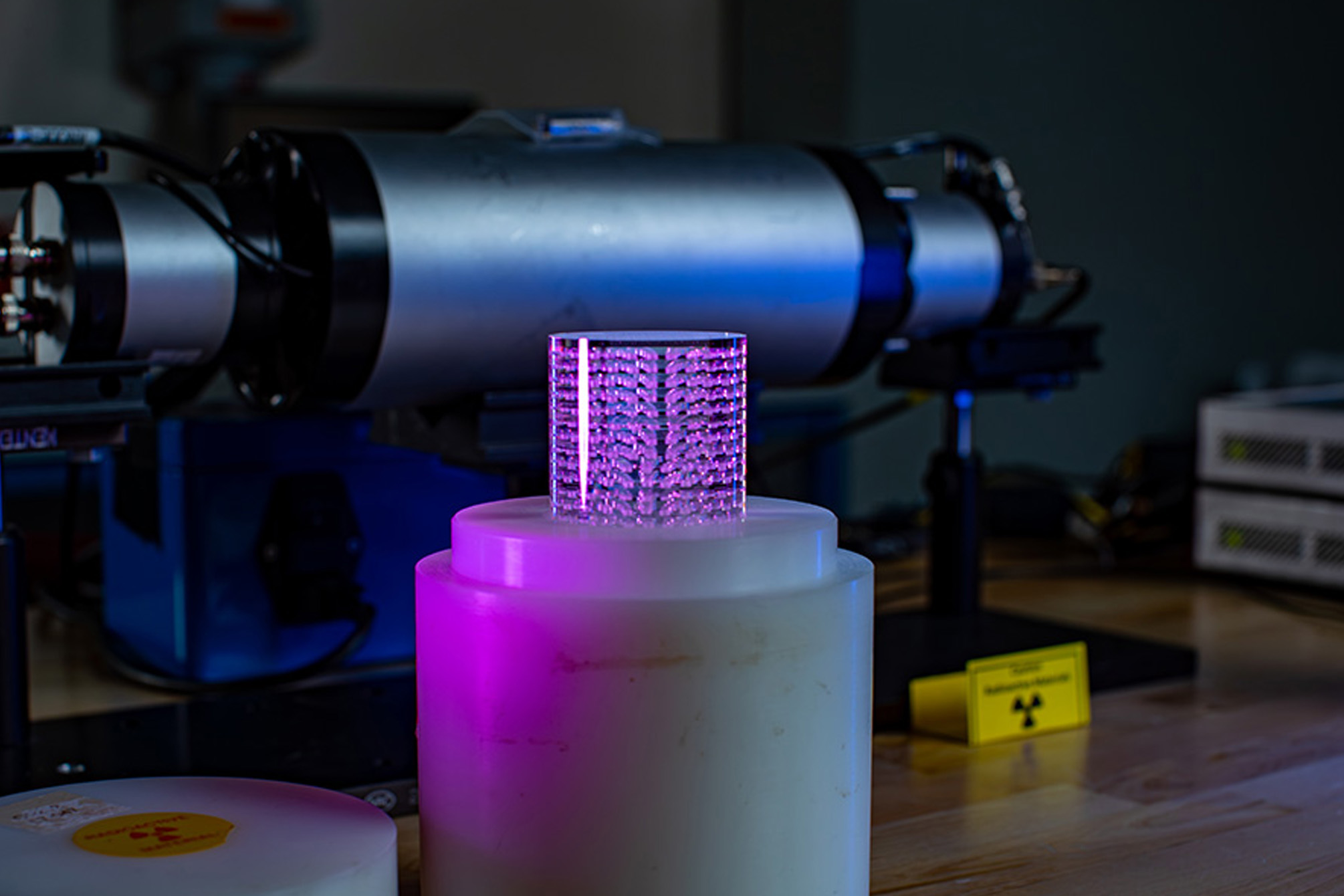
ICONS is a solid-state detector that identifies neutrons, particles released during nuclear reactions. Detecting neutrons can indicate the presence of nuclear material. Instead of relying on limited supplies of helium-3 gas contained in pressurized tubes, ICONS uses glass containing lithium-6. The glass produces a tiny flash of light when it captures a neutron. The detector can distinguish these flashes from other radiation nearby and operate across a wide range of radiation levels.
ICONS received a Gold Medal Special Recognition Award in the market disruptor category.
Persistent DynAMICS
Persistent DynAMICS is a software platform that coordinates networks of existing sensors. It helps the sensors work together and focus their attention where more information is needed.
For example, if one sensor detects something unusual along a pipeline, the software can direct nearby sensors to take a closer look. This approach can reduce unnecessary data collection and false alarms while helping operators respond more quickly. Persistent DynAMICS was co-developed with Lawrence Livermore, Oak Ridge, Pacific Northwest and Sandia national laboratories and the Nevada National Security Sites.
UltraSep Acoustic Separation Platform
UltraSep is a separation system that combines ultrasonic equipment with control software to remove solid particles from liquids. Instead of relying on filters that can clog or centrifuges with moving parts, the system uses sound waves to gather particles together so they can be removed. UltraSep continually adjusts the pitch of the sound to keep the waves at their most effective setting, much like tuning a musical instrument. With fewer moving and replaceable parts, the system offers an alternative for nuclear materials processing, mineral recovery and other industrial applications.
See all the 2026 R&D 100 Award winners.
LA-UR-26-27888