DOE/LANL Jurisdiction Fire Danger Rating:
  1. LANL Home
  2. engage
  3. collaboration
  4. feynman center
  5. tech and capability search
  6. icons

Integrated Composite Optical Neutron Sensor (ICONS)

A solid-state, scalable alternative to helium-3 neutron detectors

technology Snapshot

Overview

In environments such as nuclear facilities, storage sites, or space, the presence of neutrons is closely associated with fissionable materials such as uranium and plutonium. Detecting neutrons indicates the presence of nuclear material and provides information on fission or fusion reactions that are occurring. However, background gamma radiation is typically also present in the same environment, and sometimes it can be significantly higher than the neutron levels.

A neutron detector must, therefore, be able to identify neutron events without mistaking gamma radiation for neutrons, and it must perform reliably across a range of radiation intensities.

Helium-3 detectors achieve this by capturing neutrons inside a pressurized gas tube. When a neutron is captured by helium-3 gas, it produces charged particles that generate a measurable electrical pulse, providing reliable neutron detection with strong rejection of gamma background. These systems require an additional surrounding material layer to slow neutrons prior to detection, increasing overall system size. The use of sealed, pressurized gas tubes also introduces handling and integration constraints in some deployment environments.

ICONS performs the same fundamental function using a solid material rather than pressurized gas. The detector consists of small neutron-sensitive particles embedded within a transparent solid matrix. These particles contain lithium-6, which efficiently captures neutrons. When a neutron is captured, a small flash of light is produced. That light travels through the transparent material to a photodetector, where it is converted into an electrical signal.

Gamma rays interact differently with this structure. Because the neutron-sensitive particles are small, gamma radiation deposits relatively little energy in them. As a result, gamma interactions produce smaller light signals than neutron capture events. The system distinguishes between the two by measuring signal magnitude, allowing reliable neutron detection in environments where gamma radiation is present.

Value Proposition

Neutron detection is essential for identifying and monitoring nuclear materials and nuclear reactions. Most deployed neutron-detection systems rely on helium-3 (3He) gas-filled tubes, which have been the standard technology for decades.

Helium-3 detectors are effective but depend on a limited global supply of helium-3 gas, require sealed pressurized tubes, and can be constrained in high-intensity or rapidly varying radiation environments.

The Integrated Composite Optical Neutron Sensor – ICONS – provides a solid-state alternative that eliminates the need for pressurized gas while maintaining neutron detection capability. The architecture uses widely available materials, supports scalable detector volumes, and enables separation of neutron signals from background radiation within a solid detector platform.
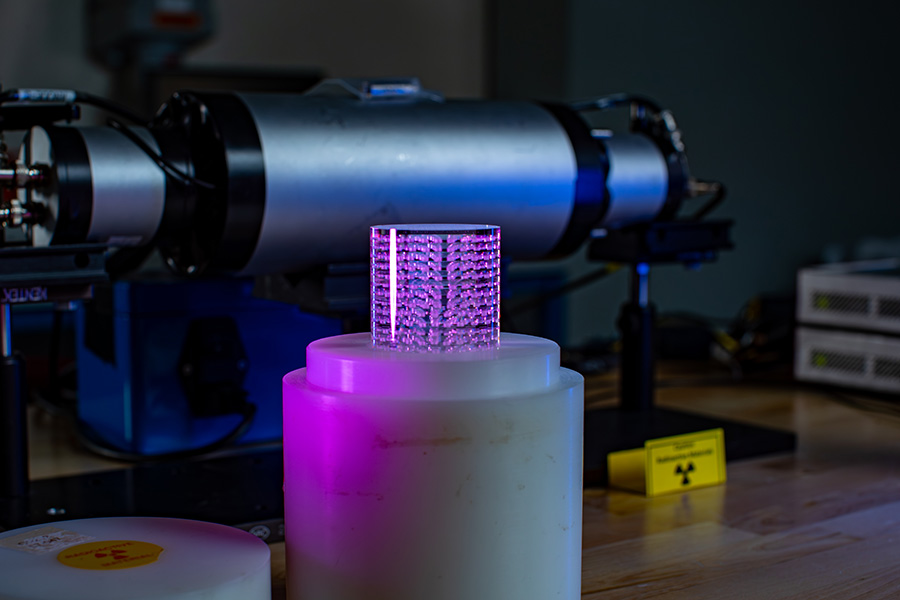
Solid-state composite neutron detector demonstrating the stackeddisk fabrication approach, with neutron-sensitive glass elements embedded in a transparent matrix to enable efficient light transport to the photodetector

Advantages

  • Solid detector architecture (no pressurized gas)
  • Uses widely available materials instead of helium-3 gas
  • Distinguishes neutrons from gamma radiation by signal magnitude
  • Operates across low and high radiation intensities, including pulsed sources
  • Scalable detector volume and adaptable geometry
  • Compatible with standard photodetectors
  • Fabrication method designed for reproducibility and optical clarity

Technology Description

ICONS is a solid-state composite detector constructed from neutron-sensitive scintillator particles embedded within a transparent structural matrix. Unlike helium-3 detectors, which rely on pressurized gas, this architecture forms a single, solid detector body in which neutron moderation, neutron capture, and light transport occur within the same composite material system.

When a neutron is captured inside one of the embedded particles, light is produced and travels through the surrounding matrix to reach a photodetector. The efficiency and consistency of this light transport directly affect detector performance. Optical defects such as bubbles, surface imperfections, or mismatched material interfaces can scatter or absorb light before it reaches the detector, reducing signal strength and resolution.

Earlier composite neutron detectors were typically produced by casting particles into liquid polymer molds that were cured into solid blocks. While functional, this approach often introduced internal optical imperfections during curing and limited the ability to scale detector size while maintaining uniform optical quality.

ICONS uses a structured stacked-disk fabrication method to improve control over material quality. Transparent acrylic disks are precision-machined with patterned cavities, filled with neutron-sensitive particles and refractive-indexmatched optical adhesive, bonded into a monolithic detector body, and finished using precision diamond-turning to produce optically smooth external surfaces.

This controlled construction process supports uniform particle placement, improved internal optical clarity, reproducible geometry, and efficient light transport. Laboratory measurements demonstrate strong neutron signal output and clear separation between neutron and gamma radiation signals.

Market Applications

This technology is applicable wherever neutron detection is required, including the following:

  • Nuclear safeguards and material monitoring
  • Reactor and fuel-cycle oversight
  • Emergency response radiation instrumentation
  • Scientific neutron measurements
  • Space-based radiation detection
  • Neutron multiplicity counting systems
  • Pulsed neutron source diagnostics
  • Radiation protection

On This Page

Overview

Advantages

Technology Description

Market Applications

Published: 2026-04-09

LA-UR-26-22676

Technology Readiness Level:

5 - Component Prototypes Tested in an Operational Environment

IP Information

S Number: S-167597

Contact

  • Licensing
  • Los Alamos National Laboratory
  • licensing@lanl.gov
Download PDF