DOE/LANL Jurisdiction Fire Danger Rating:
  1. LANL Home
  2. engage
  3. collaboration
  4. feynman center
  5. tech and capability search
  6. aimss

Autonomous Ion Mass Spectrometer Sentry (AIMSS)


A high-resolution ion mass spectrometer for measuring the space plasma environment in low-Earth orbit (LEO), with flight operations on the International Space Station (ISS).

technology Snapshot

Overview

Satellite measurements of plasma density and temperature help predict the intensity of geomagnetic storms, which can impact satellites, communications, and power systems. Accurate forecasting requires knowledge of plasma composition.

However, typical orbital mass spectrometers have difficulty distinguishing between nitrogen (N+) and oxygen (O+) ions due to their similar masses.

This limitation makes it difficult to validate modern space weather models, which depend on accurate knowledge of ion composition in near-Earth space.

N+ and O+ ions behave differently in space due to differences in their origin, transport, and loss mechanisms. Improving our ability to distinguish between these ions is critical for understanding and predicting space weather.
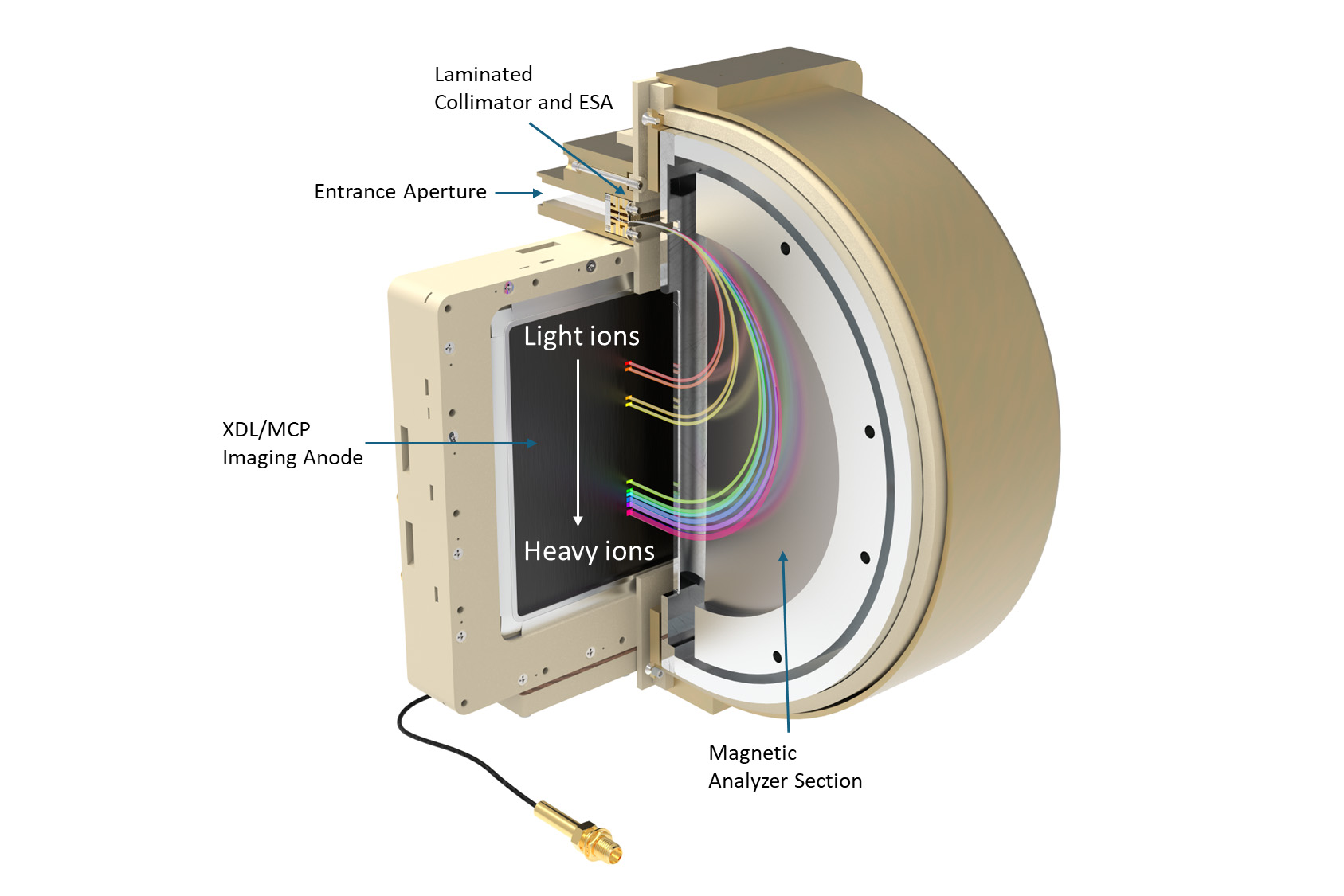
AIMSS separates ions by energy and mass as they move through the instrument, with lighter ions bending more than heavier ions before being detected at the imaging anode.

Advantages

  • High mass resolution enables distinction between ion species that are typically unresolved in space-based measurements (e.g., N+ vs O+)
  • Simultaneous measurement of multiple ion species for improved data collection efficiency
  • Commandable ion throughput allows for high dynamic range without detector saturation
  • Flight-qualified design with near-term on-orbit demonstration on the ISS

Technology Description

The AIMSS instrument uses electric and magnetic fields to sort ions first by energy and then by mass. As ions move through the instrument, different species are separated and spread out across the detector as a spectrum, similar to how a prism separates white light into different colors.

First, incoming ions pass through two electrostatic energy filters (ESAs) located at the front of the sensor. These filters allow only ions within a selected energy range to continue through the instrument. By adjusting the voltage applied to each filter, AIMSS can control how many ions reach the detector and adapt to changing plasma density.

Next, the ions enter a magnetic field section that separates them by mass. Lighter ions are deflected more than heavier ions, causing different ion species to land at different positions on the detector.

The detector records where ions land, allowing the instrument to measure multiple ion species at once and determine their mass and energy.

This design achieves clear separation of closely spaced ion species such as N+ and O+, improving the accuracy of plasma composition measurements.

Market Applications

AIMSS supports both scientific and operational markets:

  • Space Domain Awareness
Monitoring plasma density and composition to attribute spacecraft anomalies and charging events.
  • Space Weather Monitoring and Forecasting
Ion composition measurements of ionospheric plasma to inform space weather models and improve forecasting.
  • Space Station Operations for Lunar and Mars Missions
Monitoring spacecraft health, contamination, and charging during extravehicular activities (EVAs) and docking operations.
  • Department of Defense / Space Force
Compliance with requirements for onboard space environment sensors.

IP Information

This technology is protected under the following intellectual property:

  • U.S. Patent No. 12,476,101 – Ultra-Compact Ion Mass Spectrometer for Space and Laboratory Plasma Measurements (S167645)
  • Patent Pending – Dual Electrostatic Plasma Analyzer for Tunable Energy Resolution and Geometric Factor (S-194425)
  • Reconfigurable High Voltage Power Supply – U.S. Provisional Application No. 63/515,283
  • Electronics Package for Two-Dimensional Imaging Spectrometry (application/patent status to be confirmed)

On This Page

Overview

Advantages

Technology Description

Market Applications

Published: 2026-04-27

26-23247

Technology Readiness Level:

6 - Full System Prototype Built with Components Thoroughly Tested

IP Information

Patent Number: 12,476,101, additional pending

S Number: 194425

Contact

  • Licensing
  • Los Alamos National Laboratory
  • licensing@lanl.gov
Download PDF