Persistent DynAMICS
A flexible, distributed sensing architecture that enables dynamic tasking of assets for activity detection, false positive elimination, and targeted follow-up.
technology Snapshot
Overview
Persistent DynAMICS is a lightweight software platform that enables distributed sensing systems to operate as a unified, responsive network. It integrates with existing sensors, data systems, and processing tools as an overlay, without requiring hardware replacement or increasing user burden.
As data is collected, the system identifies situations that require additional attention and directs selected sensors to gather more information. For example, if a sensor detects an unusual condition along a pipeline, the system can task nearby sensors or different sensing modalities to confirm the event and focus data collection where it is needed.
To support this, the platform forms temporary groups of sensors that work together to address specific objectives. Once complete, these groups are dissolved and resources are reassigned as needed.
Communication is handled through an integrated messaging framework with client and server components, enabling reliable operation and data continuity even in low-bandwidth or intermittent connectivity environments.
Value Proposition
Many monitoring systems rely on networks of sensors that collect data on fixed schedules or within predefined areas. This approach generates large volumes of low-value data, increases storage and processing demands, and may miss short-lived or unexpected events.
Persistent DynAMICS addresses these limitations by adding a layer of decision-making on top of existing sensing systems. Instead of collecting data continuously, the system evaluates incoming information and directs selected sensors to gather additional data when and where it is needed.
By adjusting sensor activity in real time, the system reduces unnecessary data collection, improves responsiveness, and makes more effective use of existing sensing infrastructure without requiring hardware replacement.
Advantages
- Directs sensors to collect data and distill information only when and where it is needed
- Improves response to unexpected events or changing conditions, even if short-lived
- Works with existing sensing systems without requiring hardware replacement
- Modular architecture supports integration with existing software and data management systems
- Coordinates multiple sensors, across modalities and domains, to operate as a unified system
- Reduces data volume, bandwidth usage, and processing burden
- Operates reliably in resource-constrained environments
Technology Description
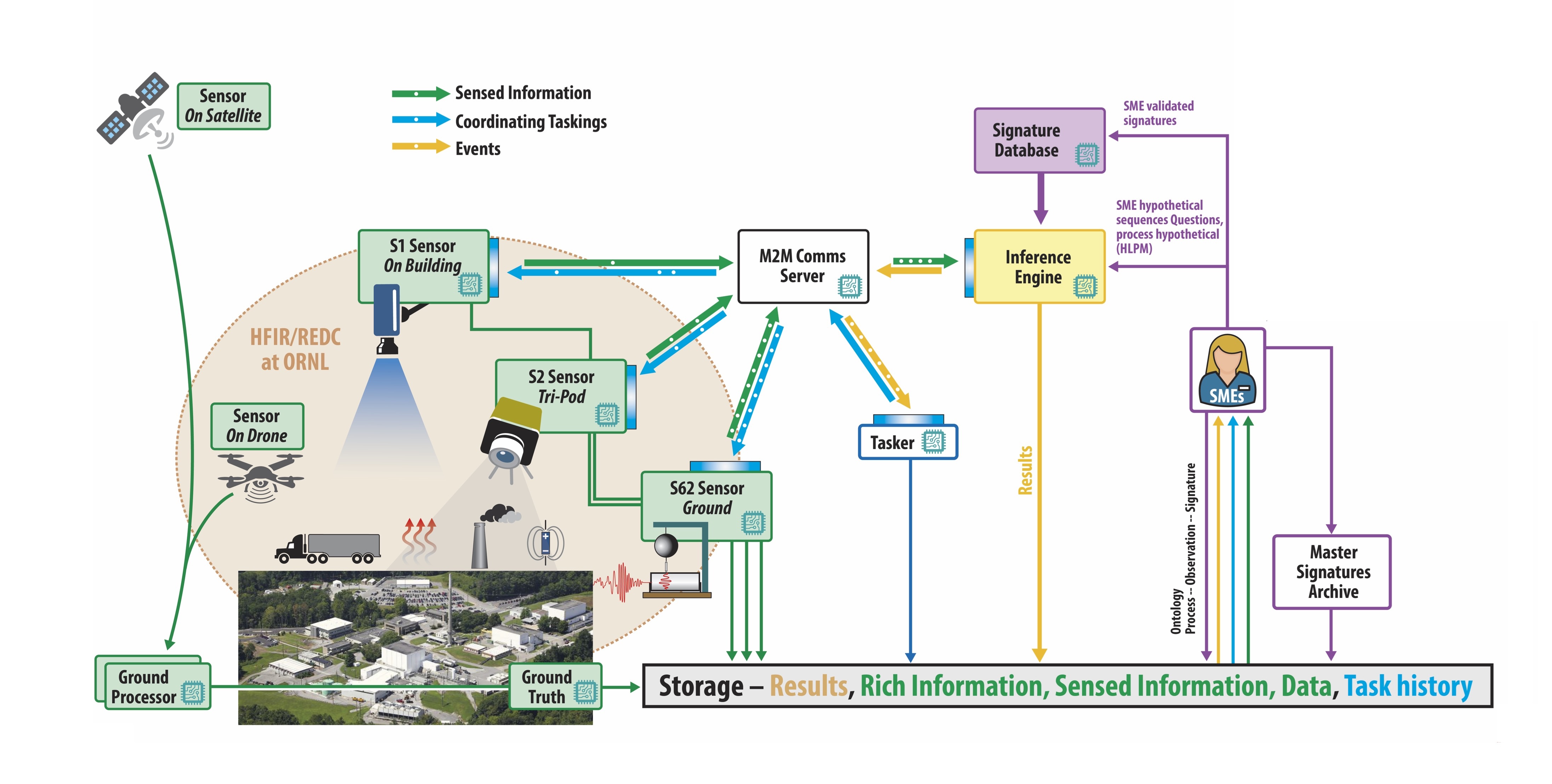
Persistent DynAMICS operates as a system-of-systems for coordinated, multi-modal sensing. The platform consists of three primary components: a coordination and tasking engine, a client-server messaging framework, and lightweight agent software deployed on individual sensors.
The coordination engine provides the core decision-making capability. It evaluates incoming information, identifies situations that require additional sensing, and generates tasking instructions for selected sensors based on predefined conditions, knowledge structures, and optional human input.
To execute these tasks, the system organizes sensors into temporary working groups assigned to specific objectives. Each group collects relevant data and reports results, and is disbanded once the objective is complete, allowing the system to continuously reprioritize sensing activities.
Communication is handled by the messaging framework. A central server receives data and alerts from sensors, validates and routes messages, and distributes tasking instructions. It also logs system activity and monitors performance to support reliable operation and analysis.
At the sensor level, lightweight agent software manages connectivity, handles message exchange, and can interface with local data sources. Custom processing can be performed at the edge to convert raw data into actionable information before transmission to the coordination engine.
The platform is designed for flexible deployment and integration. Components can be containerized and incorporated into existing computing environments, enabling adoption without significant modification to existing hardware, software, or infrastructure.
Market Applications
This technology is applicable wherever dynamic coordinated sensing is required, including:
- Critical infrastructure monitoring
- Oil and gas pipeline monitoring
- Environmental and conservation monitoring
- Disaster response and emergency management
- Remote and autonomous sensing systems
- Defense and national security applications
IP Information
Persistent DynAMICS is implemented through a suite of integrated software components disclosed under multiple copyrights, including:
- “Persistent DynAMICS Intelligent Tasking for Dynamic Coordination”
- “Hotot Agent Utility Package”
- “Hotot Server”
Copyright assertion is in progress.