Chargeless and nearly weightless, the neutrino seems designed to evade detection. As early as the 1930s, physicists had hypothesized the existence of such a particle — the “neutrino,” as it would be dubbed — that would help all the puzzling physics fit together. But actually detecting the “ghost particle” would take many years along with the acumen and inventiveness of Los Alamos scientists, a journey that culminated with the detection of the mysterious particle 70 years ago this summer.
“The discovery of the neutrino is an important moment in physics,” said William Louis, neutrino physicist at Los Alamos National Laboratory. “We still have a lot to learn about the neutrino’s properties and behavior. Neutrino detection could lead us to still-unknown particles and to physics beyond the Standard Model. Neutrino physics represents the best of science, a challenging search for discovery that brings understanding with known and unexpected benefits.”
After 70 years, the full story of the “ghost particle” remains elusive and intriguing. Scientists work to better assess its mass, its oscillations and its interactions with other particles. And there may yet be a type, or “flavor,” of neutrino still unconfirmed, which could explain key questions in physics and unlock the door to understanding dark matter and more.
“Los Alamos has a distinguished role in the story of neutrino physics,” said Laura Stonehill, Los Alamos Physics division leader and a scientist on the Sudbury Neutrino Observatory project. “But this remains a cutting-edge field. With new tools, approaches and whole experiments to apply to neutrino physics, this particle still has new chapters to write in our understanding of how the universe works.”
Project Poltergeist searches out the ‘ghost particle’
In the early 20th century, physicists studying electrons in the radioactive decay of atomic nuclei were puzzled by data that seemingly violated the principle of energy conservation. Physicists, including Wolfgang Pauli in 1930, theorized an undetected particle with specific properties — electrically neutral and nearly massless — that would make sense of the data. Enrico Fermi, future luminary of the Manhattan Project, dubbed the still-missing particle the “neutrino,” or “little neutral one” in his native Italian, and incorporated the particle in a theory of beta decay. (The neutron, also chargeless, though much larger, had recently been confirmed by James Chadwick in 1932.)
But neutrinos, if they existed, were predicted to interact so weakly with other, known particles that tens of quadrillions would need to pass through a detector before just one was observed. Working at Los Alamos in the 1950s, physicists Frederick Reines and Clyde Cowans explored the problem and settled on fission reactors as the most feasible method that would produce enough neutrinos for scientists to catch one. The team would be looking for the signature — a distinct, observable series of particle interactions leading to positron and gamma ray emissions — that occurs when one of those tiny neutrinos finally hits a proton. This collision starts a set of interactions that results in the detection of an electron antineutrino, the antiparticle of the electron neutrino, whose existence proved the existence of the other.
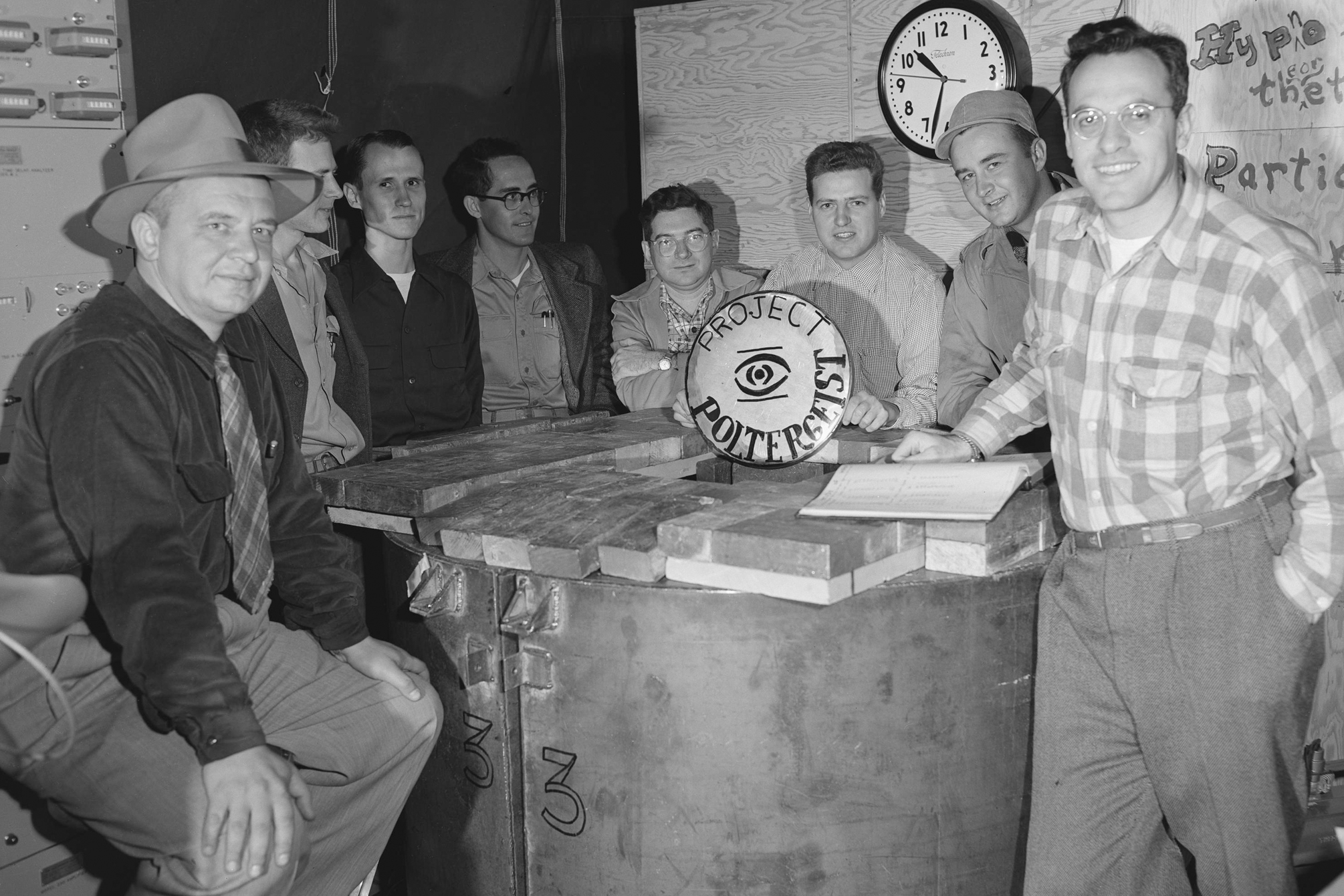
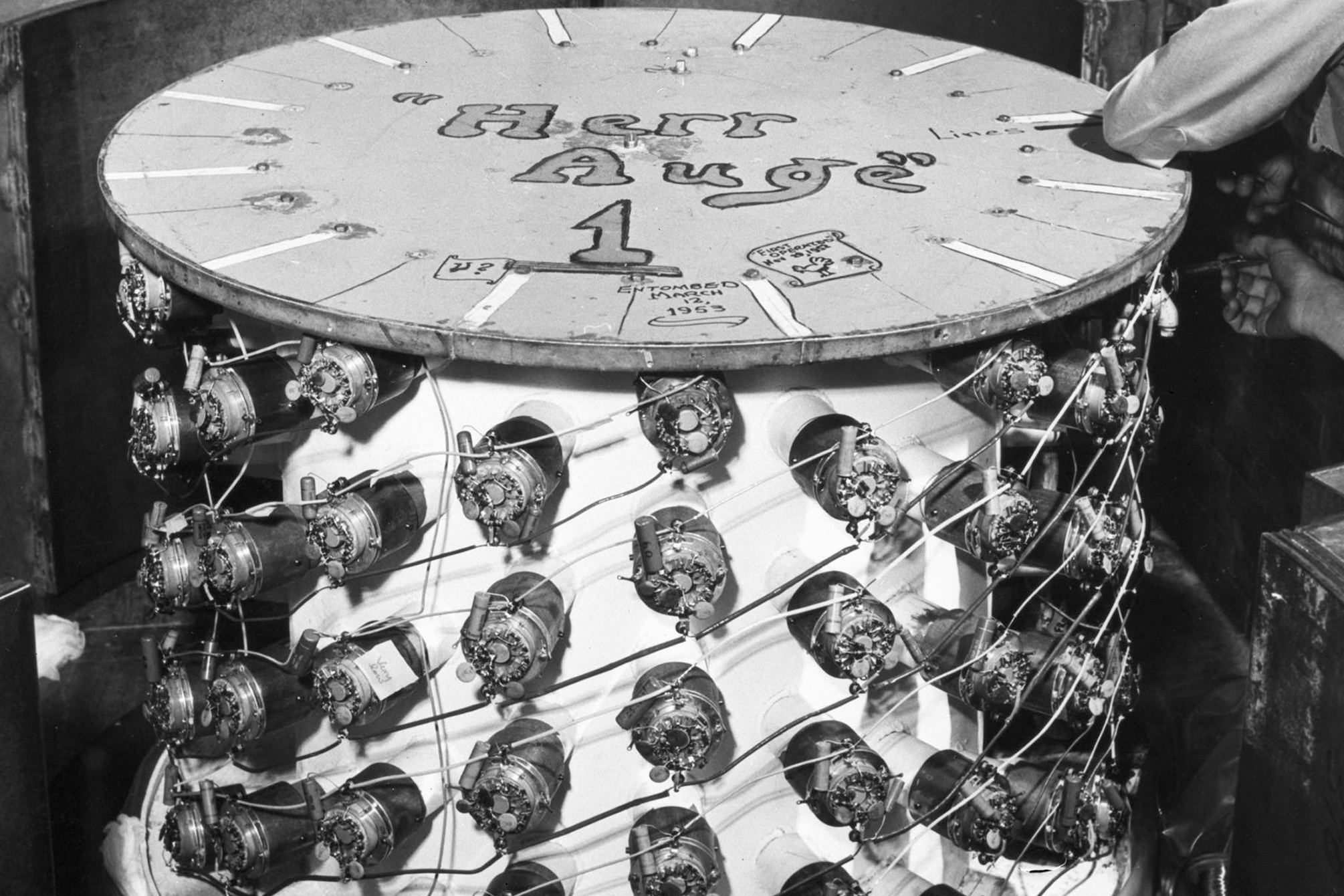
Because of the ghostly nature of the neutrino, Reines and Cowan dubbed their neutrino experiment “Project Poltergeist.” In 1952, they tested custom-built detector components for the machine they would dub “Herr Auge” (“Mr. Eye” in German) in a tunnel underneath Los Alamos townsite, hoping to take advantage of the low-background-radiation environment. The team then built a larger assembly — including a 300-gallon tank of water as a source of protons for neutrinos to collide with — and took it to Hanford, Washington, where a “probable” identification of the neutrino was made, as described in a 1953 letter published in Physical Review. But that detection needed further confirmation, given the signature noise created by overabundant cosmic rays.
The team brought the experiment to South Carolina’s Savannah River Plant in 1955 to take advantage of a stronger fission reactor and better shielding against cosmic rays. They installed two 200-liter detection tanks surrounded by an even larger detection apparatus 11 meters from the reactor (and 12 meters underground), which provided abundant neutrinos. They took data for 100 hours and assembled their analysis.
On July 20, 1956, the Los Alamos team published their results in the journal Science. The “ghost particle” had been confirmed, at the rate of three detections per hour. The team published a more detailed analysis, “Detection of the Free Antineutrino*,” in Physical Review in 1960.
Neutrino physics advances
In the decades following the neutrino’s discovery, scientists have pinned down key facts about the neutrino’s behavior and properties. They have identified different “flavors,” or types, of neutrinos — tau, muon and electron neutrinos. The oscillation, or changing from one flavor into another while traveling, and the fact of the neutrino’s mass have also been established.
But tantalizing questions remain, with the answers potentially pointing physics in new, compelling directions. Physicists are interested in finding the exact masses of the particle, as the neutrino consists of a superposition of three or more masses, and the hierarchy of the masses. Another physics question implicating the neutrino is the role of the particle in the violation of charge parity symmetry, a key to understanding what is known as “matter-antimatter asymmetry”: why is there more matter than antimatter in the universe or, put simply, why there is something rather than nothing?
The fact of the mass of the neutrino was confirmed in the 1,000-ton heavy water Sudbury Neutrino Observatory experiment that ran from 1999 to 2006. The exact amount of mass remains the subject of exploration. With contributions to the international collaboration from Los Alamos physicists, the experiment also confirmed the standard solar model of neutrinos and proved neutrino oscillations — the spontaneous transition a neutrino can make from one flavor to another, a feat which requires neutrinos to have mass, if only a tiny amount.
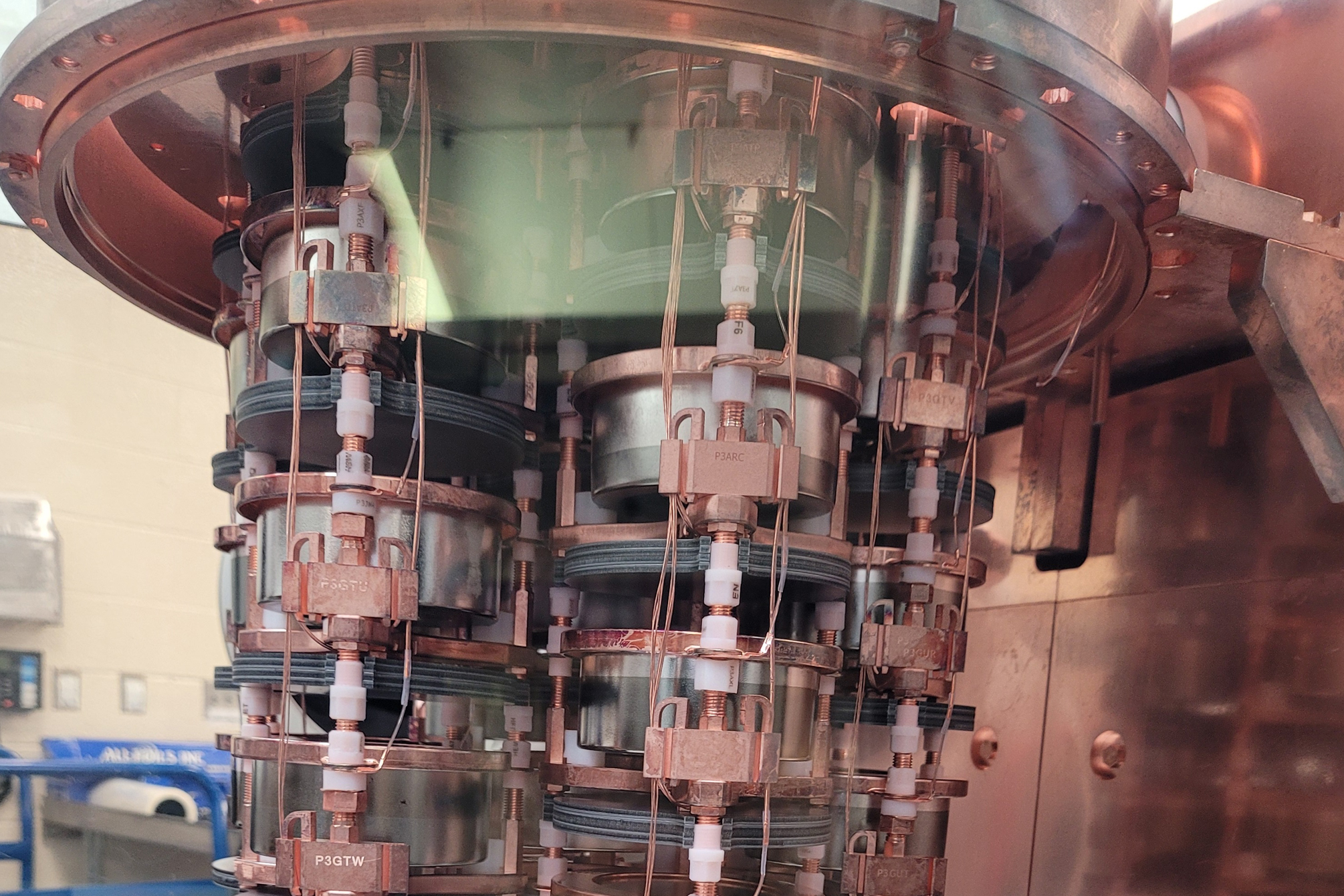
The observation of a long-theorized nuclear process called neutrinoless double beta decay has so far eluded science, but it is believed that the process would resolve the question of whether the neutrino is its own antiparticle, a potential paradox of the neutrino that would bear on matter-antimatter symmetry. The Majorana Demonstrator experiment in South Dakota, a collaboration including a host of Los Alamos experts, used an ultrasensitive, 44-kilogram germanium radiation detector to demonstrate the feasibility of a large detector designed on that basis to search for the hypothesized nuclear decay.
The Majorana Demonstrator’s proof-of-concept is realized at scale in the forthcoming LEGEND-1000 detector, deep underground in Italy. (LEGEND-200 is presently operating on the same site and has published initial results.) With Los Alamos scientists designing and testing the detectors — as well as other important work like engineering the ultracold cryostat chamber and developing highly specialized shielding — the detector will search for neutrinoless double beta decay. Those 1-ton germanium detectors are being fine-tuned in the same Los Alamos tunnels where the Project Poltergeist team sought out the neutrino in the 1950s.
The sterile neutrino
Another related neutrino mystery is the subject of much research: Is there a fourth flavor of neutrino, a still-undiscovered particle? The hypothesized “sterile neutrino,” as the potential fourth flavor is known, has been the subject of extensive experimentation that is still ongoing. The existence of a sterile neutrino particle would account for anomalies seen in past experiments and could even unlock physics beyond the Standard Model.
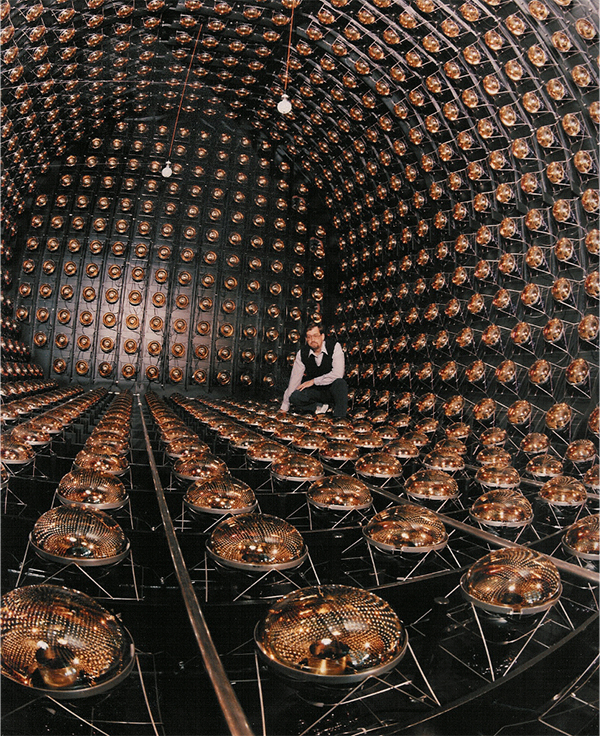
After the Cowan-Reines experiment, Los Alamos National Laboratory has continued to play an important role in the advancement of neutrino detection physics. The Liquid Scintillator Neutrino Detector (LSND) experiment, a 167-ton mineral oil detector and electron scintillator at the Los Alamos Neutron Science Center, captured data from approximately 1993 to 1998 and offered evidence for neutrino oscillations at a higher mass than the oscillations reported by solar and atmospheric neutrino experiments. The experiment detected electron-neutrino and muon-neutrino flavors but also showed an anomalous surplus of electrons — exciting the physics community with the possibility that an as-yet-unknown neutrino might be responsible for the surplus.
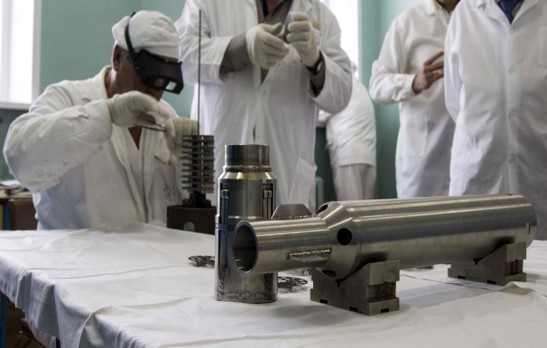
Los Alamos scientists brought their expertise to additional experiments that have hinted at the sterile neutrino or unknown physics, notably contributing to the Soviet-American Gallium Experiment (SAGE), which studied neutrino oscillations and resulted in the so-called “gallium anomaly.” SAGE also very notably accomplished the detection of solar neutrinos; in particular, the low-energy neutrinos from proton-proton fusion in the sun. With its successor Baksan Experiment on Sterile Transitions, again supported by Los Alamos scientists’ collaboration, a physics team deep underground in the Caucasus irradiated an outer and inner tank of soft, silvery gallium, anomalously producing 20% to 24% less germanium 71 than what models predict.
“SAGE and BEST were groundbreaking experiments that helped us learn about solar neutrinos and neutrino properties,” said Los Alamos physicist Steven Elliott, a BEST team member as well as a contributor to the Majorana Demonstrator experiment. “Repeating the gallium neutrino capture measurements with the higher-precision BEST confirmed the perplexing anomaly. The result is consistent with a sterile neutrino hypothesis, but incompletely understood atomic or nuclear physics remain intriguing alternative explanations.”
Neutrino physics has continued on this intriguing quest in the United States, as well. The MiniBooNE experiment, a detector at Fermi National Accelerator Laboratory, tested the LSND results and found further evidence of oscillations, suggesting a fourth neutrino type and physics beyond the Standard Model. The MicroBooNE experiment, a 170-ton liquid argon neutrino detector housed at Fermilab, built off of that work, concluded recently and found no evidence of sterile neutrinos under one model, but left the door open for other possible explanations where a sterile neutrino might yet be the culprit. Two more detectors at Fermilab — ICARUS and the Short-Baseline Neutrino Detector (SBND) — find Los Alamos scientists contributing expertise in the search for neutrino oscillations and their meaning for physics.
Looking to the future
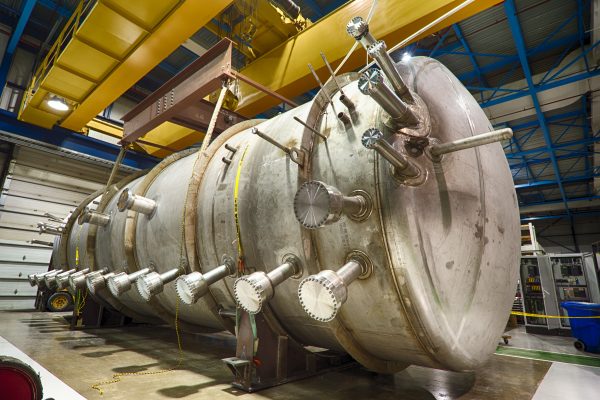
The SBND is a 112-ton active mass liquid argon time projection chamber neutrino detector, a highly precise system that can provide a 3D reconstruction of a particle’s trajectory and interactions. This same technology will be implemented at massive scale (about 100 times larger) with the forthcoming Deep Underground Neutrino Experiment (DUNE), a set of detectors nearly a mile underground in a former South Dakota gold mine, which will receive a subterranean neutrino beam from 800 miles away at Fermilab in Illinois.
Housed a mile underground in a space equivalent to nine soccer fields, the neutrino detectors in South Dakota will each be about the size of a seven-story building. Each detector will hold 17,000 tons of liquid argon kept cool at temperatures lower than negative 300 degrees Fahrenheit. DUNE will take data for 20 years, with Los Alamos scientists providing critical expertise in apparatus design and installation, instrument calibration, data analysis and more.
By comparing how neutrinos (and antineutrinos) behave as they travel through 800 miles of earth, DUNE’s core program will determine their "mass ordering" and measure the level of matter-antimatter asymmetry that may help explain why the universe is made of predominantly matter. Beyond this, the experiment features a broad scientific program capable of capturing solar neutrinos directly from the core of the sun to refine stellar physics. The massive underground detectors will also act as a cosmic observatory, waiting to intercept the sudden, intense burst of neutrinos emitted when a nearby star collapses into a supernova. Ultimately, DUNE’s advanced detector capabilities will enable a broad search for physics beyond the Standard Model and point the way toward a more complete theory of nature.
“Seventy years after the neutrino's discovery, DUNE stands as the ultimate, most ambitious experiment ever designed to unravel its deepest secrets,” said Sowjanya Gollapinni, Los Alamos neutrino physicist and co-spokesperson of the DUNE collaboration. “By pairing the world’s most intense neutrino beam with massive, high-resolution liquid argon ‘cameras’ buried a mile underground, we are completely redefining the boundaries of neutrino physics. With installation moving rapidly ahead, DUNE is on track to capture its first data by the end of the decade and usher in a whole new era of fundamental discovery.”
A milestone of modern physics
Reines was awarded the Nobel Prize in Physics in 1995 for the discovery of the neutrino (Cowan died in 1974, and the prize is not awarded posthumously). Swedish physicist Carl Nordling made a presentation speech highlighting the ingenuity and impact of Cowan and Reines’ work.
“It was a long-awaited discovery,” Nordling noted in his speech. “For nearly 25 years, physicists had been waiting for someone to accomplish this feat. Meanwhile, the neutrino had been a mental construct that physicists had needed in order to ‘save’ the law of conservation of energy in certain types of radioactive decay. But it seemed impossible to verify the neutrino’s actual existence. It flashed undetected past every observer at the speed of light.”
Cowans left the Laboratory in 1957, teaching physics at George Washington University. Reines became the head of the physics department at Case Western Reserve University in 1959, then moved on to the University of California, Irvine in 1966 as the founding dean of the Physical Sciences Department, at each spot continuing his neutrino experiments. He would go on to lead groundbreaking work in the detection of neutrinos from cosmic rays and then from supernova explosions.
“They had proved the existence of the neutrino,” Nordling continued of the 1956 results. “This discovery was a milestone of modern physics. It opened the way to a major new field of research, neutrino physics.”
In his lecture upon receiving the Nobel Prize, Reines described the journey and mentioned many of the advances that neutrino physics had made in the decades since Project Poltergeist first captured the neutrino — measurements of the neutrino properties, the detection of neutrinos from cosmic sources and more.
“But with all of the important accomplishments, are there any things left for the future?” he asked. The answer, Reines said, was “most definitely yes.”
“I am confident that the future of neutrino physics will be as exciting and fruitful as the past has been,” he declared.
LA-UR-26-27292