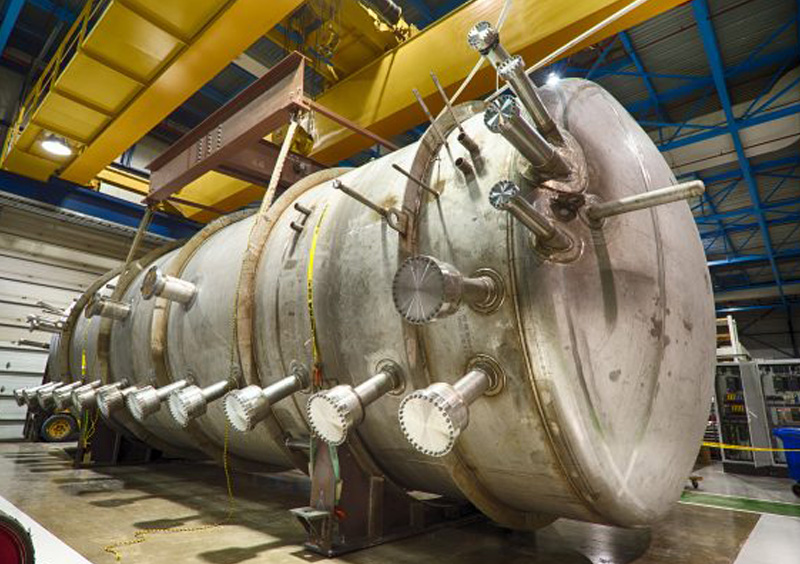
The groundbreaking MicroBooNE project, a 170-ton liquid argon neutrino detector housed at Fermi National Accelerator Laboratory, has offered new results in the detector’s yearslong investigation of anomalies from previous experiments. As described in Nature, final data analyzed by the MicroBooNE team disfavors the existence of a sterile neutrino in one possible model, while leaving open other possibilities for continued physics investigation.
“While they disfavor the existence of the sterile neutrino in one possible model, the MicroBooNE results are nonetheless tantalizing in how they align with anomalies present in previous experiments,” said Bill Louis, physicist at Los Alamos National Laboratory. “In its results and in its capabilities, MicroBooNE offers a steppingstone to larger-scale experiments that may ultimately prove definitive as to the existence of the sterile neutrino.”
The international collaboration analyzes years of results to rule out with 95% certainty the “three-plus-one” sterile neutrino model, in which the anomalies in previous experiments would be attributed to the oscillation, or changing, of one of three known neutrino types — muon, electron and tau — into a currently unconfirmed fourth type, the sterile neutrino.
Notably, however, the data leaves open the possibility of a more complicated mechanism with two or more sterile neutrinos that would explain the anomalies.
Beamlines present different pictures
As neutrinos pass through the dense, transparent liquid argon in the MicroBooNE detector, their interactions are recorded, allowing scientists to reconstruct the path and numbers of interactions. The difference between the particles expected and the particles recorded, based on Standard Model calculations, forms the evidence favoring or disfavoring a yet-undiscovered sterile neutrino.
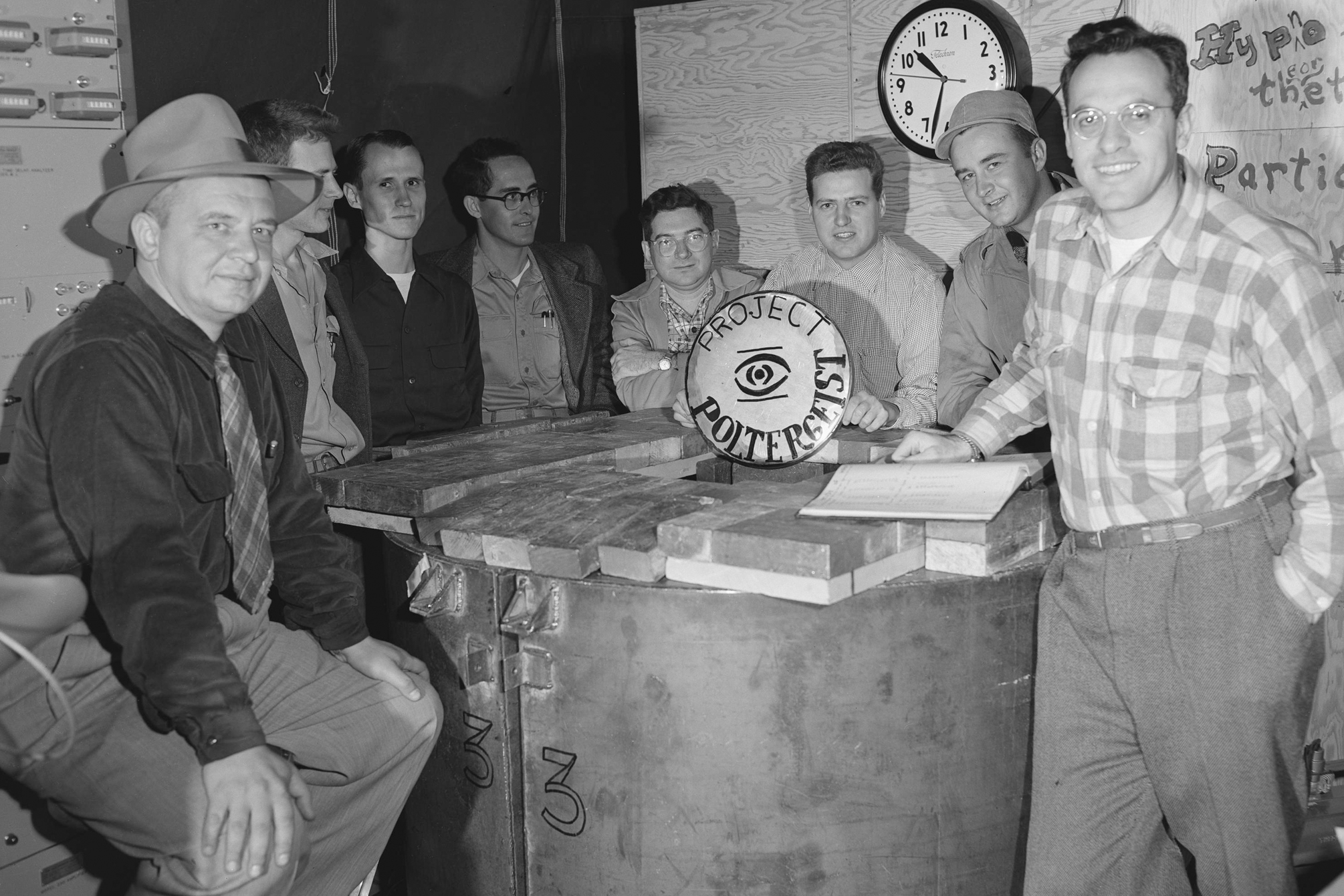
A series of previous neutrino experiments have found a discrepancy between particles expected and particles recorded. In 1995, the Liquid Scintillator Neutrino Detector at Los Alamos found an anomalous excess of electron anti-neutrinos. The MiniBooNE experiment, the predecessor to MicroBooNE, recorded a similar anomaly several years later, with an excess of electron neutrinos. The Baksan Experiment on Sterile Transitions (BEST) experiment, using a 50-ton tank of liquid gallium deep underground, found an anomalous deficit of germanium than what should have been produced by the interaction of electron neutrinos with gallium.
In all these experiments, a nearly massless, non-interacting particle called the sterile neutrino is the suspect that can resolve the physics. Sterile neutrinos could play a role in unresolved physics questions like the matter-antimatter asymmetry of the universe, the composition of dark matter, and other new, exotic physics. But confirmation of that particle has remained elusive.
Two beamlines deliver neutrinos to the MicroBooNE detector. The Neutrinos at the Main Injector (NuMI) beamline runs 680 meters to MicroBooNE, and the Booster Neutrino Beam (BNB) beamline runs 470 meters. The beamlines offer different energy ranges and different signatures, or records of interactions, in the detector.
“This first-of-its-kind two-beam measurement is a trailblazing result that significantly constrains the parameter space where a sterile neutrino could exist,” said Sowjanya Gollapinni, Laboratory physicist and leader of the Lab’s MicroBooNE team.
At the BNB beamline, results show a slight deficit of electron neutrinos, meaning a lack of observed electron neutrinos compared with Standard Model calculations, while the NuMI beamline results show no deficit. These results cannot be explained by only one sterile neutrino. With the three-plus-one model and its lone sterile neutrino ruled out, it may be that the known neutrinos oscillate into more than one unknown neutrino. Or there may be still more exotic physics at play.
Building capacity to resolve the sterile neutrino mystery
The future of the sterile neutrino question may be resolved by new detector projects. At FermiLab, the emergence of new detector experiments, including the 110-meter and 600-meter dual liquid-argon detectors at the Short Baseline Neutrino Program as well as the Deep Underground Neutrino Experiment will leverage the capabilities developed at MicroBooNE to further the investigation into the sterile neutrino.
At MicroBooNE, researchers spent years developing tools and techniques to process signals, conduct calibration, and then reconstruct what the detectors were recording — a significant technical challenge with two beamlines delivering information.
“As we enter a new era of next-generation neutrino experiments, the MicroBooNE results provide crucial guidance with which to focus on new physics searches and inform how neutrino theorists and phenomenologists chart out these next steps,” Gollapinni said. “Getting to this point was not easy and took years of hard work from the collaboration, which is commendable.”
The international collaboration has featured contributions from hundreds of scientists and support from innumerable technicians and support staff. And many students and postdoctoral researchers affiliated with Los Alamos contributed to the Lab’s leading role.
“This new result from MicroBooNE is a significant advancement in our search for the origin of multiple anomalies,” said Erin Yandel, Los Alamos Director’s Postdoc Research Fellow and co-convener of the oscillation physics group with the project. “As a result of MicroBooNE, neutrino physics now has a novel tool that other experiments can deploy in what remains a vital and exciting scientific challenge.”
Paper: “Search for light sterile neutrinos with two neutrino beams at MicroBooNE.” Nature. DOI: 10.1038/s41586-025-09757-7
Funding: MicroBooNE is supported in the United States by the Department of Energy, Office of Science, offices of High Energy Physics and Nuclear Physics, as well as the National Science Foundation.
LA-UR-25-32032