DOE/LANL Jurisdiction Fire Danger Rating:
Dense Matter Theory Banner
  1. LANL Home
  2. Engage with LANL
  3. Lab Organizations
  4. X Computational Physics
  5. XCP-5: Materials and Physical Data
  6. dense matter theory
  7. types of dense matter

Dense Plasma in Fusion Research

Dense plasma in the laboratory

Exploring different approaches for inertial confinement fusion

Dense plasmas are created in inertial confinement fusion experiments, which attempt to initiate nuclear fusion reactions by heating and compressing a fuel target of deuterium and tritium. To initiate fusion, the deuterium and tritium fuel must be heated to over 500 million degrees and held together long enough for the reactions to take place.
Different approaches for inertial confinement fusion are being explored

Laser Direct Drive

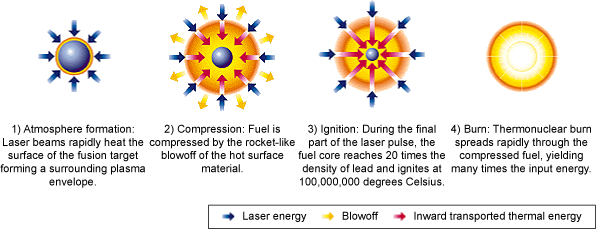
In a direct-drive target, powerful laser beams strike directly on the fuel capsule.

Dense Plasma Research Diagram. Ift Concept

Laser Indirect Drive

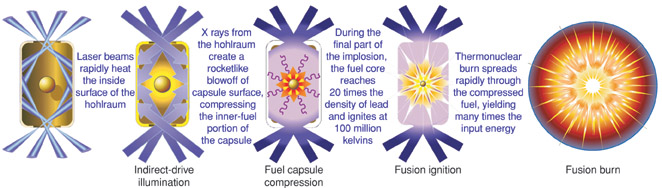
In an indirect-drive target, powerful lasers strike the inner surface of a hollow chamber (the “hohlraum”) that surrounds the fuel capsule, exciting X-rays that transfer energy to the fuel capsule.

Dense Plasma Research. Diagram of Indirect Drive

Laser-Driven Fast Ignition

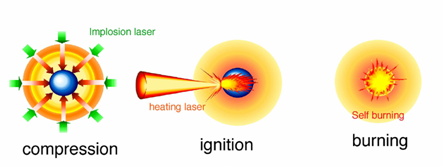
In laser-driven fast ignition, the target is compressed to high density with a low implosion velocity and then ignited by a short, high-energy pulse of electrons or ions induced by a very short (a few picoseconds), high-power laser pulse.

Dense Plasma Research. Diagram of Fast Ignition

Pulsed-Power Drive

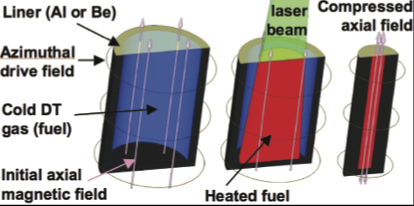
Pulsed-power-driven inertial fusion utilizes large electric current from a pulsed-power accelerator to generate sufficiently high magnetic field pressures to compress and heat magnetized, pre-ionized fusion fuel contained in a cylindrical target to ignition conditions. One promising conceptual approach along these lines is the Magnetized Linear Inertial Fusion (MagLIF) experiment on the Z-machine at Sandia National Laboratories, which involves magnetic implosion of magnetized, laser-preheated fusion fuel on a fast (~100 ns) time-scale.

Dense Plasma Theory Diagram of Mag Li F. Magnetized Linear Inertial Fusion

References

  • An assessment of the progress of inertial confinement fusion (The National Academy Press, 2013)
  • Hydrodynamics, Hot Dense Matter (Oxford University Press, 2004). Highlights on Highlights on MagLif
  • S. Atzeni and J. Meyer-ter-Vehn, The Physics of Inertial Fusion: BeamPlasma Interaction, Hydrodynamics, Hot Dense Matter (Oxford University Press, 2004).

Meet the Team

Los Alamos brings together experts from diverse backgrounds, including plasma physics, dynamic fluid flows, and computational sciences. Join us to tackle complex challenges in energy research, astrophysics, and inertial confinement fusion.

Meet the Team